
I've been calling this piece a few things in my head over the past week—maybe "The Quiet Utility Comeback of $PIXEL in a Noisy Web3 World," or "Why Logging Into Terra Villa Every Evening Has Me Thinking Long-Term About This Token," or even "Pixels Isn't Just Farming Anymore—It's Building Something That Actually Lasts." Whatever the headline, the feeling is the same: after months of hands-on time in Pixels, grinding crops, chatting with guild mates, and watching my little pixel homestead grow, I'm genuinely optimistic about where $PIXEL is headed. It's not the hype cycle talking; it's the day-to-day gameplay loop and the on-chain signals that keep pulling me back in a positive way.
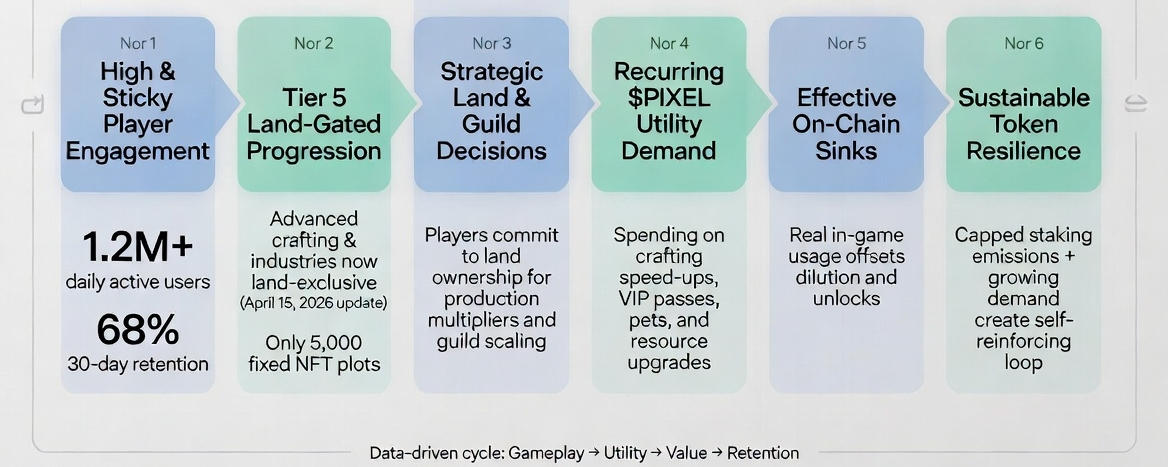
What strikes me most is how the game has shifted from pure fun to a real economic flywheel where $PIXEL isn't just along for the ride—it's the fuel. I've felt this firsthand since the Tier 5 update dropped on April 15. Suddenly, those advanced crafting recipes and new industries aren't optional side quests; they're gated behind meaningful decisions around land ownership and resource management. It doesn't feel forced or pay-to-win. It feels like the team is rewarding players who stick around and invest time (and yes, tokens) into deepening their experience. That's the kind of design that turns casual farmers into committed participants, and it's exactly why my thesis here is simple yet strong: $PIXEL's value is increasingly tied to genuine in-game utility demand that's starting to outpace the dilution pressure, creating a more resilient token than most Web3 games manage in this post-hype era.
Let me walk you through what I've observed directly from the data and my own play sessions, because these aren't abstract charts—they're things I've seen reflected in my farm's output and the broader Ronin ecosystem.
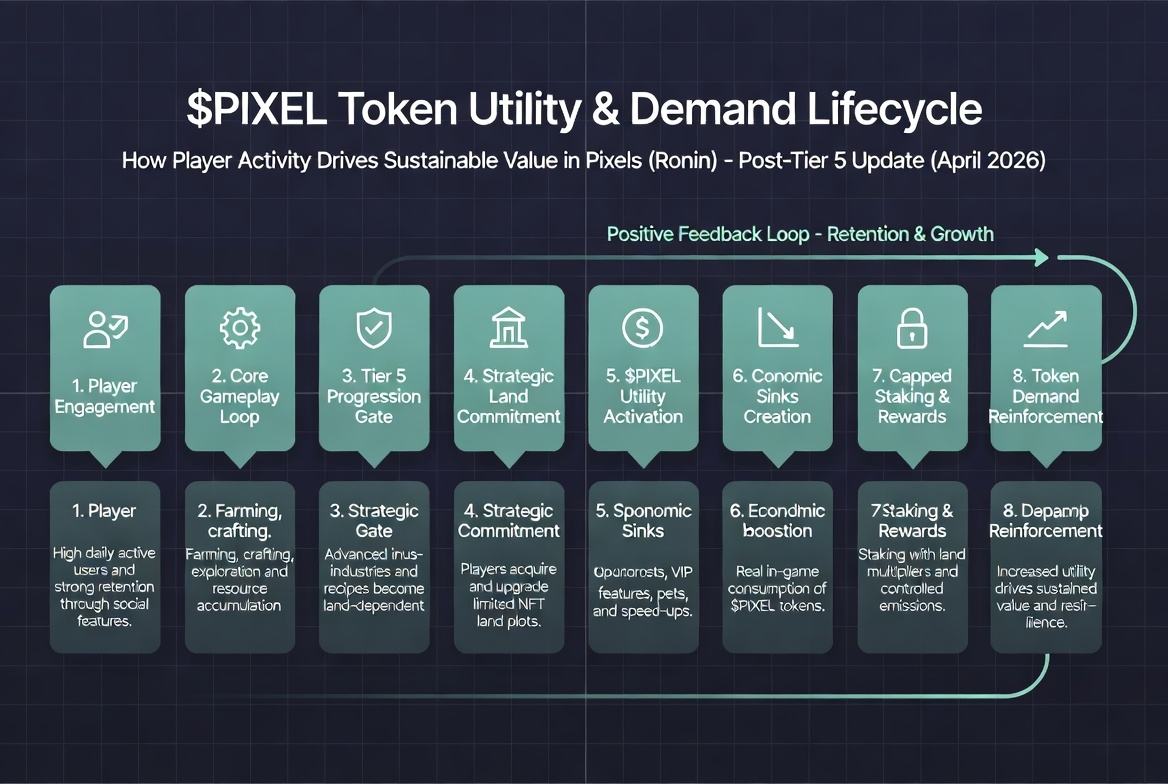
First, the 24-hour trading volume has been running at an eye-popping level relative to the market cap—often hitting $18-28 million against a roughly $28-29 million fully diluted picture. That's a velocity ratio pushing toward or above 80-100% on many days. What changed? It's not random pumps; it's sustained interest tied to gameplay events like the recent Tier 5 rollout. This matters because it shows real conviction from players and traders who are actively using or betting on the token's role in progression, not just holding for a narrative. To me, it implies that any fresh wave of utility-driven demand could spark quicker price discovery without needing massive external catalysts.
Second, the circulating supply now sits at about 3.38 billion out of the 5 billion max—roughly 67.6% unlocked. The next unlock tomorrow (April 19) is around 91 million tokens, which feels far less overwhelming than earlier releases in the schedule. This maturation didn't happen overnight; it's the result of steady vesting that's shifted the conversation from "when will the next dump hit?" to "can demand actually absorb this?" It matters for anyone holding or playing because it reduces the overhang and lets fundamentals shine through. I see it implying that $PIXEL's price action will become even more sensitive to on-chain activity in the weeks ahead, rewarding the protocol's growing sinks over pure supply fears.
Third, NFT land activity has held remarkably steady even as the broader Ronin NFT market ebbs and flows. With only around 5,000 fixed plots available, Tier 5 made high-level industries and resource multipliers land-exclusive, which has quietly boosted secondary demand and royalty flows back into the ecosystem. I've noticed guild chats lighting up with land-strategy talks since the update—players aren't just buying plots for bragging rights anymore; they're calculating ROI on production boosts. This scarcity signal matters because land acts as a natural multiplier that funnels value straight back to Pixel through staking incentives and governance. It could easily imply upward pressure as more players scale into guilds and compete for those limited high-yield spots.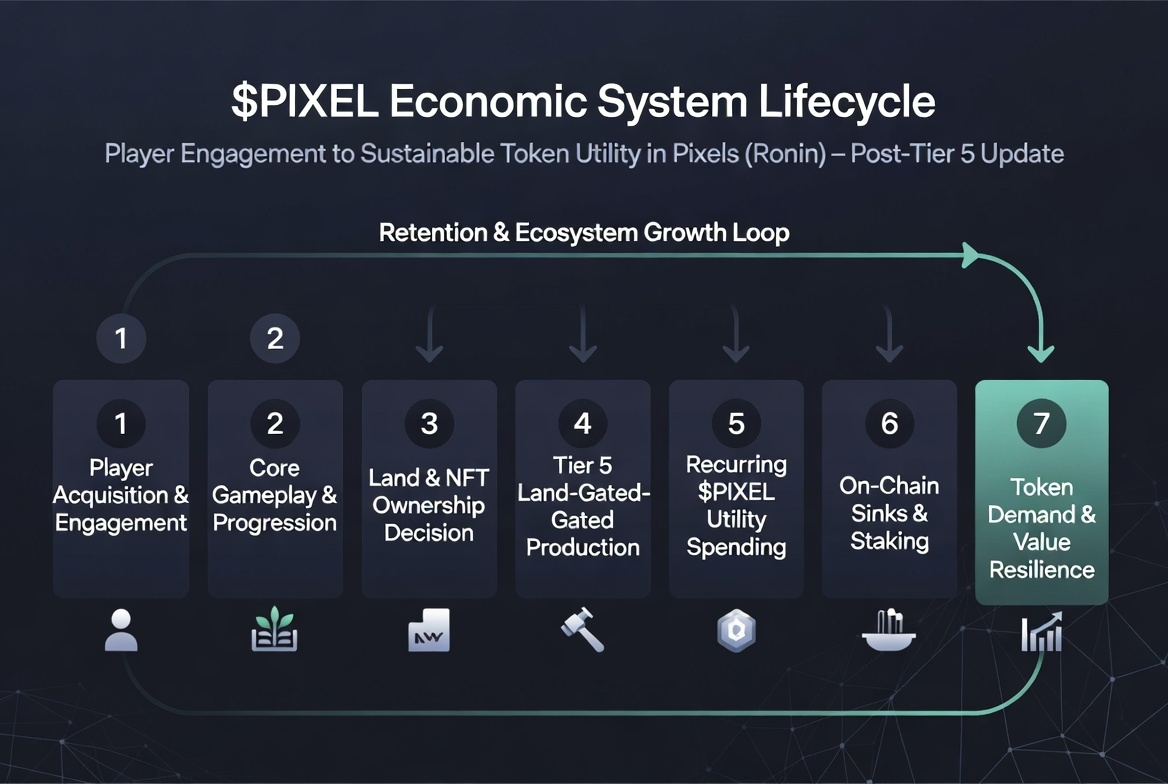
Fourth, player retention metrics are standing out in a sector where drop-off is the norm. Reports and community sentiment point to 30-day retention rates holding around 68%—well above typical Web3 gaming averages—and daily active users continuing to scale with organic social features rather than short-term incentives. From my own experience, that tracks: friends I've invited months ago are still logging in daily, not for airdrops but because the social layer and bi-weekly updates keep things fresh. This change toward stickier engagement matters enormously for Pixel because every retained player translates to recurring spends on speed-ups, pets, VIP perks, and crafting. It implies a compounding demand curve that's far more predictable and sustainable than one-off hype events.
Fifth, the staking mechanics remain thoughtfully capped—monthly rewards locked at around 28 million $PIXEL—while land ownership now amplifies staking power and ties into resource allocation across the growing platform (pets, mini-games, and hints at future expansions). Emissions haven't spiraled despite user growth, which is a deliberate design win I've appreciated as someone who's staked my own bag. This matters because it avoids the inflationary death spiral that killed earlier play-to-earn experiments. In my view, it implies that as Pixels evolves into more than a single farming loop, $PIXEL's role in governance and yields will create a self-reinforcing loop that insulates it from isolated game fatigue.
Sure, there are valid counterpoints I remind myself of while tending my fields. Tomorrow's unlock, even if proportionally smaller now, could still create short-term selling if liquidity thins out. Broader competition in Web3 gaming and Ronin's overall address activity mean Pixels hasn't locked in total dominance yet. And at a $28-29 million market cap, there's clearly execution risk priced in—converting all those casual players into consistent high-value Pixel users won't happen automatically. But the logic I've seen play out in real time outweighs those risks: most games chase fleeting engagement through endless emissions, while Pixels has engineered gated, recurring demand that the latest update has only accelerated. The token isn't floating on vibes; it's backed by players actively choosing to spend it to level up their worlds.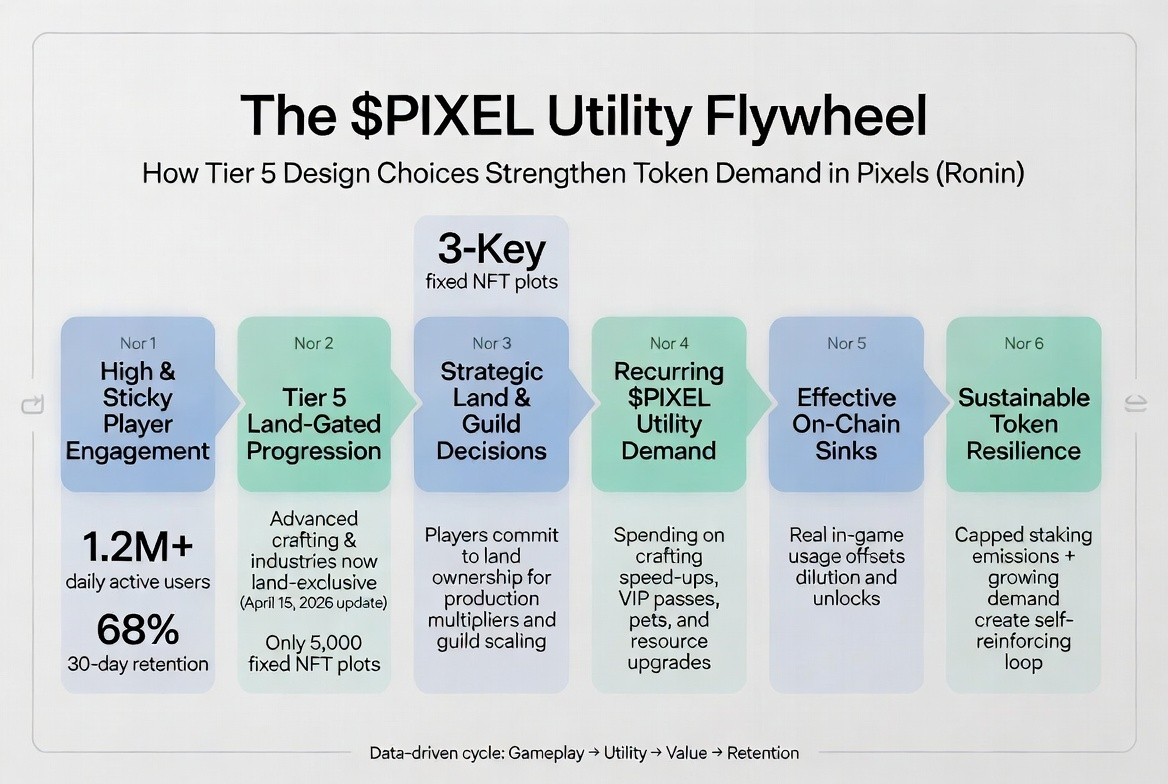
In the end, spending my evenings in this mesmerizing open-world on Ronin has left me more convinced than ever that Pixel is quietly assembling the rarest thing in Web3 gaming—an actual economic flywheel where utility leads and price follows. The next 30-60 days after Tier 5 settles and the unlock passes will be telling, but from where I'm sitting at my virtual farmhouse, the foundation feels stronger than the current valuation suggests. If you're on the fence, jump in and play a bit; the experience might just change how you see the token too.
