
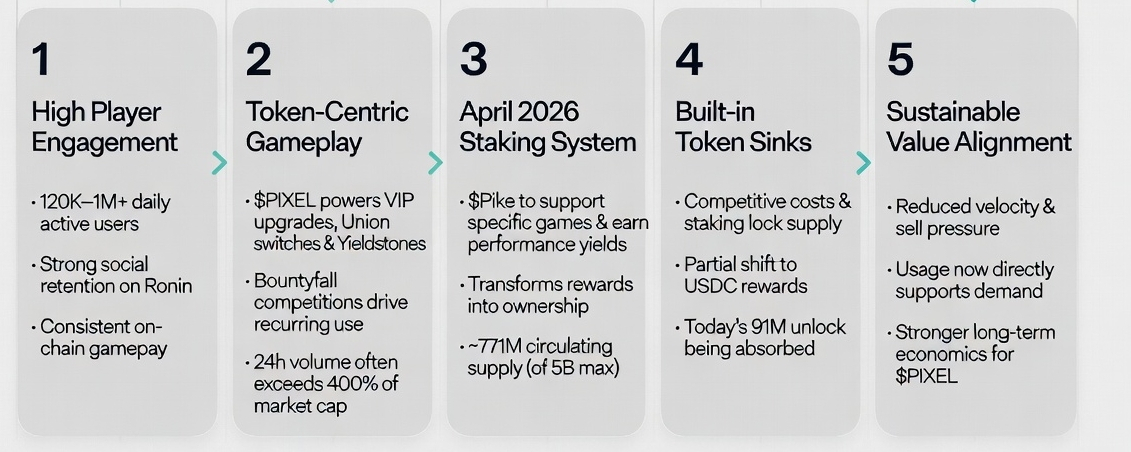
I’ve been logging into Pixels almost every day for the past few months, tending my little pixel farm, chatting with strangers in the town square, and watching how the whole world on Ronin just keeps pulling people in. What started as pure nostalgic fun has slowly turned into something deeper for me, and lately I’ve found myself zooming out to look at the numbers behind $PIXEL. The more I dig, the more convinced I am that this project is doing something rare in Web3 gaming: it’s turning high daily engagement into actual, lasting demand for the token instead of just burning through it.
One thing that jumps out immediately is how the trading activity around $PIXEL has stayed unusually intense. We’re talking daily volumes that have regularly topped $25 million while the market cap hovers around $6 million. That kind of turnover didn’t feel random to me; it lines up with players constantly using the token for VIP upgrades, Union switches in the current Bountyfall season, and harvesting rewards. It’s clear the token sits right at the center of daily gameplay now. If even a decent slice of that flow starts getting locked up instead of flipped, the velocity could finally ease, giving price action room to breathe and reflect the game’s actual scale.
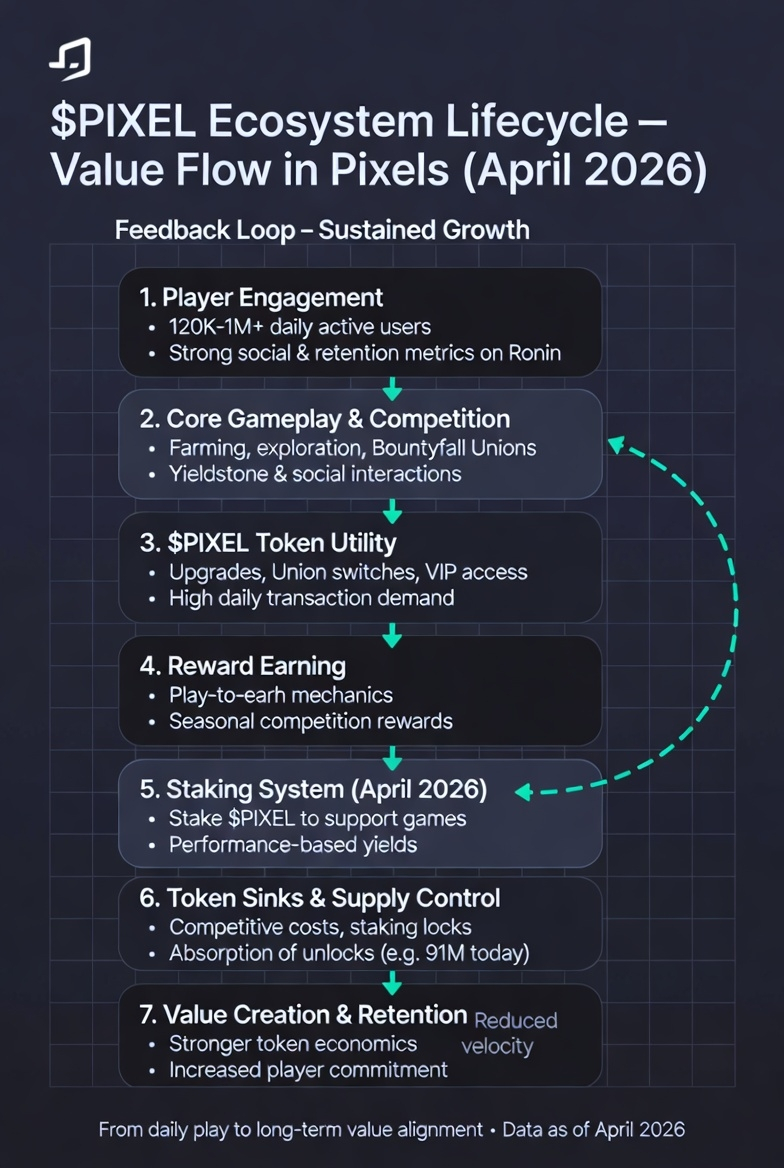
At the same time, the player base has shown impressive staying power. Early 2026 saw daily active users climb sharply from around 45,000 in January to sustained levels that have hit the hundred-thousand-plus range on many days, sometimes pushing much higher. That growth matters because these aren’t one-and-done wallets; they’re people interacting with $PIXEL-gated features like Yieldstone deposits and seasonal competitions every single session. From what I’ve seen on-chain, that consistent usage is creating a natural pool of participants who are more likely to try staking than to sell immediately, tightening the loop between playtime and token demand.
The staking system that rolled out in April feels like the real turning point I’ve been waiting for. Instead of blanket emissions, holders can now direct their Pixel toward specific games in the growing Pixels ecosystem, earning yields tied to each title’s performance. Early signals show players shifting portions of their holdings into these positions rather than cashing out rewards. To me, this quietly transforms $PIXEL from a reward ticket into something closer to an ownership stake, giving people a reason to hold through ups and downs. With roughly 771 million tokens currently in circulation out of the 5 billion max supply, every bit of staking adoption directly eases the dilution pressure that has weighed on the price for so long.
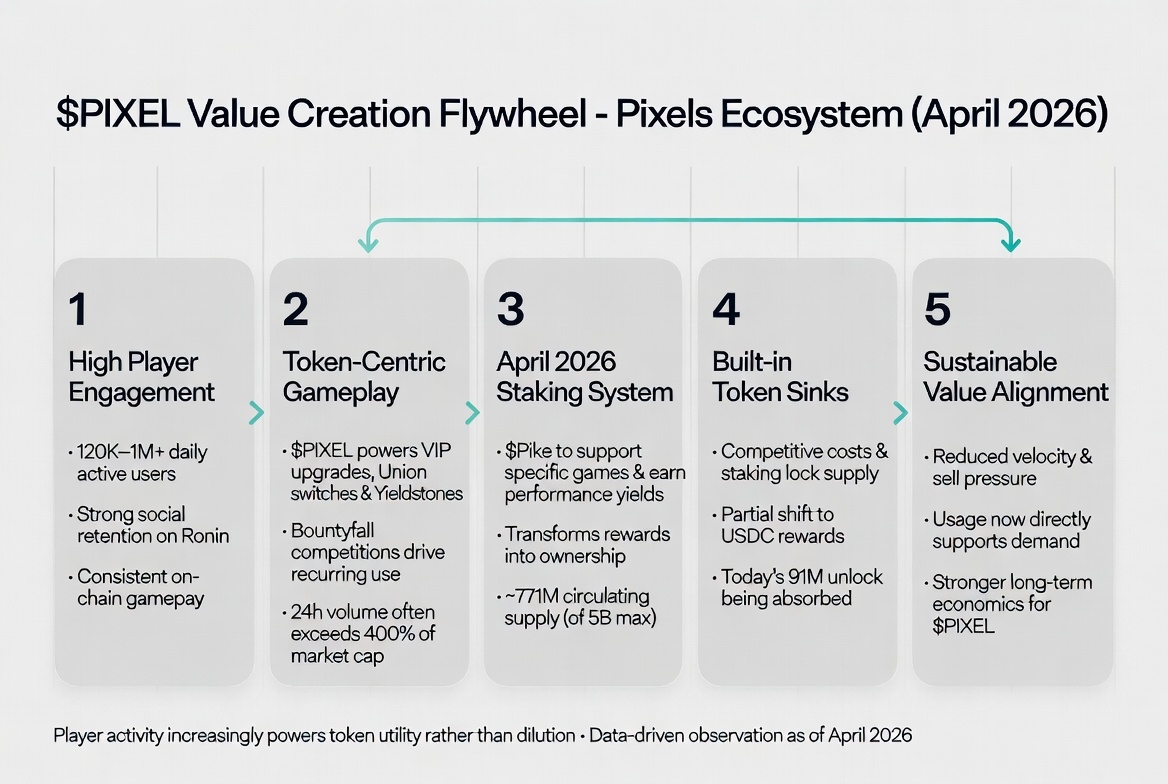
Then there’s the way Chapter 3’s Bountyfall chapter has woven $PIXEL costs and rewards into the social fabric. Union competitions, sabotage mechanics, and scalable prize pools (some reaching tens of thousands of tokens per season) have turned group play into a repeatable sink. I’ve watched transaction counts around Yieldstones and leaderboard claims stay elevated, showing that the competitive loop isn’t just fun; it’s actively pulling tokens out of circulation or back into the system. That feels different from older play-to-earn models that only pushed supply outward. If these seasons keep scaling with participation, $PIXEL demand could become self-sustaining rather than dependent on external hype.
And yes, today’s scheduled unlock of about 91 million tokens (roughly 12 percent of the circulating supply) is the kind of event that would have spooked me a year ago. But watching the protocol’s recent behavior, I’m actually curious to see how well the new staking channels and USDC-shifted rewards absorb it. The team has clearly been building absorption tools ahead of these releases, and if on-chain uptake holds steady, it could prove the flywheel is finally catching.
Of course, I’m not ignoring the risks. High volume can sometimes mask coordinated selling from reward recipients, and structural dilution is still baked into the schedule until a much larger share of supply gets locked. Broader market sentiment for GameFi remains cautious, and Ronin’s overall TVL isn’t exactly exploding. Still, the logic I keep coming back to feels solid: when you pair record engagement levels with explicit Pixel costs inside competitive and staking loops, you create scarcity that earlier versions of the game simply didn’t have. The protocol isn’t promising moonshots; it’s quietly engineering a setup where everyday play strengthens the token.
In the end, Pixels isn’t just surviving as another farming sim; it’s maturing into a platform where Pixel finally has a clear economic job to do. The data I’ve tracked over these recent months—sky-high velocity, resilient user growth, fresh staking incentives, competitive sinks, and today’s unlock test—tell me the pieces are aligning. If the next few cycles show staked supply rising and effective velocity dropping, I believe $PIXEL’s price will start to mirror the ecosystem’s true scale. I’m staying in the game, and I’m more optimistic than ever about where this ride is headed.