
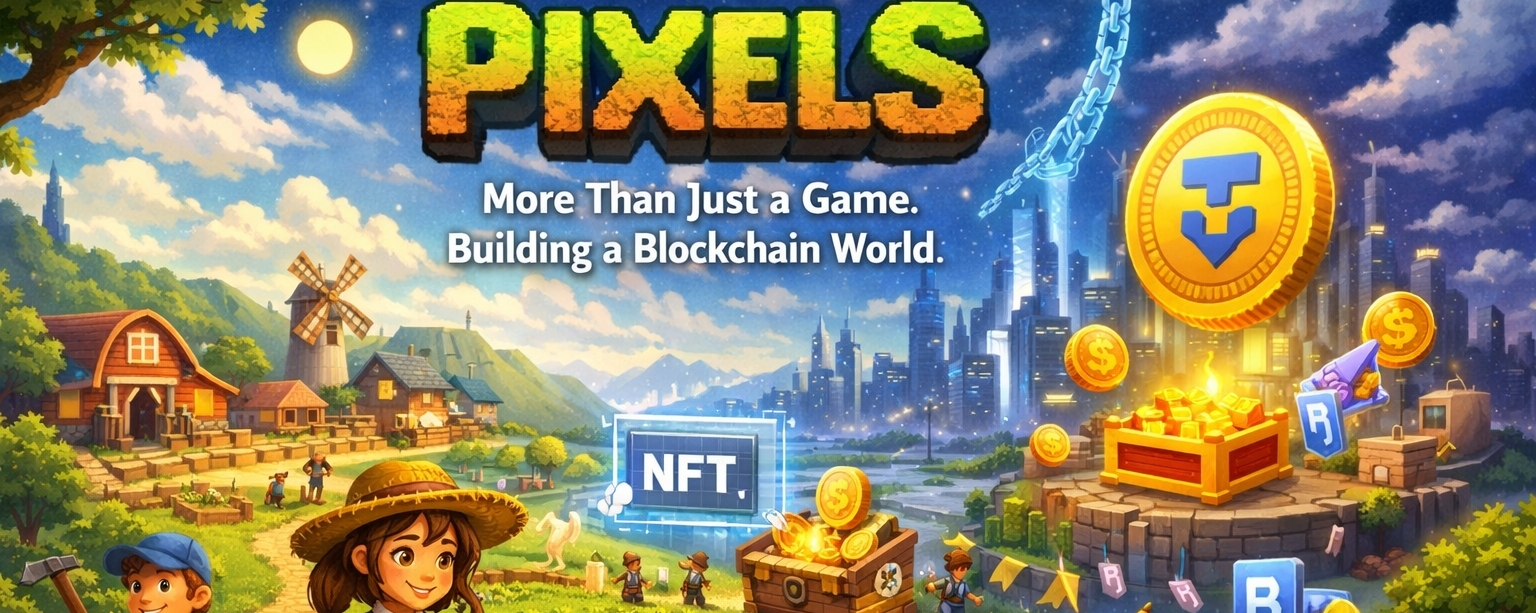

At first, Pixels does not look like a game that should matter this much.
It looks calm. Colorful. Easy to get into.
You plant crops, collect materials, craft items, explore the map, meet other players, and slowly build your place in the world. It feels light. Familiar. Almost comforting. If someone showed it to you without context, you might think it was just a charming online farming game with a retro look.
But that surface is a little deceptive.
Because underneath that soft pixel-art world, Pixels is doing something much bigger than it first appears. It is testing whether a blockchain game can feel like a real game first — not just a token economy wrapped in game graphics.
And that is a much harder thing to pull off than many Web3 projects expected.
More than a cute farming game
A lot of blockchain games made the same mistake early on. They focused too much on tokens, assets, and “earning” before they gave people a world worth caring about. Players were expected to understand the economy before they even enjoyed the game. For many people, that made the experience feel less like play and more like work.
Pixels took a softer approach.
Instead of throwing people straight into the financial side of Web3, it lets them settle into the game itself. The farming, gathering, crafting, and exploration come first. The world is easy to read. The atmosphere is social. The routine makes sense almost instantly.
That is one reason Pixels stood out. It did not try to impress players with complexity. It tried to make them comfortable enough to stay.
And in gaming, that matters more than a lot of teams realize.
Why the farming genre actually makes sense
The choice to build around farming was smarter than it may seem.
Farming games are naturally built around habit. You come back, check your progress, gather what is ready, plant the next thing, improve a small part of your setup, and keep moving forward. It is not about speed. It is about rhythm.
That kind of loop works especially well in an online world. It gives players a reason to return without making the experience feel stressful. Over time, those little routines create attachment. The player starts to feel connected to the world because they have invested time into it in a quiet, steady way.
That is exactly the kind of behavior a live online game wants.
And for a Web3 game, it is even more valuable. A tokenized economy only works if people keep coming back, keep participating, and keep finding reasons to stay involved. Farming games already know how to create that pattern. So Pixels did not just pick a cozy theme — it picked a structure that naturally supports long-term engagement.
Pixels made Web3 feel less intimidating
One of the biggest reasons Pixels grew so quickly is that it lowered the barrier to entry.
This is where many blockchain games struggle. Wallet setup, chain switching, asset management, confusing onboarding — all of that creates friction before the player has even had a chance to enjoy anything. For most mainstream users, that is enough to kill interest immediately.
Pixels understood that.
It gave players a simpler entry point and let the world do the convincing. That is a huge difference. When people can first experience a game as a game, they are much more open to everything that comes later. But when they are asked to understand the crypto side before they care about the world, the whole experience feels heavy too early.
Pixels made the experience feel lighter.
That does not sound revolutionary, but in Web3 gaming, it actually is.
The real challenge is not attracting players — it is keeping value inside the world
This is where the conversation gets more interesting.
The biggest problem in blockchain gaming has never really been getting attention. Tokens can do that. Rewards can do that. Speculation can definitely do that. A project can become visible very quickly if there is money in the story.
The harder part is building a world where value stays in motion inside the game instead of just being pulled out of it.
That is the real test for Pixels.
It is not enough for players to show up because a token exists. It is not enough for activity numbers to spike for a while. What matters is whether the game creates enough real interest, utility, identity, and social value that people want to spend, build, upgrade, participate, and remain part of the ecosystem.
That is a much deeper challenge than simply handing out rewards.
And to be fair, this is where most Web3 games start to struggle. If people are mainly there to extract value, the economy becomes fragile. The game starts to feel like a temporary opportunity instead of a living world. Once the rewards weaken, the weakness of the foundation becomes obvious.
Pixels matters because it has been trying to solve exactly that problem.
The token only works if the game works
The PIXEL token is an important part of the ecosystem, but it should not be the main character of the story.
That is where a lot of crypto projects go wrong. They treat the token as proof that the system is meaningful. But a token by itself does not create depth. It does not create belonging. It does not create fun. It does not make players care.
The game has to do that first.
If the world feels alive, then the token can become useful. It can support access, upgrades, convenience, membership, status, and deeper participation. But if the world does not feel meaningful on its own, then the token becomes the only thing holding attention together — and that rarely ends well.
Pixels seems to understand this better than many projects in the space.
Over time, it has looked less like a game trying to hand out rewards and more like a game trying to build reasons for those rewards to circle back into the ecosystem. That is a healthier direction. It suggests a more mature understanding of what a long-term game economy actually needs.
The social side of Pixels may be its strongest feature
One thing that often gets overlooked is how social Pixels really is.
Yes, there is farming and crafting. Yes, there are resources and progression systems. But the game also works because it gives players a sense that they are sharing a space. There are other people around. There are communities, guilds, land systems, identity elements, and visible signs of participation.
That matters a lot.
People do not stay in online worlds only because of mechanics. They stay because the world starts to feel inhabited. They recognize names. They form routines. They want to be seen. They want their progress to mean something to other people, not just to a spreadsheet.
Pixels benefits from that feeling.
Its land and avatar systems are not just economic tools. They also help create identity. Its guild and community features are not just side extras. They give the world texture. They make it feel more lived-in.
That kind of social layer is one of the best defenses a Web3 game can have. A token may attract people, but a shared world gives them a reason to care.
Ronin gave Pixels the right environment
Pixels also benefited from being on Ronin.
That is not just a technical point. It is a cultural one too.
A gaming-focused network gives a project like Pixels a more natural home. The surrounding ecosystem already understands gaming, NFTs, digital ownership, and player economies. That makes it easier for the game to fit into a larger story. It is not isolated. It feels connected to a network that already knows what kind of experience it is trying to build.
That helped Pixels scale in a way that would have been harder in a less gaming-native environment.
At the same time, Pixels also helped Ronin. It brought activity, attention, and energy. So the relationship worked in both directions. Ronin gave Pixels better ground to grow in, and Pixels gave Ronin one of its clearest examples of broad player traction.
The hardest question is still unanswered
For all its success, Pixels still faces the same question that follows every major Web3 game:
Are people here because they love the world, or because they see an opportunity in the economy?
The honest answer is probably both.
And that is not automatically a bad thing. Most live-service games use incentives in one form or another. Daily rewards, limited items, battle passes, event loops — games have always shaped behavior through rewards. Web3 just makes those incentives more visible and more liquid.
Still, visibility creates pressure.
If too much of the player base is driven only by extraction, the ecosystem becomes unstable. The numbers may look good on the outside, but the loyalty underneath is thin. If the rewards slow down, so does the commitment.
That is why Pixels’ long-term success will depend on whether it can keep strengthening the game side of the equation — the fun, the identity, the status, the social experience, the reasons people stay even when the market mood changes.
That is the real challenge. Not growth alone, but staying power.
Why Pixels stands out
What makes Pixels interesting is not that it solved Web3 gaming.
It did not.
What makes it interesting is that it seems to understand the real problem better than many others do.
It understands that onboarding should feel easy.
It understands that games need habit, not just hype.
It understands that rewards are not enough without meaningful sinks and reasons to spend.
It understands that people stay for identity and community, not only for economics.
That already puts it ahead of a large part of the sector.
Pixels feels less like a project trying to force blockchain into gaming and more like a game that is trying to figure out how blockchain can support a world people genuinely enjoy being in.
That is a much healthier way to build.
Final thoughts
Pixels looks small at first. That is part of its charm.
It does not come across like a grand technological statement. It feels like a place where you can log in, do a few things, see familiar faces, make progress, and slowly build something over time.
But that calm surface hides one of the most important experiments in Web3 gaming.
Pixels is trying to prove that a blockchain game does not need to begin with speculation. It can begin with comfort. With routine. With community. With play. Then, only after players care, it can introduce ownership and token-based systems in a way that feels natural instead of forced.
That is why it matters.
Not because it is perfect.
Not because its token solves everything.
Not because big activity numbers guarantee the future.
It matters because it points in a more believable direction.
If Web3 gaming is going to work at scale, it will probably look less like a marketplace pretending to be a game — and more like Pixels: a real world first, with blockchain quietly working underneath it.
