
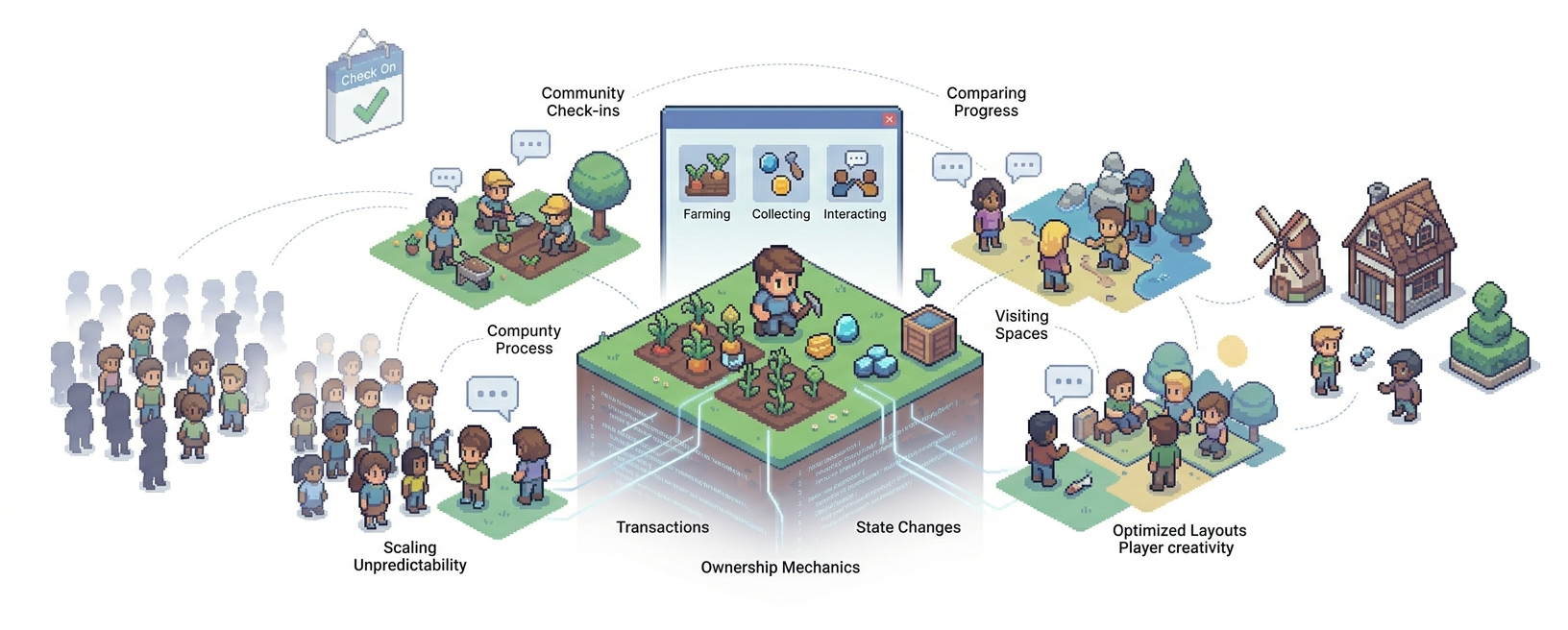


I didn’t notice when Pixels stopped feeling like a series of tasks and started feeling like a place I check on.
That shift is subtle, almost easy to miss. At first, I thought the engagement came from the mechanics themselves. Farming, collecting, interacting. But the more time I spend inside the system, the more I feel like the pull isn’t coming from what I do, but from what might have changed since the last time I looked.
The interface plays a role in this. It’s clean enough that I don’t think about it much, which is probably the point. But that simplicity hides a layered structure underneath. I’m not constantly aware of transactions, state changes, or ownership mechanics, yet they quietly define everything I interact with. I keep wondering whether that invisibility is a strength or a risk. If players don’t fully understand the system beneath the surface, are they engaging with it meaningfully, or just reacting to what feels intuitive?
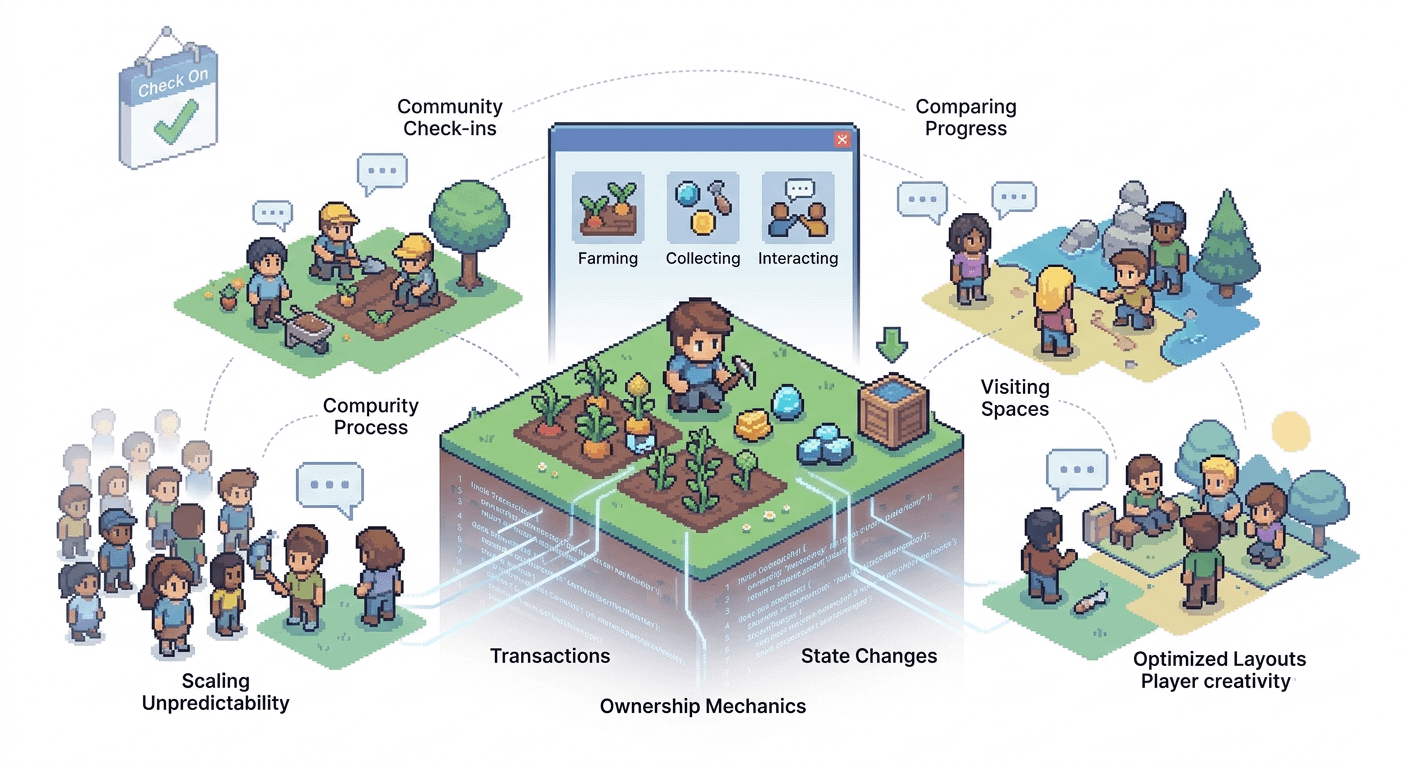
Then there’s the question of scale. I try to imagine what happens when the number of players grows beyond a certain point. Not just technically, but behaviorally. More players means more interactions, but it also means more unpredictability. Systems that feel balanced at a smaller scale often shift when participation increases. I’m not sure if Pixels anticipates that shift or simply adapts to it as it happens.
The visual design contributes to how stable everything feels. The art style is consistent, almost calming, which makes the environment easier to interpret. But I also wonder if that consistency masks underlying complexity. When everything looks coherent, it’s easier to assume the system itself is equally stable. I’m not convinced that assumption always holds.
Customization adds another dimension I didn’t initially think much about. Being able to shape space feels like ownership, but I keep noticing how choices start to converge over time. Players tend to optimize layouts, align with similar strategies, and gradually reduce variation. That doesn’t eliminate creativity, but it does suggest that freedom operates within invisible constraints.
The social layer sits quietly behind all of this. Visiting other players’ spaces, observing their progress, interacting indirectly. It doesn’t feel forced, but it influences how I interpret my own position inside the system. I start to measure progress not just against mechanics, but against visible patterns of activity around me. That kind of comparison isn’t explicitly designed, yet it emerges naturally.
Technically, the system depends on infrastructure working without interruption. If interactions slow down or fail, the sense of continuity breaks quickly. I find it interesting that most of the experience relies on something players rarely think about. Stability is expected, not noticed. But if that expectation is disrupted, it becomes the defining feature of the experience.
What keeps pulling my attention, though, is how engagement is sustained. It doesn’t rely on intensity. There’s no constant urgency pushing me forward. Instead, it builds through repetition and familiarity. That approach feels more sustainable in theory, but it also raises questions about long-term variation. Can familiarity hold attention over extended periods, or does it slowly turn into routine?
Outside the system, things feel less controlled. People don’t engage consistently. They step away, lose interest, return unpredictably. If Pixels depends on steady interaction to maintain its internal balance, then those irregular patterns might quietly reshape how the world feels over time.
So I’m left with this impression: Pixels feels stable because it’s continuously active, not because it’s fixed. And I can’t quite tell whether that activity is something the system can sustain on its own, or something that depends entirely on how long players choose to stay within it.
