
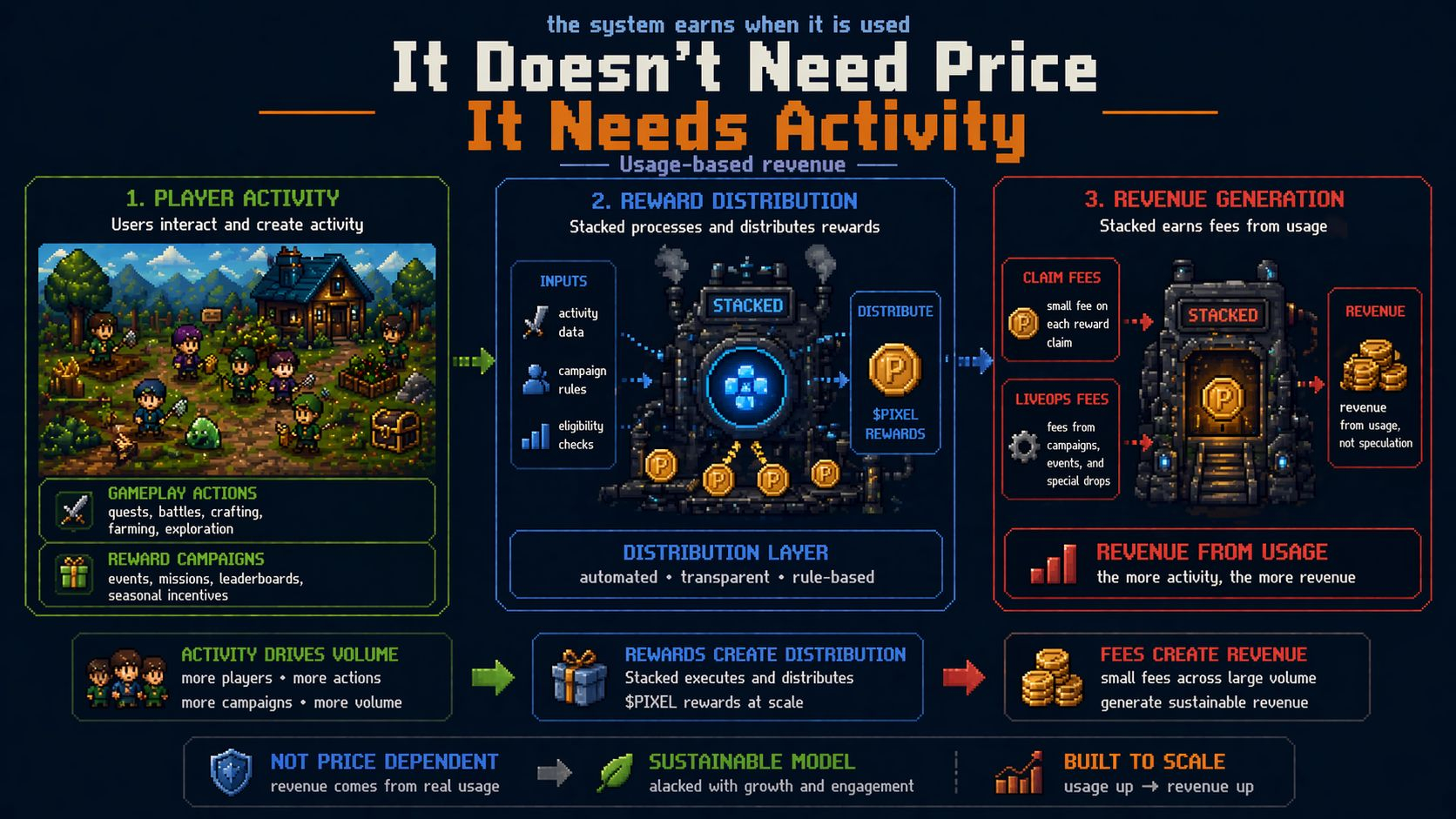
I was reading through Stacked’s docs again and there’s one line that honestly feels more important than most of the big narratives around it, but it’s written in the most boring way possible. Something like: revenue comes from reward claim fees and LiveOps service fees.
At first glance, it doesn’t look like much. Just another SaaS-style fee structure. But the more I think about it, the more it feels like this is actually the core of how the whole system sustains itself.
Because what’s happening here is pretty straightforward, but also easy to overlook. Stacked makes money every time rewards are distributed through its system. Not from token price going up, not from speculation, but from usage. The more campaigns run, the more rewards processed, the more fees it collects.
And those rewards are often paid in PIXEL.
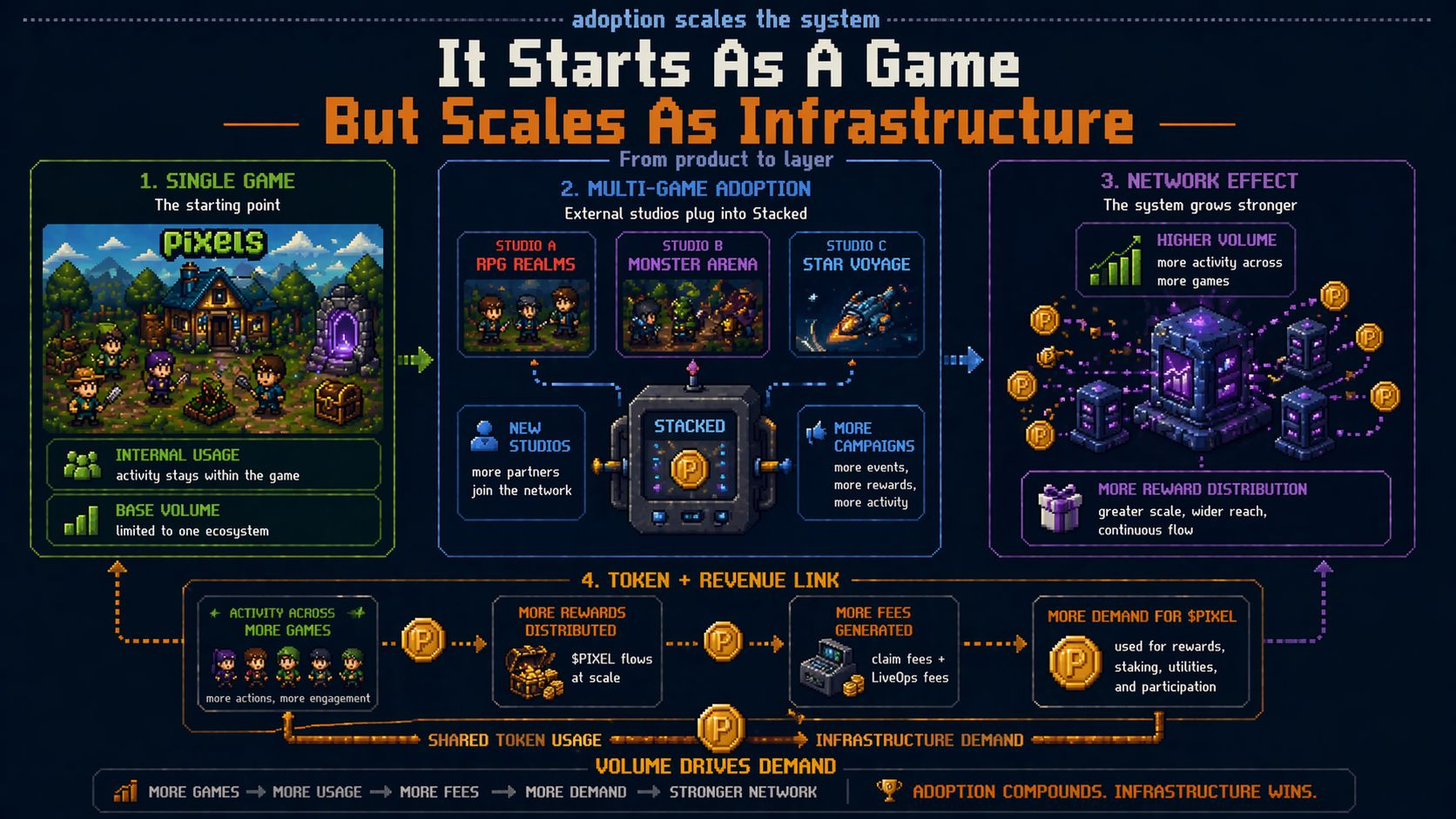
So the same token being used inside the game is also the token moving through this infrastructure layer. Which means activity doesn’t just stay inside gameplay, it feeds into a system that generates actual revenue from volume.
That’s already a bit different from how most game tokens are positioned.
But the part that keeps me thinking is what happens when external studios come in. Because once Stacked is open beyond Pixels, every new studio using it does two things at the same time. They generate fee revenue for Stacked, and they create demand for PIXEL if they’re using it to run reward campaigns.
Those two things move together. More adoption doesn’t just mean more users, it means more volume flowing through the system.
And that’s where it starts to feel less like a single-game economy and more like a distribution layer.
I think most people still look at PIXEL mainly through the lens of the Pixels game itself. Player count, engagement, how well the game performs over time. That’s valid, but it feels incomplete. Because there’s another side here that behaves more like infrastructure, where revenue grows with usage, not necessarily with token price.
And that distinction matters.
A system that earns from volume can keep operating even if the market cycle isn’t ideal. It doesn’t rely entirely on token appreciation to justify itself. It just needs activity.
Of course, there are still open questions. External adoption isn’t guaranteed, and onboarding studios is a completely different challenge compared to building the tech. That part hasn’t really been proven yet outside of Pixels.
But still, I keep coming back to that one line. It sounds simple, but it changes how I think about the whole thing. Because if Stacked really scales as a reward distribution layer, then PIXEL isn’t just tied to one game anymore.
It’s tied to how much of that layer the market actually uses.
And I’m not sure that’s fully priced in yet, or maybe it is and I’m just late to seeing it.