
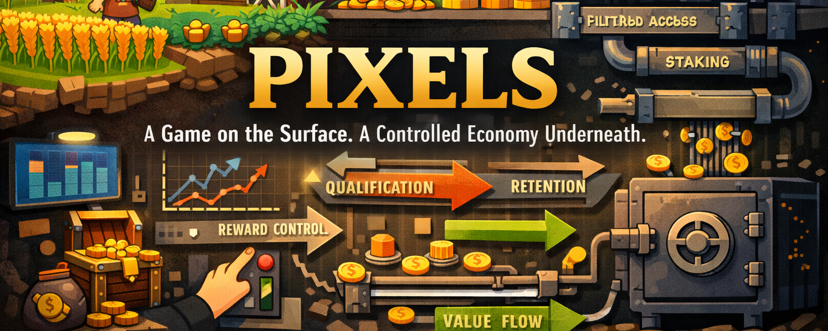


Pixels is starting to look less like a game and more like one of those controlled crypto economies that hides its real priorities behind a softer surface.
I have seen this pattern too many times. A project gives people something familiar to do, wraps it in progression, adds a social layer, pushes rewards through it, and hopes nobody looks too closely at where the pressure really sits. With Pixels, the farming loop is the easy part to understand. The harder part, and honestly the more important part, is the way the whole thing seems built around managing emissions, slowing down extraction, and deciding which users are actually worth paying.
That is where my attention goes now. Not the art. Not the routine chatter about engagement. I am looking at the plumbing.
Because the old play-to-earn cycle did not fail for mysterious reasons. It failed because most of these systems were just recycling incentives into noise. Rewards went out, people farmed them, the token got sold, and the project called that activity. It was a grind dressed up as growth. Pixels feels aware of that, which already puts it ahead of a lot of dead projects I could name.
But awareness is cheap.
The real test, though, is whether Pixels is actually building something durable or just a smarter extraction loop with better pacing. Right now, I do not read it as a normal game economy at all. I read it as a filtering system. Gameplay matters, sure, but mostly because it gives the project a way to measure behavior. Who stays active. Who stakes. Who participates in the right places. Who keeps value inside the system instead of pulling it out the first chance they get.
That changes the whole mood of the project for me. The game is not just there to entertain you. It is there to sort you.
And I do not even mean that in a dramatic way. I mean that literally. Pixels looks like it is trying to move away from broad, lazy reward distribution and toward something much tighter, where incentives go to the users and actions that create less friction for the economy. From a design perspective, I get it. After everything this sector has burned through, of course teams want more control. Of course they want to cut out the mercenary behavior. Of course they want a cleaner loop.
Still, there is a cost to that.
Once a project starts treating rewards less like player upside and more like carefully deployed budget, everything gets colder. The question stops being are players having fun and starts becoming are players behaving in a way that helps the system survive. I have watched enough crypto projects drift into that mindset to know how slippery it is. You start by fixing emissions. Then you start gating access. Then you start rewarding the most economically useful behavior. Then one day the whole thing is technically healthier, but it does not feel open anymore. It feels managed.
Pixels is getting close to that line, if it is not already on it.
The social side matters here too, but not in the cheerful community-growth way people like to pretend. Social systems in crypto games are retention tools. They make leaving harder. They make the grind feel shared. They turn repetition into routine and routine into attachment. In Pixels, I do not see the social layer as decoration. I see it as part of the economic defense system. If players build identity inside the world, they are less likely to act like tourists. That helps. Until it doesn’t.
And that is why I keep coming back to the same uneasy thought. Pixels might actually be one of the more honest projects in this cycle, not because it says less, but because the structure tells you what it really is. It is not just trying to reward play. It is trying to direct behavior. It is trying to keep value circulating internally for longer. It is trying to reduce the usual leak points that turn token economies into open drains.
I understand why. I am just not ready to pretend that makes it harmless.
Because if this works, then Pixels is not interesting because it saved crypto gaming. That phrase is tired already. It is interesting because it shows where things may be headed once the industry gets serious about control. Less open reward flow. More qualification. More filtering. More pressure on users to act in ways the system prefers. The language will still sound playful. The art will still look light. But underneath it, the machine gets stricter.
So no, I do not think Pixels is just gameplay. Gameplay is the wrapper. The real project is inflation control, reward design, and social stickiness all fused into one slow-moving attempt to build a token economy that does not immediately bleed out.
Maybe that is what survival looks like now. Or maybe this is just a more polished version of the same old grind, with better retention and quieter exits. I keep wondering which one it is.