
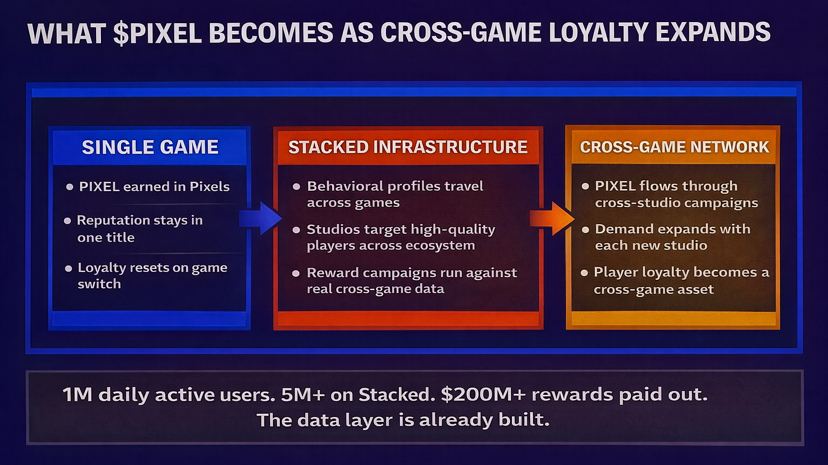
think about how player loyalty works in traditional gaming. you spend three months building reputation, unlocking skills, earning your place in a community. then you try a new game. none of it transfers. you start from zero. the loyalty you built in one title means nothing in the next one.
this is so normal in gaming that most players don’t even question it. it’s just how games work.
@undefined is building on the thesis that it doesn’t have to.
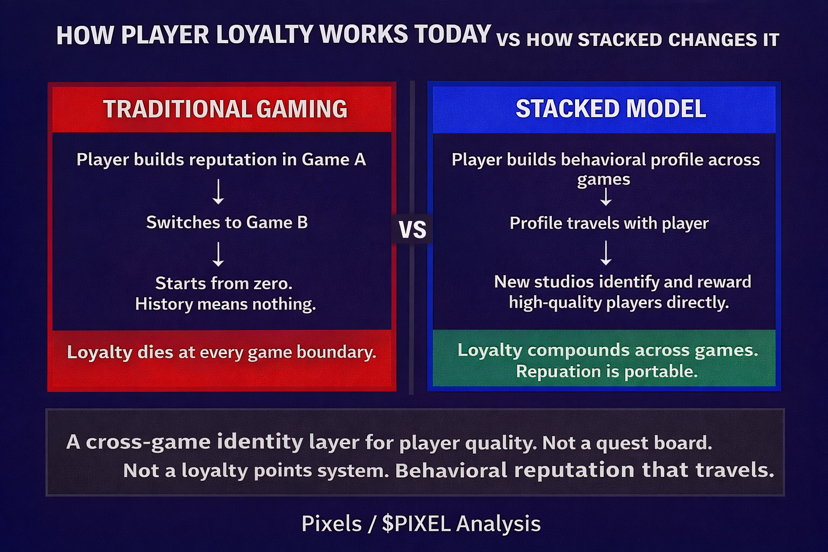
Stacked’s cross-game reward model is the part of this that i think most people following $PIXEL haven’t fully processed yet.
the Pixels team described it directly in a recent interview. they have good data on Pixels players. they know who is valuable to the ecosystem. those players are labeled. when another studio wants to run a campaign targeting high-quality engaged players, they can use Stacked to reach exactly that segment across games.
the practical result for players is that your reputation in one game becomes a signal that unlocks rewards in another. you don’t start from zero when you try something new in the Stacked ecosystem. your history travels with you.
that’s genuinely rare. most Web3 gaming loyalty programs are single-title by design. your progress in game A has zero relevance in game B because there’s no shared infrastructure connecting them. Stacked creates that infrastructure.
the Pixels Events API already supports asset interoperability. a player’s reputation and progress in the core farming game can unlock perks in partner titles. that’s not a roadmap promise. it’s already running.
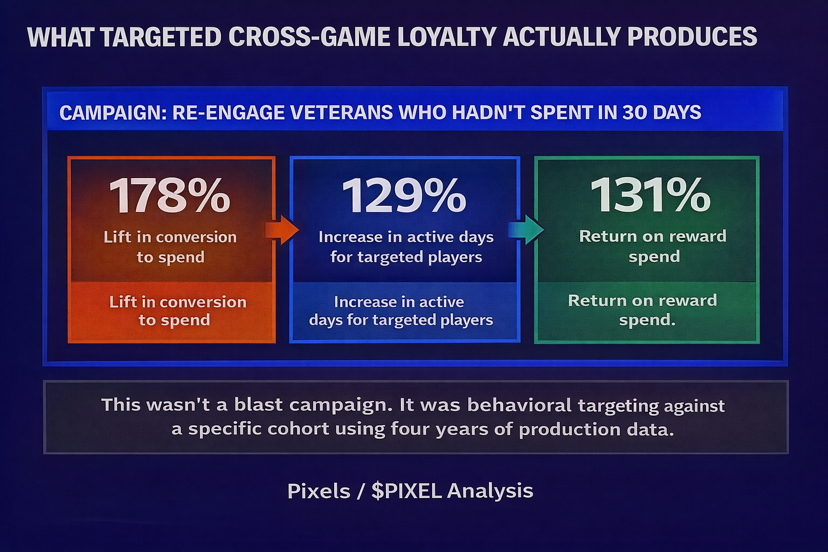
the numbers behind the loyalty model are specific enough to take seriously.
when the @undefined team targeted veteran players who hadn’t made a purchase in over 30 days using Stacked’s behavioral targeting, they saw a 178% lift in conversion to spend, a 129% increase in active days for those players, and a 131% return on reward spend. those aren’t aggregate platform metrics. those are results from a single targeted campaign against a specific cohort.
the Pixels CEO described the core principle behind this directly. most reward systems treat every player the same and optimize for the wrong things. Stacked is built to reward actions that actually matter, coming back, progressing, spending, contributing to a healthy economy.
the distinction matters because it changes what loyalty means in this system. it’s not loyalty to a token or a platform in the abstract. it’s a behavioral profile that gets recognized and rewarded across games. a player who shows up consistently, progresses meaningfully, and contributes to a healthy economy in Pixels becomes a known quantity that other studios in the Stacked ecosystem can identify and reward directly.
that’s a fundamentally different model than a quest board. it’s a cross-game identity layer for player quality.
for $PIXEL the cross-game loyalty model has a specific implication. the token is already the core of the Pixels economy. as Stacked expands to more studios, $PIXEL becomes one of the reward types that can flow through cross-game campaigns. a player who builds reputation in Pixels can earn pixel rewards from a studio they’ve never interacted with before because Stacked identified them as the right player for that campaign.
demand for the token expands not from roadmap promises but from actual cross-game reward campaigns running against real player data.
1 million daily active users in the Pixels ecosystem as of March 2026. 5M+ players across Stacked. $200M+ in rewards already paid out. the behavioral data layer is already built.
whether the cross-game loyalty model becomes the standard for how Web3 gaming treats player reputation, or stays as an interesting experiment inside the Pixels ecosystem, is the question that matters most for where pixel goes from here.