There is a phrase in Pixels' documentation about its Web3 Reputation system that reads as almost modest. The platform describes the system as combining on-chain data with in-game behavior to build a richer picture of each user. The word richer is doing something that deserves attention. It implies completeness, nuance, a profile that captures more of who the person actually is rather than a reductive view of them. The framing is positive, and for many use cases it genuinely is positive. A game that understands its players better can serve them better. That is true, and I do not want to pretend otherwise before getting to the part that I think is harder.
What the system is actually constructing is a unified record in which a player's financial history and their behavioral history sit in the same profile, accessible to the same queries, and subject to the same analytical logic. Those two kinds of data have historically lived in different places for reasons that were not accidental, and the decision to merge them even in a gaming context is a structural choice with consequences that are worth thinking through slowly.
To understand what the reputation system is doing, it helps to trace what it observes at each stage of a player's life inside Pixels. When a player connects a wallet, the system can read that wallet's public transaction history which tokens it holds, which protocols it has interacted with, how long the address has been active, and what patterns of activity it has shown across Web3 generally. That is the on-chain input. When the player begins engaging with the game, a separate stream of data accumulates session length, in-game purchases, progression choices, social interactions, reward claim patterns, referral activity. The reputation system weaves these two streams into a single representation of the player, which is then used to inform decisions about reward tiers, segmentation, access to features, and presumably eventual integrations with other studios in the Stacked network.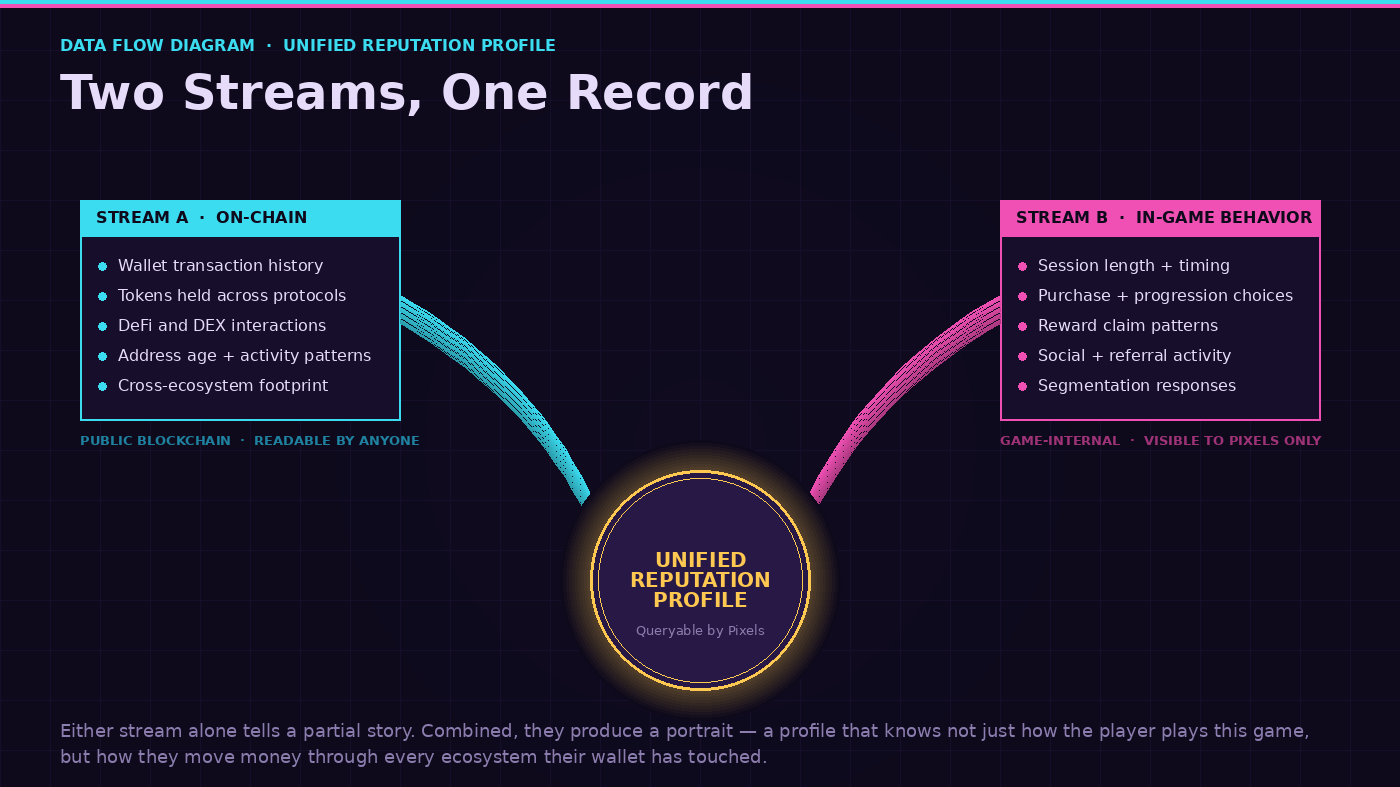
The combination is what produces the picture. Either stream in isolation would tell a partial story. On-chain data alone shows a financial history without context about intent or behavior. In-game data alone shows a player's actions without reference to their broader Web3 life. Together, they produce something that is closer to a portrait a profile that knows not just how the player behaves inside this specific game, but how they behave as a crypto-economic actor across the ecosystems their wallet has touched.
This is where the concept of player identity starts to feel different from how it has worked in traditional gaming. In a conventional game, the studio knows the player inside the context of the game. Their progression, their spending habits inside the game, their interactions with other players all of that is visible to the studio, but it is bounded by the walls of the product. When the player logs off, their identity outside the game is not part of the studio's model of them. A player who spends two hundred dollars a month inside a game is legible to the studio as someone who spends two hundred dollars a month inside a game. What they do with the other portion of their financial life is not visible.
On-chain reputation breaks that boundary. A wallet's transaction history is not limited to interactions with the game reading it. Every protocol the wallet has used, every token it has held, every pattern of accumulation or liquidation is part of the record that the reputation system can, in principle, incorporate into its view of the player. The game does not just know how the player plays. It knows, to the extent the wallet is active on-chain, how the player moves money through the broader Web3 economy.
None of this is hidden from the player in a legal sense. On-chain data is public by design, and anyone who connects a wallet to a game understands, at some level, that the wallet's history is readable. But understanding that something is technically readable and understanding what it means for it to be read, stored, and integrated into a behavioral profile by a specific company are different things. The first is a property of the blockchain. The second is a product decision that the player has less direct control over.
The reputation system as Pixels describes it appears to be oriented toward legitimate and defensible uses. Better segmentation can mean more relevant rewards for genuine players and faster fraud detection for suspicious ones. A player who has a long and consistent history of genuine engagement across multiple Web3 games arguably should be treated differently than a freshly created wallet whose only activity is claim attempts. Reputation, in that sense, is doing work that benefits the honest participant. The question is not whether the system can be used well. It almost certainly can be.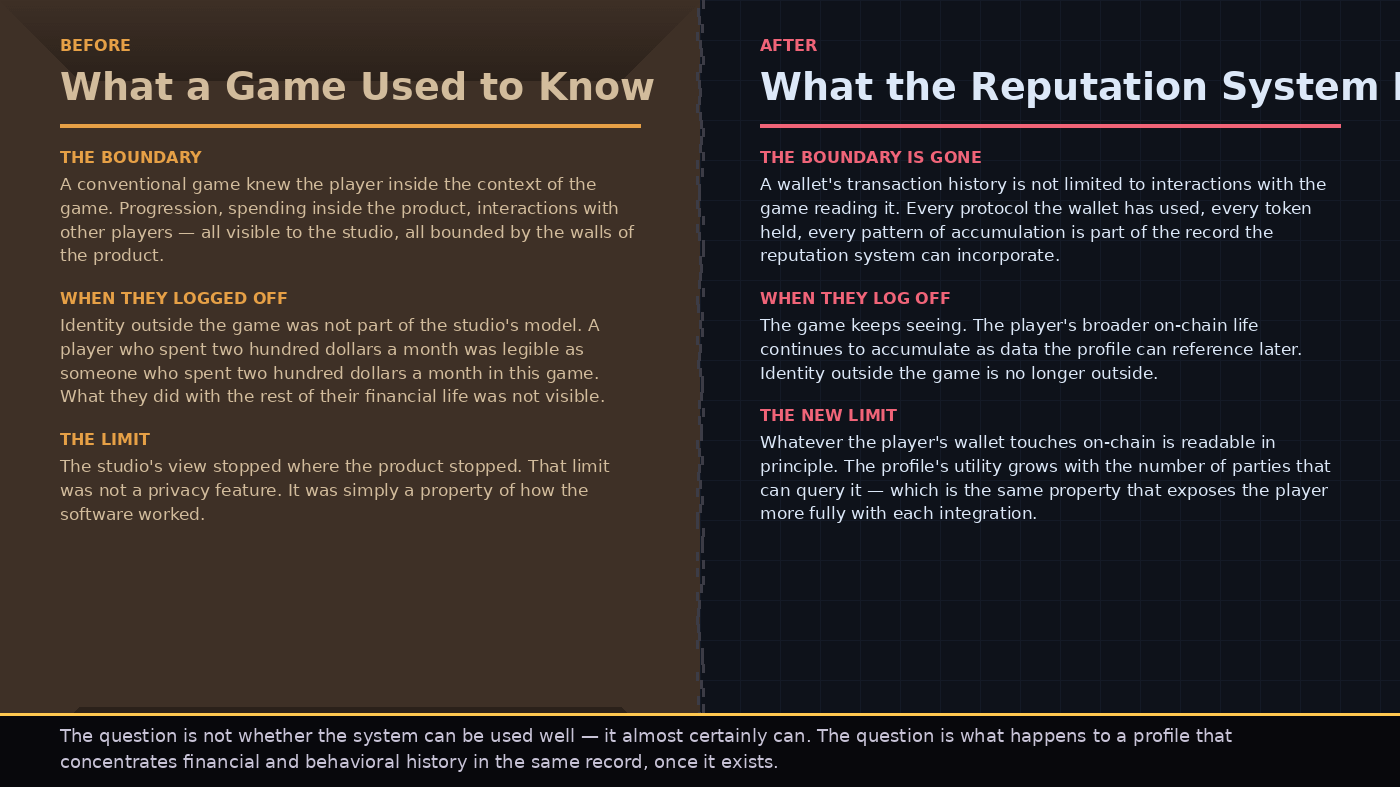
The question is what happens to the data once it exists. A unified profile that combines financial history and behavioral record is useful precisely because it is comprehensive, and that comprehensiveness is what makes it sensitive in ways that either stream alone would not be. A marketing team can do more with it. A fraud detection system can do more with it. A future partner studio integrated through the Stacked network can, depending on data-sharing arrangements, potentially do more with it as well. The profile's utility grows with the number of parties that can query it, which is the same property that makes it expose the player more fully with each additional integration.
This is not a problem unique to Pixels. It is a general feature of reputation systems in Web3 that they tend to concentrate information rather than distribute it, and that the concentration point becomes both the source of value and the source of risk. The player benefits when their good history travels with them across games. The player is exposed when their full economic profile travels with them into contexts they did not anticipate.
What I find myself wondering is whether the players currently playing games that use these systems have a clear mental model of the difference between a game that knows them and a game that knows them in this new, cross-contextual sense and whether the value they receive from the system is meaningfully larger than the value they are giving up, or whether the framing of richer is doing the same kind of quiet work that open did in a different article I was thinking about not long ago. $PIXEL

Artigo

Pixels' Web3 Reputation knows how you spend and how you play at the same time
--
Aviso Legal: inclui opiniões de terceiros. Não se trata de aconselhamento financeiro. Poderá incluir conteúdos patrocinados. Consulta os Termos e Condições.