


I started noticing PIXEL not when something exciting happened, but when nothing did. The world kept moving, players kept passing by, resources kept circulating, and I couldn’t quite tell if I was progressing or just staying aligned with a system that doesn’t like to pause.
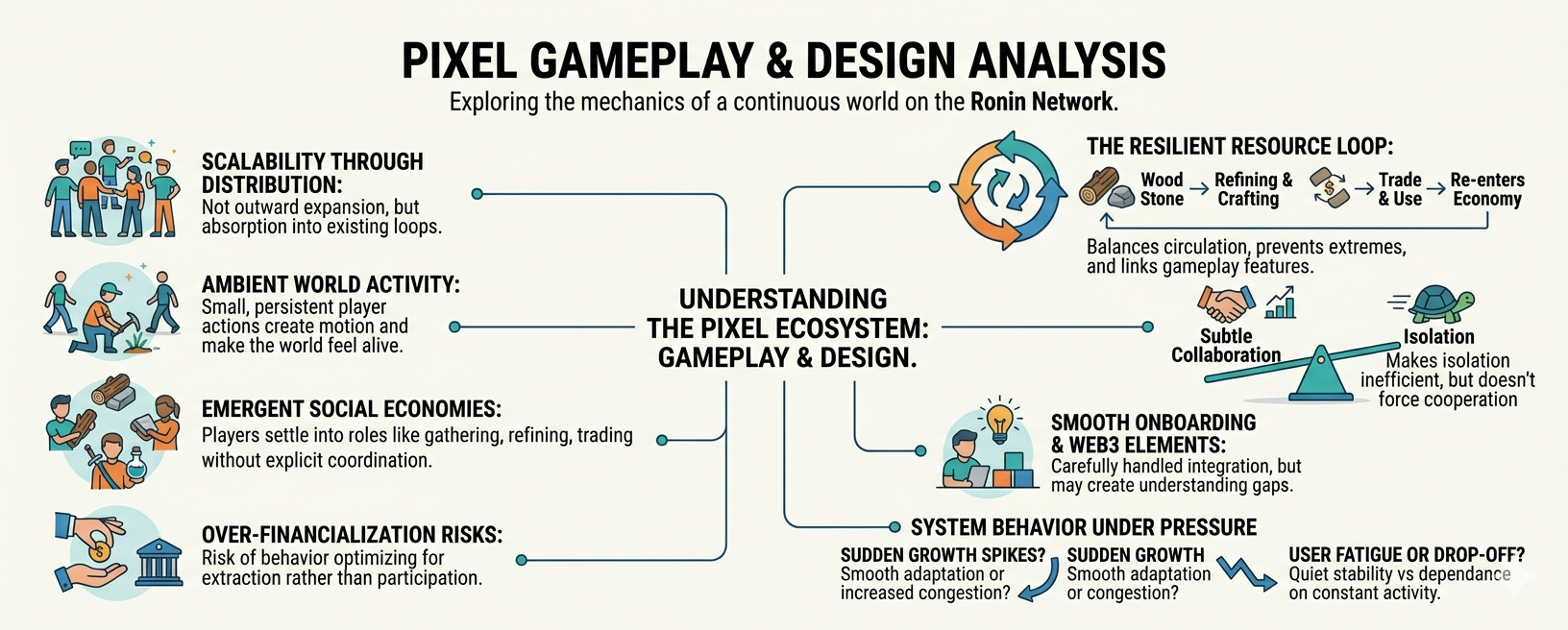
Scalability, at least from what I can see, isn’t handled through visible expansion but through quiet distribution. As more players enter, the system doesn’t stretch outward aggressively, it absorbs them into existing loops. That creates a strange effect. The world doesn’t feel crowded in the usual sense, but it also doesn’t feel entirely personal anymore. It’s like the design expects density, but hides it behind routine.
The open world feels alive, though not in the dramatic sense. It’s not about dynamic events or constant change. It’s the small, persistent actions of other players that create motion. Someone harvesting, someone passing through, someone crafting in the background. It builds a kind of ambient activity that makes the world feel occupied rather than designed.
What surprised me more was how social economies form without explicit coordination. People settle into roles naturally. Some focus on gathering, others on refining, others on trading. It isn’t assigned, it just emerges. But that also raises a question. If everyone optimizes over time, does the system lose flexibility?
Collaboration exists, but it’s subtle. The game doesn’t force cooperation, it makes isolation slightly inefficient. That’s a different approach. You don’t team up because you have to, you do it because doing everything alone starts to feel slow.
Resource scarcity plays a quiet but important role here. It doesn’t block progress, but it shapes behavior. You begin to notice patterns. Certain areas become more active, certain items more contested. It creates soft pressure without turning the experience into competition-heavy gameplay.
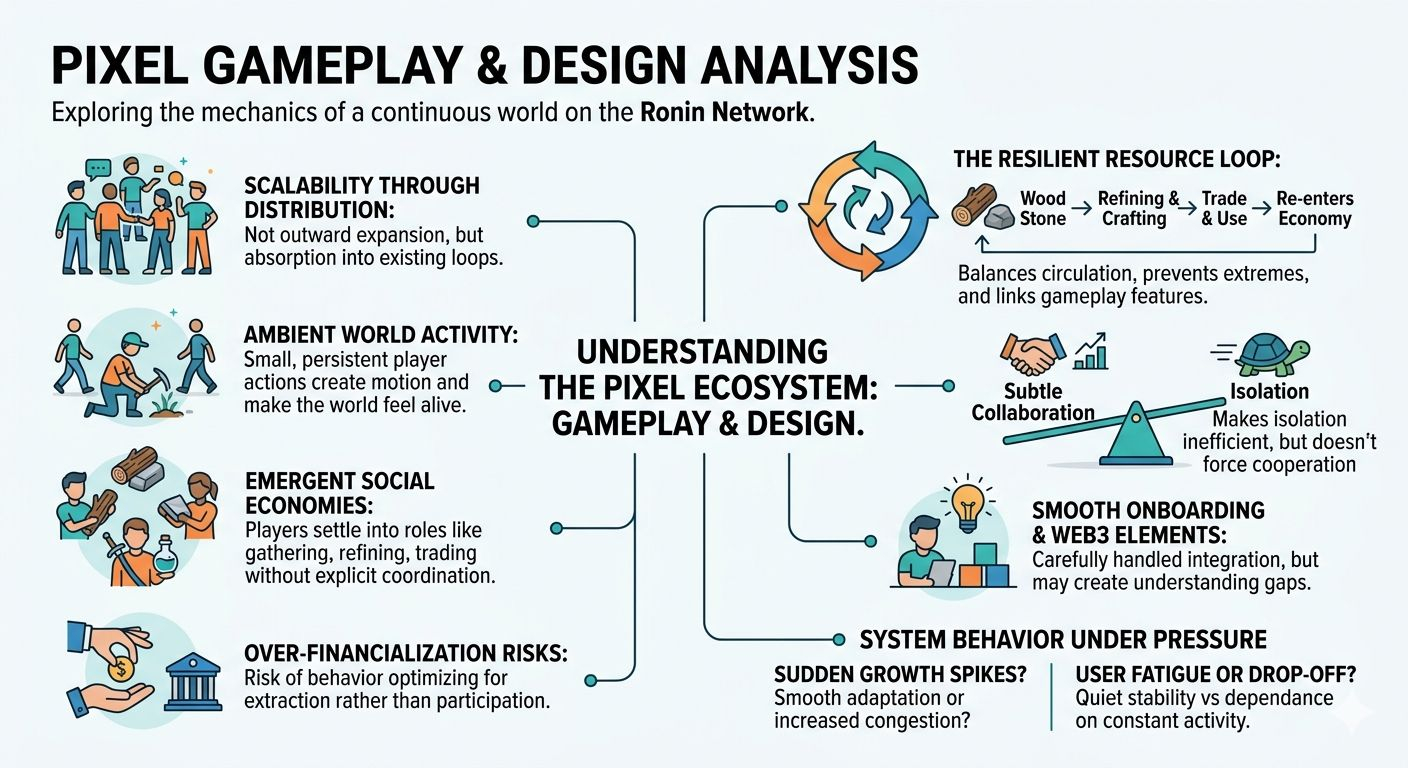
Crafting ties all of this together. It’s not just a feature, it’s part of the circulation system. Resources move, get transformed, and re-enter the economy. That loop feels stable, but also a bit controlled, like it’s designed to prevent extremes rather than encourage experimentation.
Compared to other games on the Ronin Network, PIXEL feels less focused on moments and more on continuity. It doesn’t try to impress immediately. It tries to keep you returning. That’s a different kind of design philosophy, and I’m still not sure if it’s more sustainable or just less noticeable.
Onboarding is handled carefully, almost to the point where Web3 elements fade into the background. You don’t feel like you’re entering a blockchain system. But that also creates a gap. If players don’t fully understand what’s happening underneath, are they really engaging with it, or just using a simplified layer?
The bigger concern, at least for me, is over-financialization. The systems are clearly structured around value flow. Even if it’s not obvious at first, it’s always there. If too much behavior starts optimizing for extraction rather than participation, the balance could shift in ways that aren’t easy to reverse.
In a real-world scenario, I wonder what happens under pressure. If player growth spikes suddenly, or drops just as fast, does the system adapt smoothly or start showing strain? And if external conditions shift, like network congestion or user fatigue, does this quiet stability hold, or does it depend more on constant activity than it lets on?
I’m still trying to understand whether PIXEL is building a game that sustains itself, or a system that depends on players continuously sustaining it. The difference is subtle, but it changes how everything else feels.
