
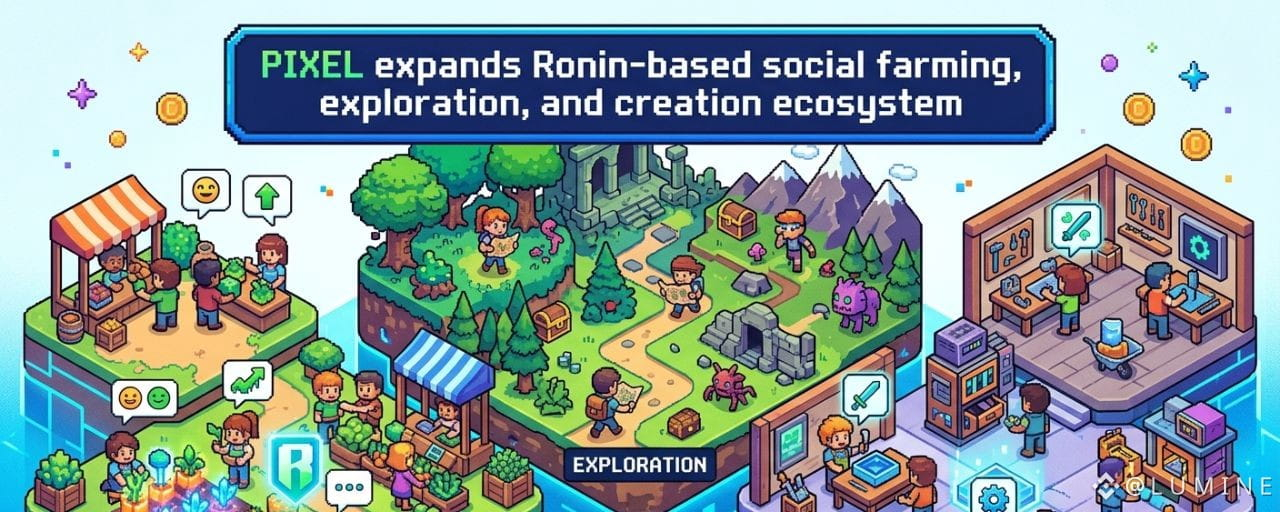

PIXEL is a social casual Web3 game built on the Ronin Network, designed around a simple but deeply engaging idea: give players a living digital world where farming, exploration, and creation are the core ways to play, progress, and express themselves. Instead of focusing on intense combat or complex mechanics, PIXEL leans into calm, repeatable, and rewarding gameplay loops that feel natural to return to every day.
At its heart, PIXEL is about routine and ownership. Players enter a shared open world where they can grow crops, manage land, gather resources, and slowly build their own space. Farming is not just a background activity—it is a central system that ties progression together. You plant, you wait, you harvest, and you reinvest. That loop creates a sense of rhythm, almost like a digital version of real-life patience and planning.
What makes PIXEL different from traditional farming games is how it blends social interaction into every layer. You are not alone in your world. You exist alongside other players who are also building, exploring, and creating. This shared environment turns simple actions into social experiences. Visiting other farms, trading items, or collaborating on goals becomes part of the natural flow of the game rather than an optional feature.
Exploration adds another layer to the experience. The world is not static. It invites curiosity. Players can move beyond their farms to discover new areas, unlock resources, and find hidden opportunities. Exploration is not rushed or forced. It is calm and gradual, encouraging players to move at their own pace. This design choice makes the game feel less like a grind and more like a living world that slowly opens up over time.
Creation is where players truly make the world their own. PIXEL gives tools for customization, building, and expression. You are not just playing in a world—you are shaping it. Farms can be designed in different ways, spaces can reflect personal style, and progress becomes visible through what you create. This sense of ownership is important because it turns time spent in the game into something meaningful and personal.
Being powered by the Ronin Network also plays a key role in PIXEL’s structure. Ronin is known for supporting Web3 games that prioritize scalability and player ownership. In PIXEL’s case, it allows in-game assets and progress to exist in a more open digital economy. This means that items, resources, and achievements are not just locked inside the game but can be part of a broader ecosystem where value and utility extend beyond simple gameplay.
However, PIXEL is not built around complexity. It is intentionally designed to feel simple and accessible. Many Web3 projects focus heavily on technical systems, but PIXEL takes a different approach by making the experience feel light and human. Players do not need to understand blockchain mechanics to enjoy the game. They just farm, explore, and create. Everything else runs quietly in the background.
This simplicity is one of the reasons the game appeals to a wide audience. It does not demand constant attention or high-level skill. Instead, it rewards consistency and presence. Logging in daily to check your farm, complete small tasks, or interact with others becomes part of the experience. Over time, these small actions build into meaningful progress.
The social aspect is also important for long-term engagement. PIXEL is not just about individual progression it is about shared spaces and collective growth. Players influence each other, trade with each other, and sometimes even collaborate on larger goals. This creates a sense of community that is often missing in more isolated gaming experiences.
From a design perspective, PIXEL reflects a growing trend in Web3 gaming: moving away from high-pressure systems and toward relaxed, sustainable engagement loops. Instead of trying to keep players constantly active through competition or urgency, it focuses on comfort and consistency. The goal is not to burn players out but to give them a world they can return to over time without stress.
The farming system especially reflects this philosophy. It is slow, predictable, and rewarding in a steady way. You do not need to rush or optimize everything perfectly. You simply participate, and over time, your efforts accumulate. This creates a different emotional experience compared to fast-paced games. It feels more like tending something than chasing something.
Exploration and creation reinforce this feeling by giving players reasons to stay curious. There is always something new to discover or improve. Even if the core loop remains simple, the world around it continues to expand. This balance between familiarity and discovery is what keeps the experience engaging without overwhelming the player.
PIXEL also represents how Web3 gaming is trying to redefine ownership in games. Instead of everything being controlled entirely by a centralized system, players have more visible participation in the economy and structure of the game. This does not mean complexity for the user—it simply means that their time and effort can have more lasting recognition.
In many ways, PIXEL feels less like a traditional game and more like a digital environment designed for daily life. It is not about winning or finishing. It is about participation, growth, and expression. You can spend a few minutes or a few hours, and the experience still feels complete.
As the ecosystem around PIXEL grows, the combination of farming, exploration, and creation will likely continue to expand. New systems can be added without breaking the core simplicity of the game. That flexibility is part of what makes its design interesting—it can evolve while still keeping its identity intact.
At its core, PIXEL is about creating a calm digital space where players can build something over time. Not through pressure, but through rhythm. Not through competition, but through presence. It is a reminder that games do not always need to be intense to be meaningful. Sometimes, the most engaging experiences are the ones that quietly grow with you.