
on This Project
I want to talk about Stacked
Not because its the flashiest announcement @Pixels has made in the past two years
But because it is the clearest signal I have seen about what this team actually thinks they are building and who they think their real competition is
Most Web3 gaming studios think their competition is other Web3 games
Pixels apparently decided their competition is every mobile gaming studio that has spent a decade perfecting behavioral retention science
That is a completely different and more serious ambition
Stacked started as an internal tool the team built to understand why players stopped logging in and how to bring them back
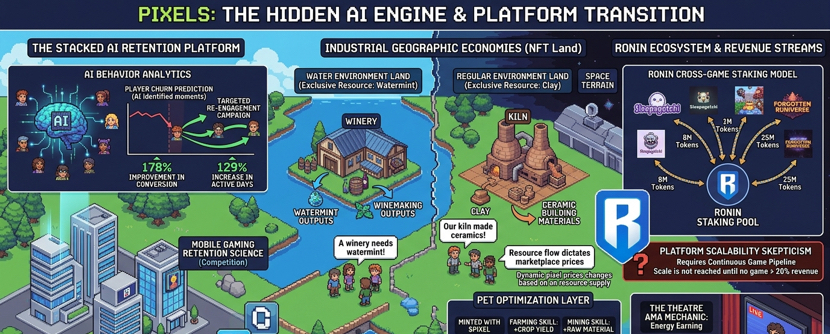
The platform uses AI to analyze player behavior patterns identify the specific moment when engagement starts dropping and trigger targeted re-engagement campaigns before the player fully churns
When deployed against lapsed player segments it reportedly delivered 178 percent improvement in conversion rates and a 129 percent increase in active days per returning player
These are not rounding error improvements
A 178 percent conversion lift is the kind of number that mobile gaming studios pay consultants six figures to achieve and most of them never get close
The team built it internally and then decided to license it to other studios
Now the industries system on NFT land is where I want to spend time because it represents the most underanalyzed economic layer in this entire game
Every NFT plot supports a number of industry buildings that range from 3 on small parcels to 4 on large ones
These industries are not decorative
They are functional production facilities that process raw resources into higher tier crafting inputs
A Winery installed on Water environment land has access to Watermint as an exclusive local resource which produces winemaking outputs unavailable to players farming on Regular or Space terrain
A Kiln on Regular land processes the Clay that only Regular environment plots produce into ceramic building materials that higher tier construction projects require throughout the game
The industry system creates geographic economic specialization across the 5000 NFT plots and most players never fully understand how it shapes the prices they see in the marketplace
The pet system is another layer that gets systematically ignored in most coverage I read
Pets are NFTs that players can mint using tokens and they provide passive bonuses to specific skill activities during farming sessions
A pet bonused toward Farming skill activities increases crop yield rates
A pet bonused toward Mining skill activities increases raw material output per action
The bonuses are not cosmetic
They create real efficiency differences between players who have optimized their pet loadouts and players who havent thought about the system at all
And because pets are NFTs that trade on the open marketplace the optimization creates genuine demand for specific pet types that correlates with whatever resource the community is currently farming most actively
Demand for pets follows demand for resources and both follow the NPC order board
And here is the thing about the Ronin ecosystem expansion that I think most people are modeling incorrectly when they try to assess the long term token picture
The staking system launched in May 2025 allows players to direct token weight toward specific games across the Ronin network
When a new game integrates token payments a percentage of that games in game spending flows back to stakers proportionally
This means that every new game that joins the ecosystem increases the total revenue base that stakers are drawing from
Sleepagotchi integrated in its first week and pulled 8 million tokens into the staking pool immediately
The Forgotten Runiverse ran a joint event that distributed 25 million tokens to Pixels players
Each integration is not just a partnership announcement
Each integration is a new revenue stream feeding the same staking pool
But here is where I get genuinely skeptical about the platform narrative in a way that I think the community needs to hear directly
The Stacked platform and the cross game staking model and the multi studio ecosystem strategy all depend on a continuous pipeline of new games joining the Ronin network and actively integrating token payments
If that pipeline slows down the platform thesis weakens significantly
A publishing infrastructure platform with two or three integrated games is still just a game studio with a side project
The platform story only becomes real when the number of integrated games reaches a scale where no single title represents more than maybe 20 percent of total staking revenue
Pixels isnt there yet
Not even close
The Theatre AMA mechanic continues to be the smartest retention tool in the game and I keep bringing it up because I want people to understand why it matters at a design level
Players earn energy while attending live community broadcasts inside the game world
The team holds a product update or a community discussion and players who show up fill their energy bars while watching
This means the incentive to attend a developer communication event is built directly into the resource economy of the game
Traditional games pay community managers to generate attendance at town halls
Pixels pays players in the games own energy currency to show up
The alignment between developer communication and player incentive is tighter here than anywhere else I have seen in this space
I want to address the crafting progression ceiling question because I raised it in a previous piece and the community pushback I received made me think harder about it
The argument against my concern was that master level crafters form a specialized economic class that serves the broader player base rather than running out of content
A player who has reached level 100 in Woodworking produces furniture and building items that lower level players need for housing customization and land development
A player who has mastered Winemaking produces sustained energy items that active farmers pay real Coins to access
The endgame is not a wall
The endgame is becoming a supplier to the mid game
I think thats a reasonable counter and I am updating my view partially based on it
The 18 percent Filipino player base and heavy Southeast Asian concentration is not just a demographic footnote
It is the reason I keep returning to the mobile gap as the most important unresolved product question in this entire project
Ronin Waypoint solved the wallet problem for desktop users brilliantly
The same friction that Waypoint eliminated on desktop exists in an even more severe form for a player trying to access a browser farming game on a mobile phone with inconsistent data connection
The players most economically motivated to engage seriously with this game are on devices the game doesnt fully support yet
That gap is not a minor inconvenience
It is the ceiling on the projects organic growth until it gets resolved
My overall read in April 2026 is that $PIXEL is a token attached to a project that is executing its platform transition more competently than I expected while simultaneously leaving its largest addressable market underserved by a missing mobile client
The AI retention infrastructure in Stacked is more sophisticated than anything I have seen from a Web3 gaming studio at this stage
The cross game staking model is architecturally sound even if the pipeline needs more studios
And the game design underneath all of it has more mechanical depth than its pixel art presentation ever gets credit for
But competent execution with a missing mobile app in a market that lives on mobile is still incomplete execution