
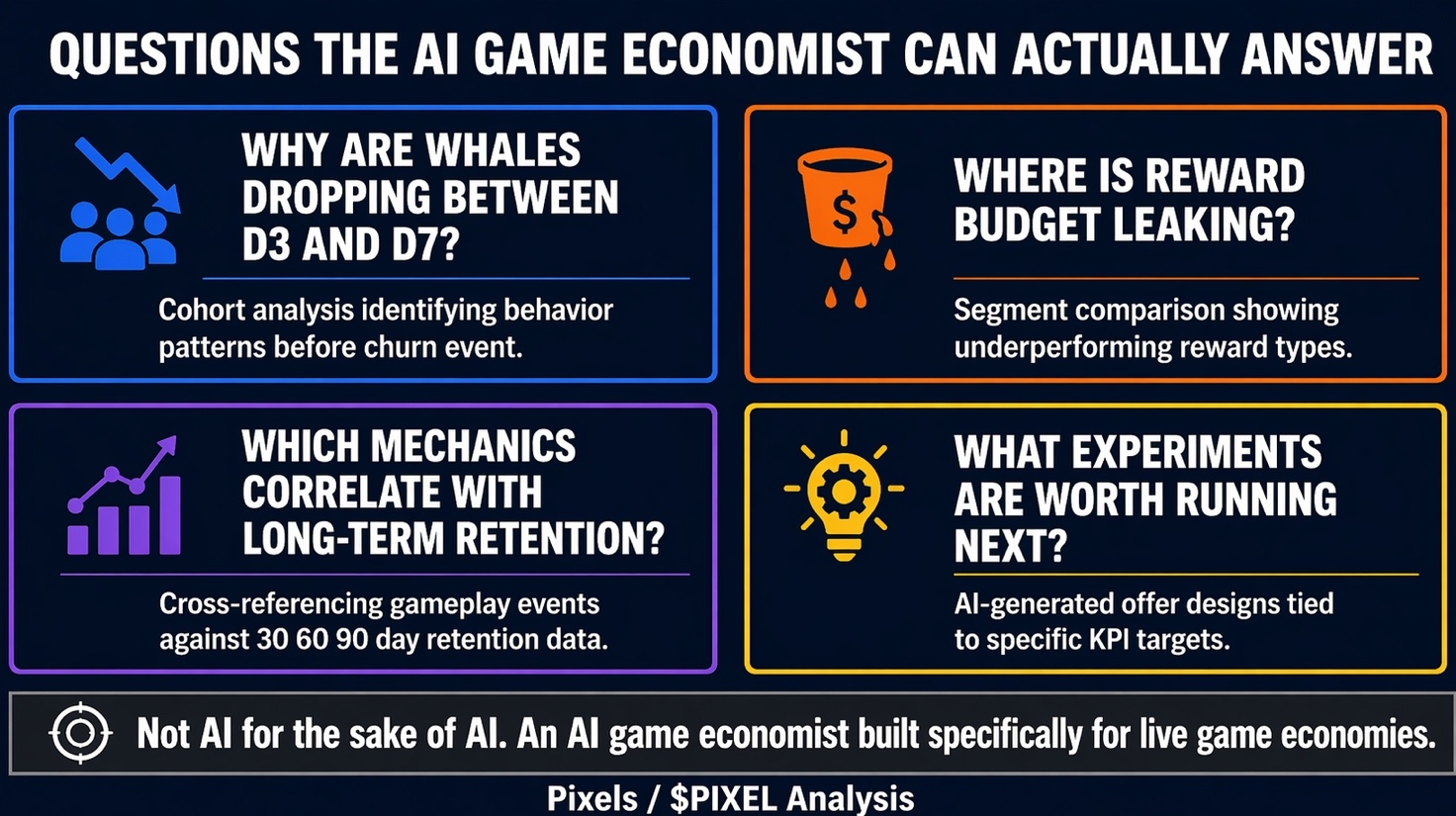
hiring a game economist is expensive. understanding a live game economy deeply enough to design rewards that actually work, identify which cohorts are underserved, know why players are dropping between day three and day seven, and build incentive structures that survive real adversarial usage at scale. that’s a specialized skill set that most game studios don’t have in-house and can’t easily hire for.
the @undefined team described this problem directly. even internally, it’s very hard to come up with rewards that you can actually implement. a game economist needs very detailed knowledge of a specific game economy. it’s not easy to design rewards correctly.
Stacked’s AI game economist is built to solve exactly that problem. not as a gimmick. as a practical answer to something the team struggled with themselves while building Pixels.
the way the AI layer actually works is more specific than most AI product announcements.
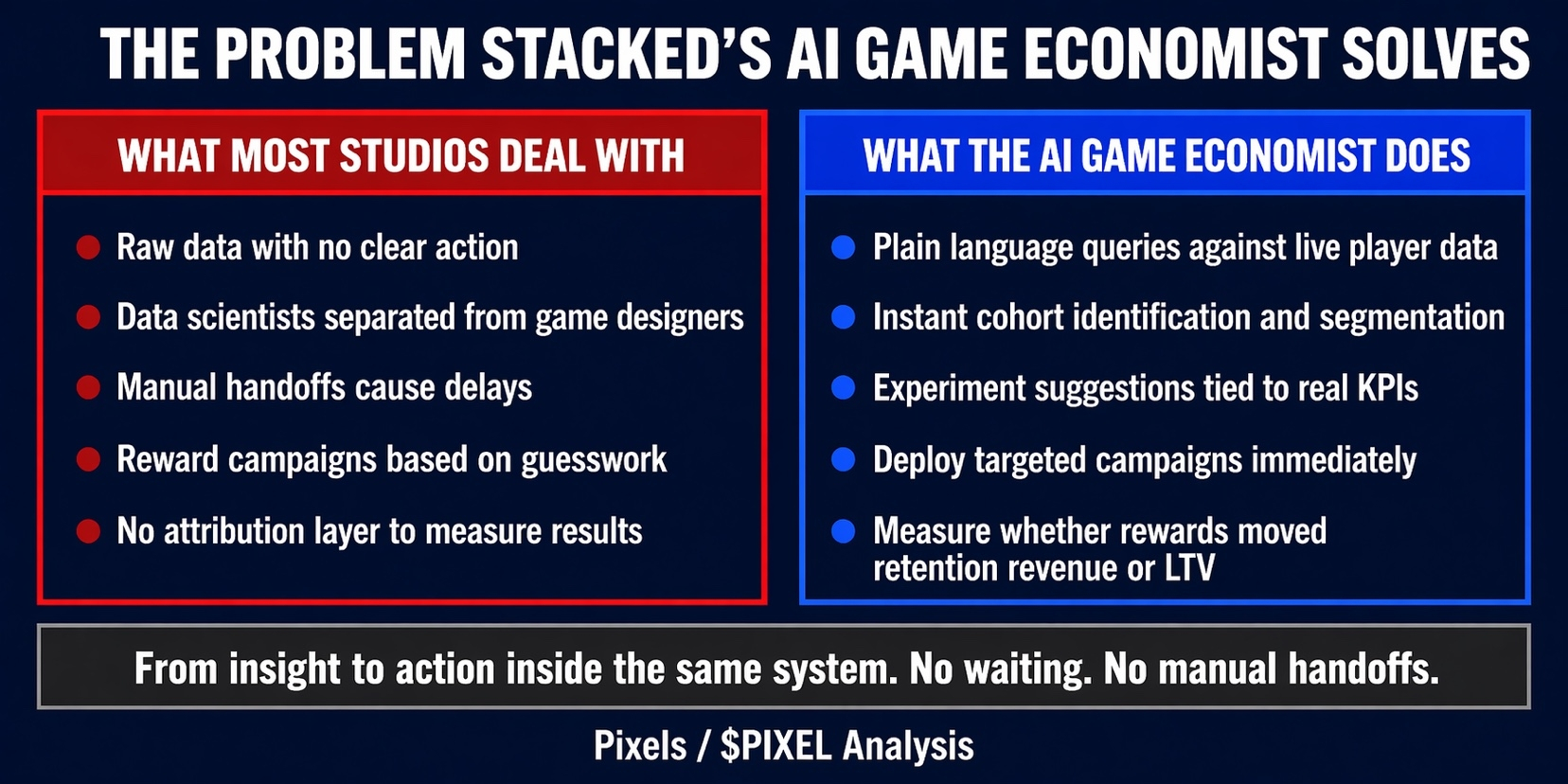
a studio integrates Stacked through a single SDK line of code that logs user activity. that data flows into the system and gets combined with the anonymized behavioral data already collected across the Pixels ecosystem. the AI game economist then runs data models against that combined dataset and surfaces results in plain language.
a LiveOps team can ask the system things like: why are whales dropping between day three and day seven? what are our most loyal users doing before day thirty? which mechanics correlate with long-term retention? which segment is underserved and not retaining as well as others?
the system generates comprehensive reports, identifies meaningful cohorts, suggests LiveOps experiments, and creates new rewarded offers tied to the specific KPIs the studio actually cares about. the key detail the Pixels CEO emphasized is that this moves from insight to action inside the same system. no manual handoff between data scientists and game designers. no waiting. you identify the problem and deploy a targeted campaign against it immediately.
If that’s the gap most studios operate in right now. they have data. they don’t have the infrastructure to turn that data into reward decisions at speed.
the production results behind this are specific enough to take seriously.
the pixel team ran a campaign targeting veteran players who hadn’t spent in thirty days using exactly this system. the results were a 178% lift in conversion to spend, a 129% increase in active days for those players, and a 131% return on reward spend. those numbers came from a targeted intervention against a specific cohort, not a broad campaign. the precision is what produced the result.
four years of building this inside Pixels means the data models running inside the AI game economist aren’t theoretical. they were shaped by hundreds of millions of rewards, thousands of experiments, and every failure mode that kills Web3 game economies. bots, farmed quests, shallow engagement, bad targeting, reward loops that look good on paper and destroy value in practice. the system learned from all of it.
the Pixels CEO framed the broader implication directly. most Web3 games will run into the same problems because ownership turns any Web3 game into a play-to-earn game. building a Web3 game means facing the hardest problem in crypto, making incentive systems work at scale in a sustainable way. Stacked is the answer the Pixels team built after four years of living that problem.
for $PIXEL the AI game economist layer has a specific implication that goes beyond the token mechanics.
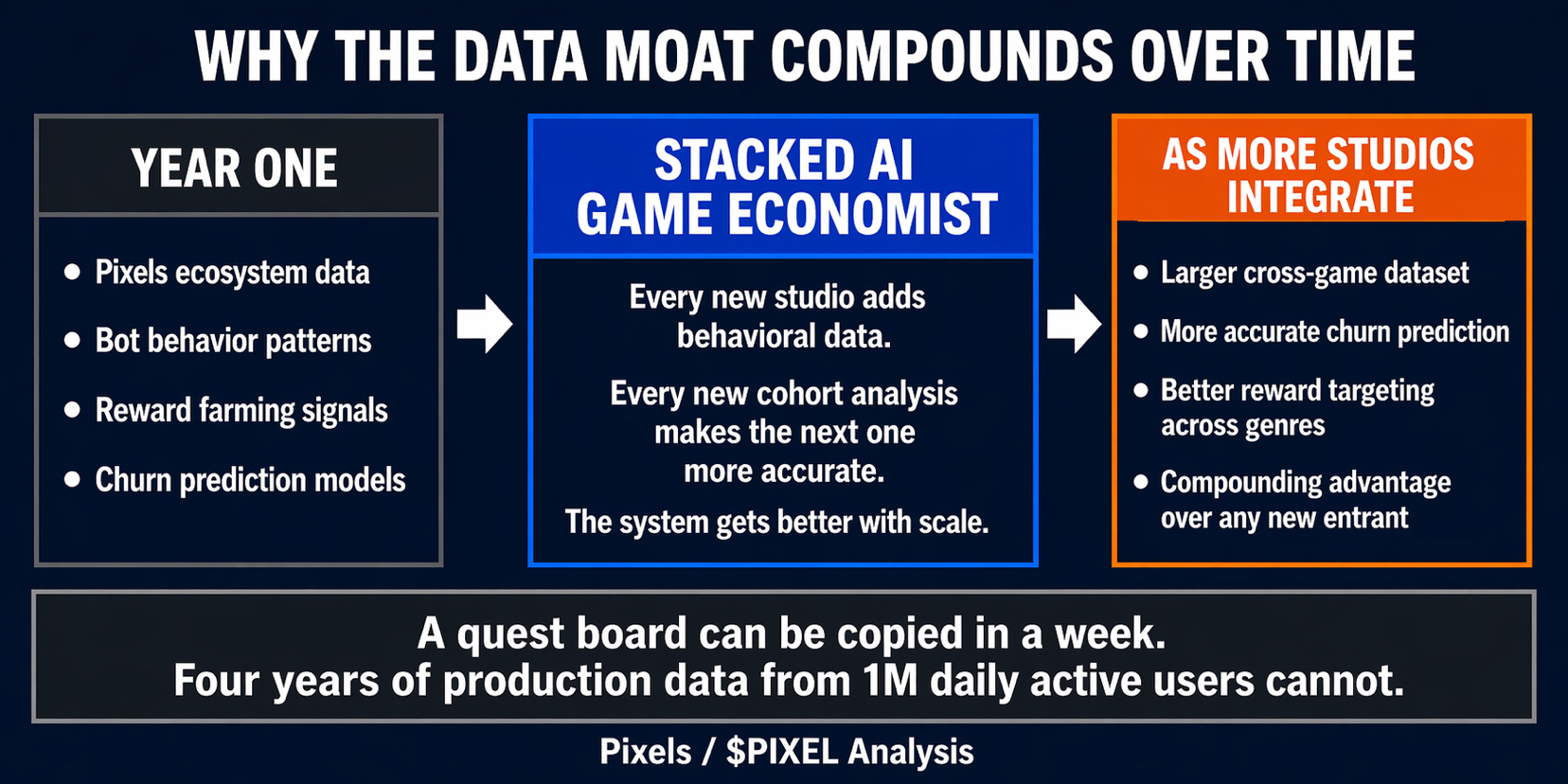
if Stacked becomes the standard infrastructure that game studios reach for when they need reward optimization, the data layer compounds over time. every new studio that integrates adds behavioral data to the system. every new cohort analysis the AI runs makes the next analysis more accurate. the moat isn’t just the fraud prevention or the production track record. it’s the accumulating dataset that makes the AI game economist progressively better at its job the more games run on top of it.
that’s a different value proposition than a quest board with a token attached. it’s an infrastructure play with a compounding data advantage.
1 million daily active users in the Pixels ecosystem. 200M+ rewards already processed. four years of production data already in the system.
the AI game economist is only as good as the data it runs on. pixel already has four years of it.