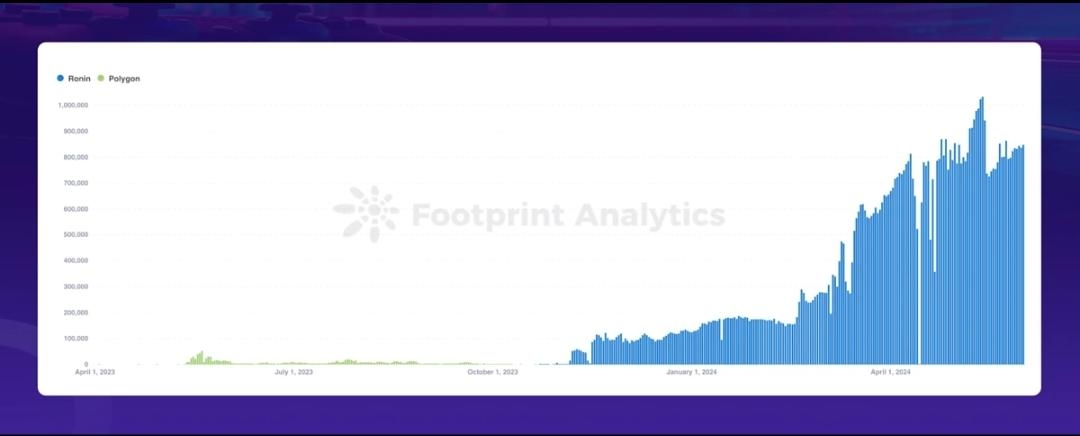
In May 2024, Pixels hit one million daily active users. For a blockchain game, that number was almost unheard of. The previous record in Web3 gaming had been held by Axie Infinity at its peak 1.1 million daily active users in November 2021, a number that became famous because it came right before Axie's economy collapsed. Pixels had come within touching distance of that record and crossed one million. Crypto media celebrated. Headlines ran. Social media lit up. By almost every visible measure, Pixels was the biggest blockchain game in the world. But inside the company, the celebration was quieter than the headlines suggested. Because the team already knew something that the headlines did not say: a daily active user count that high meant very little if the people showing up every day were just there to collect rewards and sell them. The number was real. The engagement behind it was the question. And the whitepaper had always been built around a completely different answer to that question one that was not about how many people showed up, but about whether the people who showed up were actually making the ecosystem stronger.

The whitepaper makes the real goal clear from its opening paragraphs. Pixels was not built to collect users. It was built to optimize long-term player engagement. There is a meaningful difference between those two things, and most blockchain games never figured that out. A user who logs in every day to click through the fastest reward-generating actions and then immediately sells their tokens is a daily active user. They show up on the graph. But they are not building anything. They are not spending inside the game, not contributing to the economy, not forming the kind of habits that keep a game alive for years. They are extracting value and leaving. The whitepaper describes this problem directly and frames Pixels' entire design around solving it using data science and innovative token mechanics to build an ecosystem that rewards genuine player contributions, not just presence. That is the distinction the team was chasing, and it is why the million-user milestone, while real, was not treated as the finish line.
The CEO of Pixels, Luke Barwikowski, said something in late 2025 that summarized the shift clearly. In an interview, he noted that for years the entire blockchain gaming industry had been obsessed with DAU and token price but that DAU means nothing if those users are not generating value or sticking around. He called RORS Return on Reward Spend the metric that actually matters. The way RORS works is straightforward. It measures how much revenue the game generates for every token it gives out as a reward. If a player receives 100 in rewards and then spends 50 of those tokens back inside the game on upgrades, purchases, or other activities, the RORS is 0.5. The goal is to push that number above 1.0 meaning the game takes in more than it gives out. Below 1.0, the ecosystem is being slowly drained. Above 1.0, it is sustainable and growing. Most blockchain games never measured this at all, which is why most of them eventually ran out of money to pay rewards and shut down. Pixels named the number, tracked it publicly, and built every economic decision around hitting it.
By the end of 2024, Pixels had a RORS of 0.5. That means for every 100 tokens given out as rewards, only 50 were being spent back inside the game. The rest were being sold on exchanges, creating constant selling pressure on the token price. The number was improving it had been much lower earlier in the year but it was still below the target. What made this honest was what Barwikowski did with that information. He published the financial report. He did not hide the shortfall or reframe it as a success. He said clearly that the game was not yet profitable, that net revenue was negative, and that the RORS needed to cross 1.0 before the ecosystem would be truly self-sustaining. At the same time, he pointed to an important trend: while total daily active users were declining the count fell from its May peak down to 283,000 by December the number of paying wallets, meaning accounts actually spending inside the game, grew by 75 percent over the same period. The crowd was getting smaller, but the people staying were doing more. That is a very different story from what the headline numbers told.
This trade-off between quantity and quality was intentional. Starting in 2024, the Pixels team made a deliberate decision to stop optimizing for raw user counts and start optimizing for the right kind of users. They changed how rewards were distributed, reducing the payouts available to people who were only showing up to farm tokens cheaply and sell immediately. They introduced new features that required genuine engagement crafting systems, guild mechanics, land management, longer quest chains. These features rewarded players who put in real effort and thought. They were not fun for bots or for people who just wanted quick token extraction. They were fun for people who actually liked the game. The result was that some users left the ones who had only come for the rewards. And the ones who stayed started spending more. Monthly revenue in tokens spent in-game hit an all-time high in December 2024 at 10 million $PIXEL, even while daily user numbers were lower than they had been at the peak. That is what optimizing for engagement over vanity metrics looks like in practice.

The RORS framework also changed how Pixels evaluated new games joining its multi-game ecosystem. When Pixel Dungeons was published and went into early playtesting, one of the first things the team measured was its RORS. The results were immediately encouraging Pixel Dungeons had a return on rewards above 1.0 from its early stages, meaning players were spending more inside the game than they were receiving in rewards. This was exactly the behavior that the core farming game was still working toward. Barwikowski pointed to this openly as evidence that the model could work, and that building games around genuine engagement rather than token extraction was the path that led to sustainability. The RORS score became a real signal for which games deserved resources from the ecosystem and which did not. A game with a RORS above 1.0 is worth supporting. A game where players only show up to drain rewards and leave is not, regardless of how many daily users it can claim.
By 2025, Pixels had stopped caring about not caring about DAU and was fully focused on the economics of engagement. Barwikowski said in one interview that the team was not caring about DAU anymore and was caring more about the macro. They reduced net token emissions throughout the year, working toward a position where the ecosystem was taking in more than it gave out. Revenue in $PIXEL tokens increased month over month even as the top-line user numbers stayed lower than the 2024 peak. The company did $20 million in revenue in 2024 and acknowledged that 2025 revenue would be lower in total but that 2025 would be the year the economics actually worked. Less money moving through the system, but more of it being healthy. That is a very different goal from what most tech companies chase. Growth-at-all-costs thinking builds crowds. Sustainable economic design builds communities.

The $PIXEL whitepaper always pointed toward this direction. Its definition of success was never stated in user numbers. It was stated in the quality of what those users did whether they were making genuine contributions to the ecosystem, whether the rewards they received were generating more value back than they cost to give out, and whether the system as a whole was becoming stronger over time rather than more dependent on constant token emissions to stay alive. The data-driven infrastructure described in the whitepaper identifying which player actions genuinely drive long-term value and directing rewards to those actions specifically was always a system for finding the right players, not the most players. A million daily users who are all draining the economy is not success. A hundred thousand daily users who are spending, building, trading, and creating habits that keep them coming back for months is exactly what the whitepaper was designed to produce.