
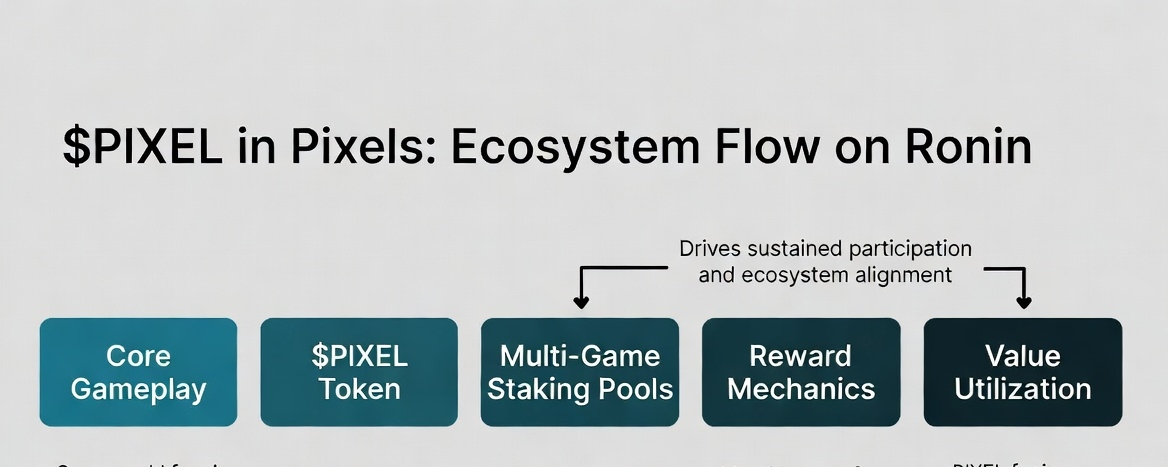
How Staking and vPIXEL Are quietly Strengthening Pixels on Ronin
A Thoughtful Look at $PIXEL Utility in 2026
Why the Pixels Ecosystem Feels More Connected Than Ever
I’ve been playing Pixels since its early days on Ronin, and lately I’ve found myself thinking a lot about how the Pixel token has matured beyond simple rewards or marketplace flips. What started as a charming pixel-art farming world has quietly grown into something more intentional—an ecosystem where the token itself helps decide which experiences thrive. It feels less like a traditional game economy and more like a shared garden where players, through staking and spending choices, help shape what gets watered next. That shift is what keeps drawing me back.
The core of it all is the multi-game staking system. You allocate your $PIXEL across participating titles—Core Pixels for the main farming loop, Pixel Dungeons for adventure, Sleepagotchi for lighter daily engagement, and newer additions like Stacked. Instead of one big pot, rewards flow based on how well each game performs in player activity and community support. It turns every staker into a quiet backer of the projects they believe in most. On top of that, the team introduced vPIXEL, a 1:1 backed spend-only token that lets you pull out your earned rewards and use them directly in-game for upgrades, pets, or progression without triggering any fees. Direct $PIXEL withdrawals still carry a Farmer Fee (usually between 20 and 50 percent, depending on your activity level), which then gets redistributed to all stakers—another clever loop that rewards those who stay committed.
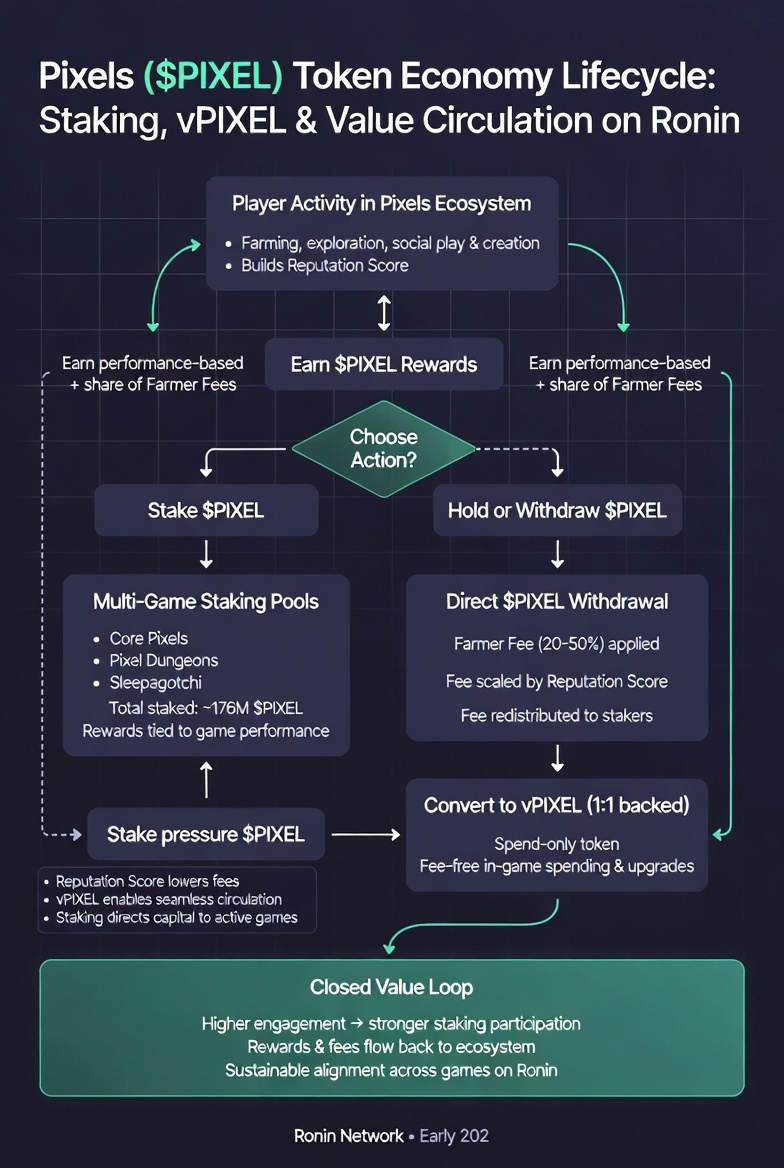
One thing I’ve noticed is how the total amount of Pixel staked across all pools has climbed past 170 million tokens in recent months, a clear step up from earlier figures after the system launched. That growth matters because it shows real player capital is staying locked in rather than circulating freely, directly tying token holders to the health of the entire platform. It could point to even stronger participation ahead as more titles join and the reward distribution becomes more performance-driven.
At the same time, the monthly reward pool has stayed capped at 28 million Pixel with no upward adjustments despite ongoing Chapter updates. Holding that line keeps the economics predictable and prevents sudden dilution, which feels like a deliberate choice to build trust over time. To me, it suggests the protocol is prioritizing sustainability, potentially encouraging stakers to focus on long-term support for underperforming games that might bounce back with more community backing.
The expansion to dedicated pools for multiple games—now at least four active ones with their own performance metrics—has also stood out. This wasn’t the case at the very beginning; the system has broadened steadily, spreading $PIXEL’s utility wider while still linking every token to actual gameplay success. It matters because it reduces reliance on any single experience and creates a natural marketplace of ideas inside the ecosystem. Looking forward, it could accelerate growth as successful games attract a bigger share of stakes in each cycle, pulling in new players and creators along the way.
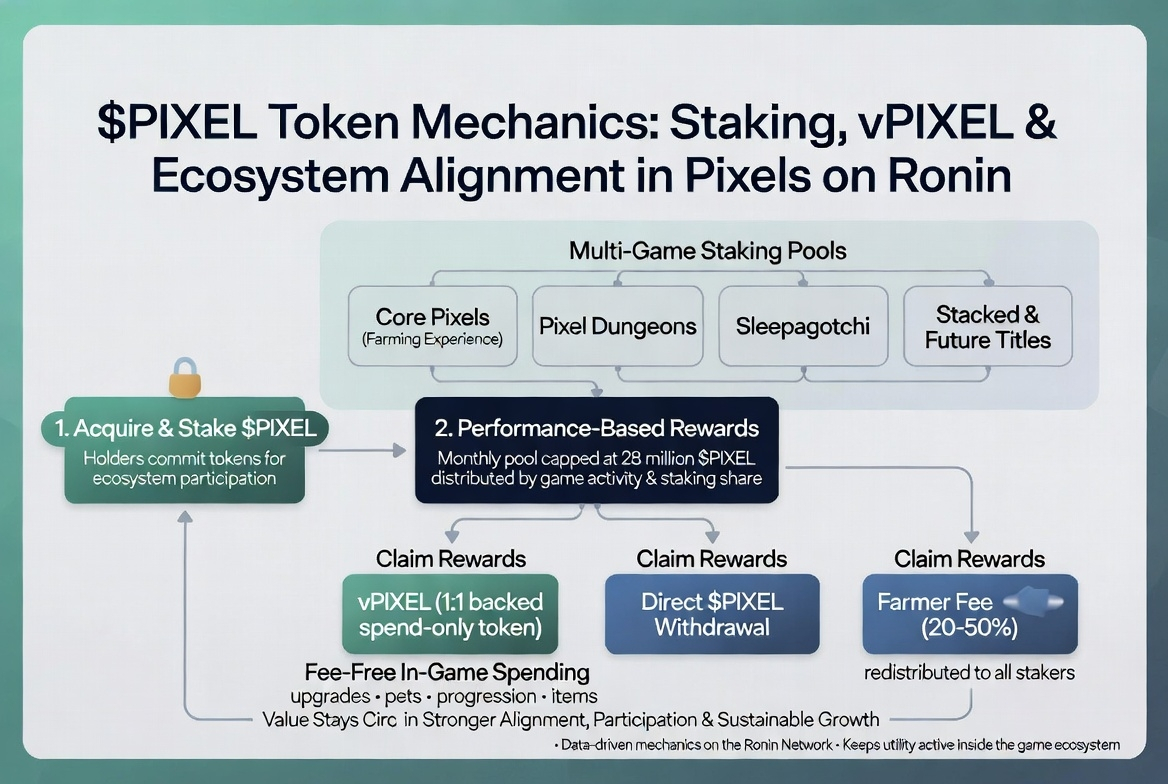
Then there’s the practical side of vPIXEL, which has become a seamless part of the reward flow since its rollout. By letting stakers spend without the Farmer Fee penalty, it keeps more value circulating inside the games instead of pressuring immediate sales. This matters for everyday players who just want to enhance their farms or try new features without friction. It could imply higher overall token velocity within the ecosystem, where earned rewards stay useful rather than sitting idle.
Finally, the broader usage picture still impresses me: the player base has surpassed 10 million lifetime accounts, and Pixels continues to drive meaningful daily activity on Ronin, with engagement holding steady even as the game evolves through Chapter 3 and beyond. That foundation gives the Pixel token a large, active audience to draw from for staking and in-game spending. It matters because utility needs real users, not just holders. It suggests these mechanics are gradually converting casual visitors into more invested participants over time.
My main takeaway after following all this is that Pixel is becoming the quiet connective tissue for a decentralized publishing model on Ronin—where staking isn’t just about yields but about voting with your tokens on which games deserve to grow. The logic feels sound: lock in commitment, reduce unnecessary selling through vPIXEL, and let performance data guide resource allocation. Sure, raw user numbers have seen natural ups and downs from earlier peaks, yet the quality of engagement through staking appears more focused now. And while capped rewards provide stability, their effectiveness still depends on overall activity levels, which can shift with bigger market moods. Even so, the design keeps the focus on practical use rather than speculation.
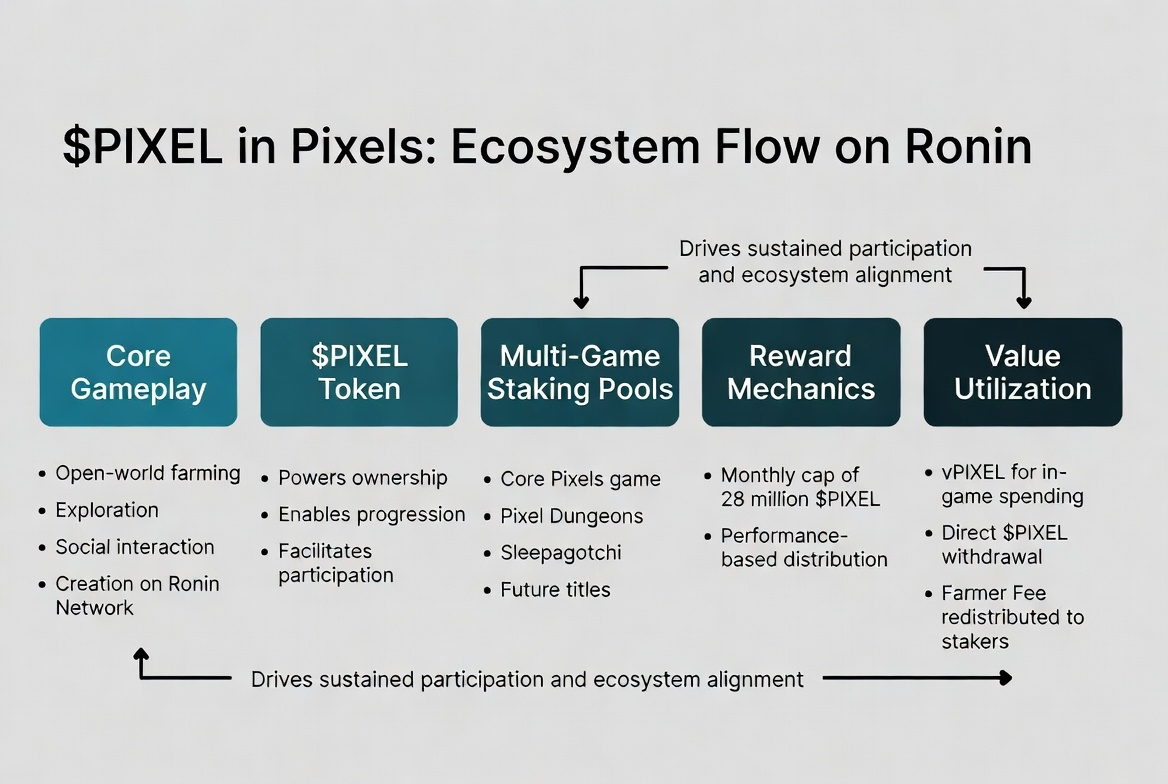
In the end, $PIXEL’s recent behavior shows a thoughtful evolution toward deeper ecosystem alignment. With staking, vPIXEL, and multi-game support working together, the token feels more integrated into daily play than ever. As new updates roll out and additional titles join, it’ll be interesting to see how these pieces scale while keeping the original fun, social farming spirit intact. For now, it leaves me optimistic about where the project is headed—one thoughtful layer at a time.
