Honestly... I didn't expect to feel this specific kind of attention reading through what early Pixels participants actually accumulated and how the systems they built compound differently from anything available to players entering the ecosystem today.
Not nostalgia. not unfairness. something closer to the feeling you get when you realize that a network being described as open has structural layers where early positioning created advantages that are now baked into the architecture rather than the rules.
because there's a pattern in how Web3 gaming ecosystems describe their economies that this space accepts without examining what early participation actually means at the structural level. the pitch describes an open world. anyone can join, anyone can farm, anyone can earn. the economy is accessible and the opportunity is present for every participant regardless of when they arrived.
but early participation in Pixels is not the same as early participation in a game with no persistent economic layer. the decisions made by the first wave of players did not just give them a head start in a race where everyone runs the same track. they shaped the track itself in ways that are now permanent features of the ecosystem every subsequent player navigates.
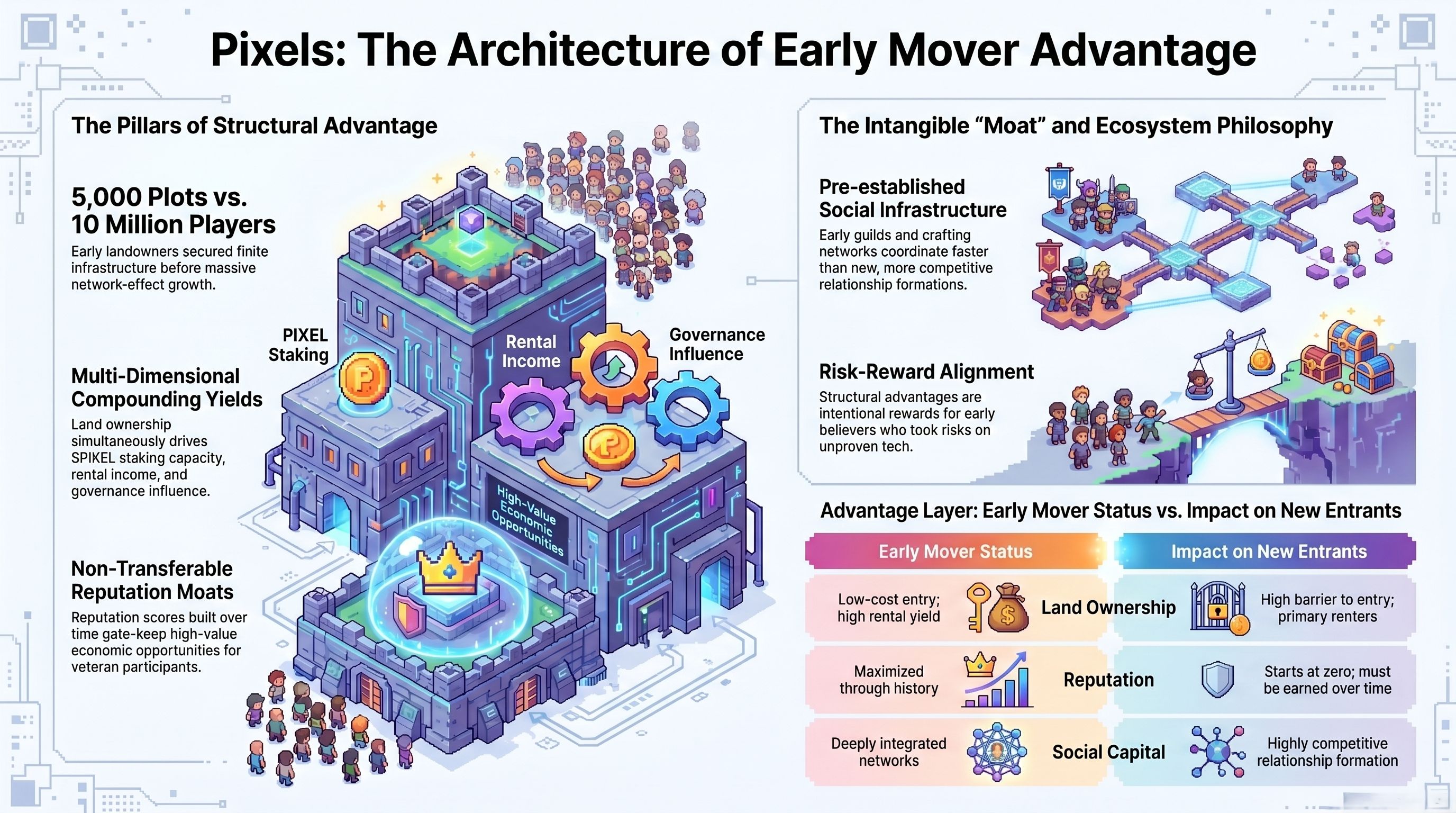
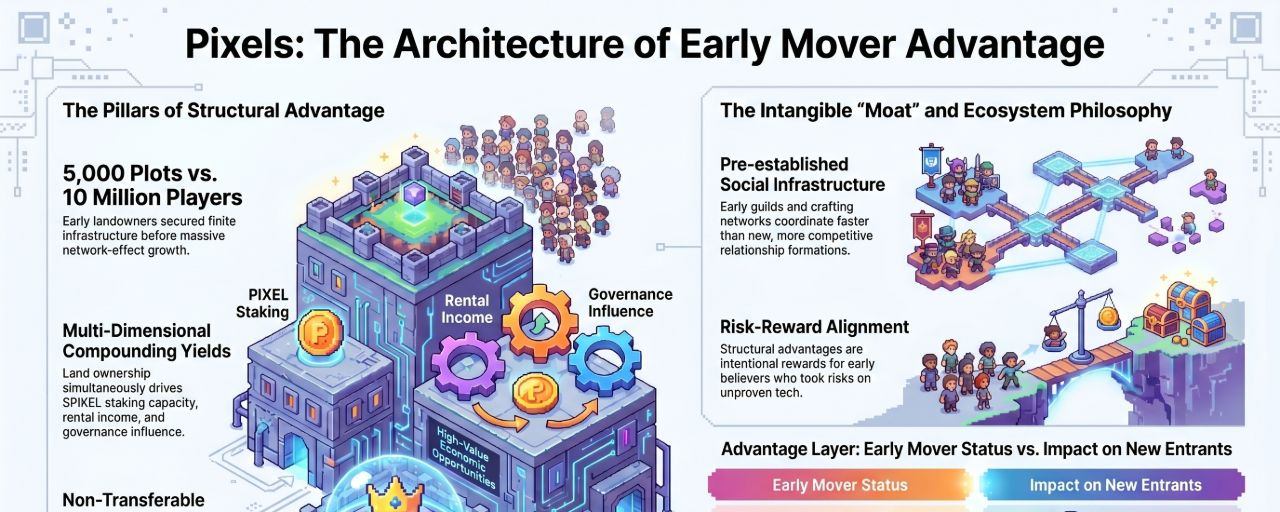
because what the early movers built is real and verifiable. players who acquired land during the initial distribution secured one of only 5,000 NFT plots at prices that reflect a pre-network-effect valuation. those plots are now productive infrastructure in an ecosystem with over 10 million registered players. the land did not change. the demand environment around it did. and the early landowner is now sitting at the center of a crafting economy, rental market, and staking system that did not exist when they made their original acquisition decision.
so yeah... the early positioning is real.
but early positioning has never been the hard part of understanding a player economy.
the hard part is identifying which early advantages compound and which ones decay. and this is where the structural analysis gets genuinely interesting.
because here's what I keep coming back to. land acquired early compounds across multiple dimensions simultaneously. the productive yield it generates feeds directly into PIXEL staking capacity, which determines what share of the monthly 28 million PIXEL reward pool reaches the landowner's wallet. the rental income it generates creates a recurring yield stream that appreciates as player demand for farmable land increases with the expanding player base. the governance influence it enables will compound further when the community treasury becomes active and decisions about ecosystem resources reflect the positions of the most established participants.
each layer of the Pixels economy that launched after the initial land distribution created a new return stream for the players who were already positioned. staking launched and early landowners had the most PIXEL to stake. rental markets deepened and early landowners had the most desirable inventory. guild systems launched and early landowners had the Trust Score history and ecosystem relationships to lead rather than join.
the system did not give early players an explicit advantage in any of these new features. it gave everyone equal access to the features. but equal access to a new feature produces unequal outcomes when the players accessing it arrive with different levels of accumulated position.
then comes the reputation question. because of course.
and here's where it gets genuinely layered. Pixels uses a Reputation Score system derived from data points weighted by the significance of each action. land ownership is one of the inputs that raises Reputation, which in turn gates access to economic opportunities within the ecosystem. a player who has held land since the early days has been accumulating Reputation signals continuously. a player joining today starts building that history from zero.
Reputation is not transferable. it cannot be purchased directly. it is a record of consistent participation across time. and consistent participation across time is, by definition, something that only early participants have fully maximized.
there's also a dimension nobody talks about enough.
the social layer of early participation created relationship networks between players that now function as informal coordination infrastructure. the guilds with the deepest organizational capacity, the rental relationships with the most established trust, the crafting networks with the most reliable supply chains, were all built by players who had time to develop them before the ecosystem became crowded enough to make new relationship formation more competitive. those networks are not on-chain assets. they do not appear in any wallet. but they are real productive advantages that compound every time a new economic feature launches and established players coordinate faster than new ones.
still... I'll say this.
the decision to build an economy where early participation creates lasting structural advantages is not a design flaw. it is the mechanism through which a decentralized economy creates genuine incentives for early adoption. a system that fully resets the playing field with each new feature has no reason to reward early believers. Pixels built something where the players who took the earliest risk on an unproven ecosystem accumulated the most durable position. that alignment between risk and reward is what makes the ecosystem's history meaningful rather than arbitrary.
the question is not whether early movers in Pixels have structural advantages. they clearly do. the question is what the most productive entry points look like for players arriving today, and which current decisions create the kind of compounding position in 2026 that land ownership created in 2023.
and in this space, that question is worth answering before assuming the window for meaningful participation has already closed.
@Pixels $PIXEL #pixel $CHIP $SPK