
I’ve been looking at Pixels (PIXEL) the way I usually look at new Web3 games—with curiosity, but also a bit of distance. I’ve seen enough of these cycles to know that excitement shows up early, while clarity takes time. Right now, PIXEL feels like it’s still somewhere in between those two.
The price has been moving, the volume comes and goes, and the circulating supply is still adjusting as more tokens enter the market. It’s active, but not exactly settled. That kind of movement doesn’t surprise me anymore—it’s what happens when a project is still being “figured out” by the market. People are trading the idea as much as the reality.
But what keeps me watching isn’t the chart—it’s the idea underneath it.
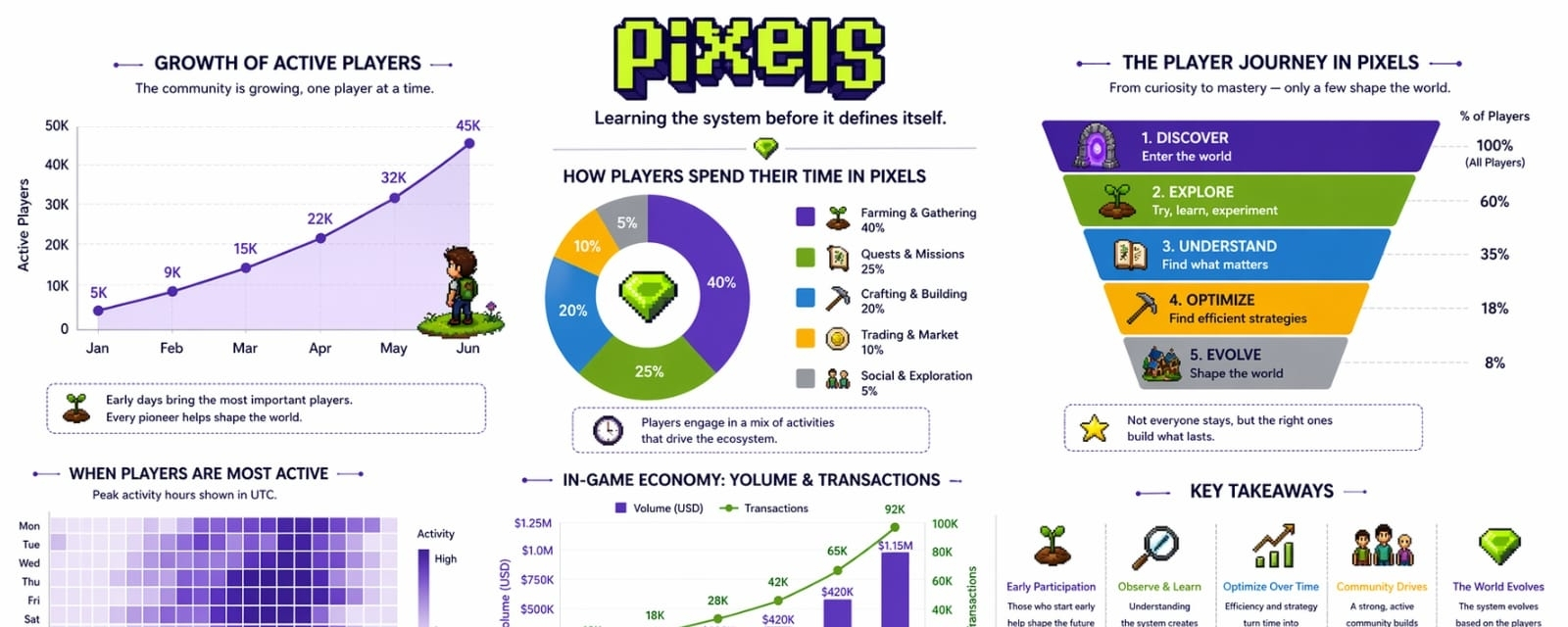
Pixels is built around something very simple: farming, exploring, creating. At first glance, it almost feels too basic. But sometimes simple systems are the ones that have the best chance of working, because people actually stick with them. The real question isn’t how complex the game is—it’s whether it can quietly turn player actions into something that resembles a functioning economy.
And that’s where things get interesting.
In the real world, economies work because people consistently do things that matter—produce, trade, depend on each other. Pixels is trying to recreate a version of that inside a game. Players grow resources, interact with others, and shape a shared environment. If it works, value should come from those interactions—not just from the token itself.
The problem is, that’s easier said than done.
Most Web3 games manage to create activity, but not all activity is meaningful. If players are only showing up because rewards are attractive, the system can feel alive… until those rewards change. Then everything slows down. I’ve seen that happen more than once.
So with PIXEL, I’m paying attention to a simple question: are people playing because they want to, or because they’re being paid to?
It’s a small difference on the surface, but it changes everything over time.
Another thing I keep in mind is that not all on-chain activity means progress. You can have thousands of transactions, plenty of wallets, and still not have a system that holds real value. What matters is whether the actions inside the game lead to something scarce, something useful, something that can’t just be farmed endlessly without consequence.
Right now, it’s still early to tell.
From a market point of view, PIXEL feels like it’s moving more on attention than on proof. That’s normal at this stage. The connection to the Ronin ecosystem gives it visibility, and the game itself is easy to jump into, which helps bring people in. But easy entry also means people can leave just as quickly. That’s something the market tends to forget in the beginning.
There are a few things that make me cautious. Incentives could end up favoring early players too much. Activity might look stronger than it really is if it’s driven by rewards. And like most early systems, there’s always the question of whether it can adapt once real user behavior starts to shape it.
Still, I wouldn’t dismiss it either.
There’s something quietly interesting about a project that doesn’t try to overcomplicate itself. Pixels is building around familiar behavior—people logging in, doing small tasks, interacting with others—and trying to turn that into something bigger. If that loop becomes natural instead of forced, it could matter more than any short-term hype.
For now, I’m just watching.
Not the price spikes, not the sudden bursts of volume—but the slower signals. Are players coming back without needing constant incentives? Is the in-game economy starting to feel balanced? Are people actually using the system, not just extracting from it?
Because in the end, the projects that last don’t usually prove themselves in the beginning. They prove themselves quietly, over time, through consistent activity that doesn’t disappear when the spotlight fades.
That’s the part of PIXEL I’m waiting to see.