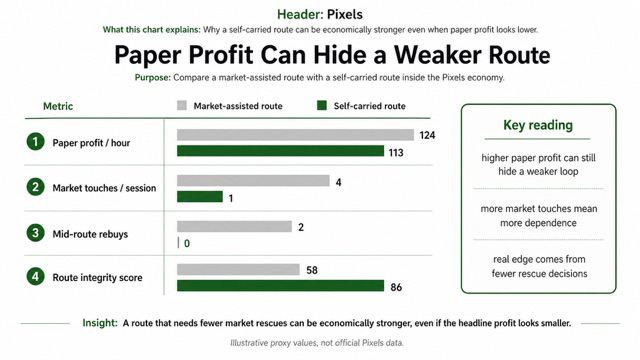
Pixels, and the Route Whose Real Edge Was Not Profit, It Was Not Having to Touch the Market
At minute 23, I paused a route I had been calling “clean” just to buy back 6 cheap inputs from the Marketplace.
That was the annoying part.
Not because the input was expensive. It was not. Not because the session was ruined. It was still fine. But the moment I had to stop and patch the route from outside, the whole thing started feeling less clean than the number on the sheet.
I was still farming. The bag was still moving. The route could still end in profit.
But it no longer felt like the route was carrying itself.
It felt like I had quietly asked the Marketplace to save it.
A route I was calling clean should not need to walk back to the market for spare parts halfway through.
That is a small difference in Pixels, but once I noticed it, I could not unsee it.
Most route talk still sounds too neat. People ask which loop pays more, which item sells faster, which path gives better coin per hour. I get why. Those are the easy numbers to compare. But after enough sessions, I started trusting a rougher question more.
How many times did this route need help before it reached the end?
Because in Pixels, some routes do not really beat the market. They just survive by asking the market to forgive them more often.
That was the part that made me trust the route less.
A route can look strong on paper and still be weak in the hand. It can show a nice margin, a good output, even a clean final sell. But if it needed a rebuy in the middle, or an early sell to clear space, or one lucky first listing line to stay intact, then I do not read it the same way anymore.
That is not just profit.
That is profit with a little apology hidden inside it.
And Pixels makes that apology easy to miss because the Marketplace is always close. One tap, one quick buy, one small correction, and the loop keeps going. Nothing dramatic happens. No big failure. No obvious mistake. Just a route that looked smooth because the market kept letting it stay smooth.
That is the kind of weakness I trust less now.
I used to think a good route was mostly about output. Farm cleanly, move fast, sell well, repeat.
That night it was only 6 Cotton before the next craft step, a stupidly small gap, but still enough to drag me back into the Marketplace.
The cheapest listing had already moved from 7 to 9 coin while I was still pretending this was just a clean route.
But Pixels kept giving me hours where the final result looked fine while the middle felt messy. A cheap input missing here. A bad sell line there. A stack I had to unload too early because the next step needed room. None of it looked serious alone, but together it changed how the hour felt.
The route was not failing.
The number was fine, but the control was leaking.
Every time a route has to touch the Marketplace before it is ready, it gives away a little control. Maybe the price is still okay. Maybe the input is still available. Maybe the sell line has not moved yet. But now the route depends on that kindness. And once a route depends on kindness, I stop calling it strong so quickly.
I have started keeping a few ugly rules in my head.
If a route needs a rebuy in the middle, I downgrade it.
If one weak sell line can bend the whole hour, the edge was never that real.
If I have to sell early just to keep the loop alive, the route is already paying a hidden cost.
If the loop only works while the Marketplace stays kind, that is not route strength. That is market cooperation.
They are not pretty rules, but they feel closer to the way Pixels actually plays.
Because the best route is not always the one with the loudest number at the end. Sometimes the better route is quieter. It does not make you stop. It does not make you rebuy. It does not make you fix a mistake with a rushed listing. It may pay a little less, but it leaves you with fewer regrets inside the hour.
That kind of route is easy to underrate.
It does not give you the best screenshot. It does not always win the simple profit comparison. But it keeps its shape. You start, you move, you finish, and the Marketplace only gets to judge you at the end instead of interrupting you every few steps.
That matters more than I thought.
And this gets worse when more players start copying the same quiet little loops. More players copy routes faster. More people optimize the same paths. More small price gaps get noticed and eaten. In that kind of game, a route that needs the market too often becomes more fragile, not less. The better everyone gets, the less forgiving those small weak points become.
That is why I care about this distinction for Pixels. Not because profit does not matter. Of course it does. But profit that only survives because the Marketplace keeps helping at the right moments is not the same as profit that comes from a route holding itself together.
One feels earned.
The other feels patched.
And patched profit is the kind that can fool you for a while.
This is where I start caring about $PIXEL beyond the usual token talk. Not because every tiny market touch needs to become a grand thesis, but because Pixels only gets interesting when its economy is real enough for small leaks to matter. If more players keep copying the same loops, I do not think the prettiest route will stay pretty for long. I want to know if the route still works when the first cheap listing is gone.
So now when a route looks good, I do not only ask what it paid.
I ask what it needed.
Did it need a rebuy. Did it need an early sell. Did it need one lucky input price. Did it need me to stop halfway and rescue it with a market decision I had not planned to make.
Because if a route only looks strong while the Marketplace keeps stepping in to save it, then maybe the edge was never in the route at all.
It was not a strong route. It was a weak route with good timing.