
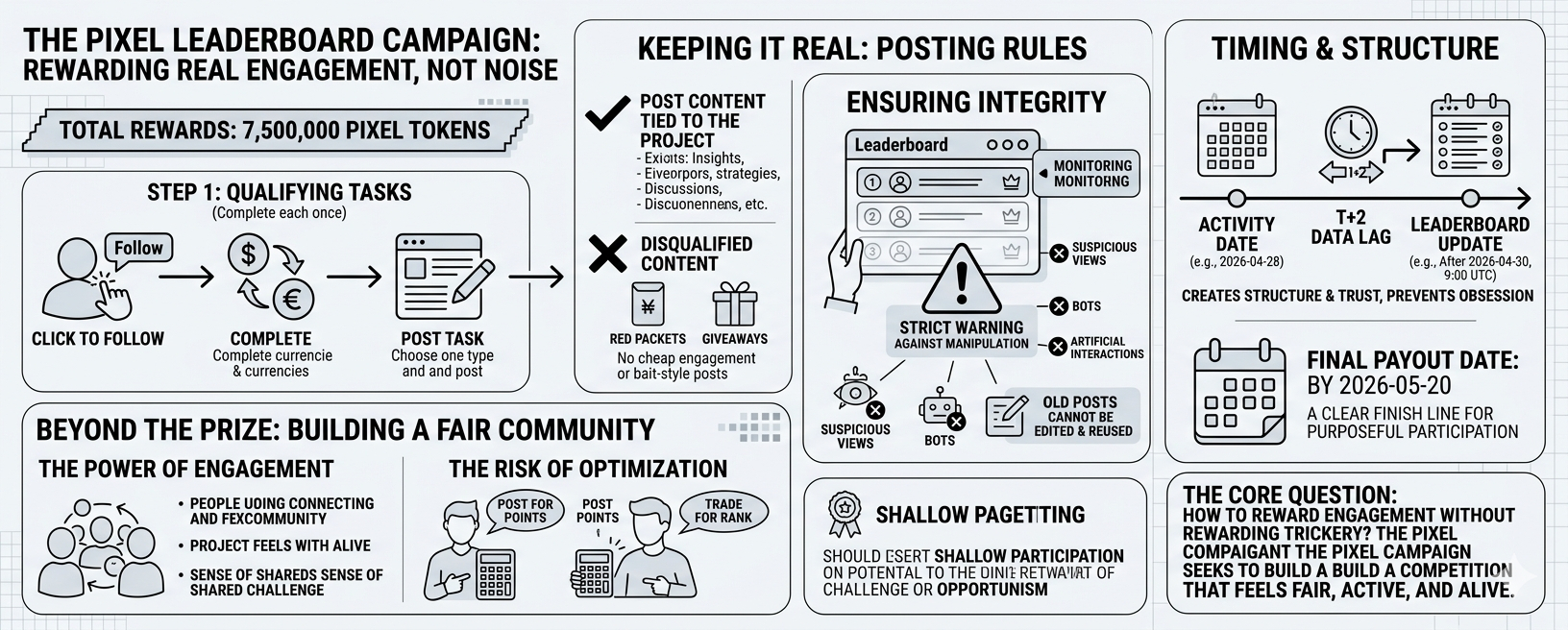
The PIXEL leaderboard campaign feels like one of those rare crypto events that is trying to do more than just hand out rewards. On the surface, it is simple enough: follow, post, and trade to compete for a share of 7,500,000 PIXEL token rewards. But underneath that, it is really about who shows up, who participates in a real way, and who can stay active without turning the whole thing into noise.
That is why the rules matter so much. To qualify for the leaderboard and the reward, participants have to complete each task type at least once during the event. For the posting part, they need to choose one post task and complete it at least once. It sounds basic, but it gives the campaign its shape. The idea is not to reward people who just hover around the edges. It is for people who actually take part. In a space where attention can be faked so easily, that matters.
The campaign also draws a line around what does not count. Posts involving Red Packets or giveaways will not be eligible. That tells you a lot about the spirit of the event. It is not looking for cheap engagement or bait-style posts that chase clicks without adding anything real. It wants content that feels tied to the project, not just something designed to pull in empty reactions. That makes the whole thing feel a little more grounded, a little more serious.
There is also a strong warning against manipulation. Anyone caught using suspicious views, suspicious interactions, or bots can be disqualified. That is the kind of rule that sounds strict until you think about how these campaigns usually work. The second a leaderboard exists, some people try to game it. The second rewards are visible, some people start looking for shortcuts. So the campaign is trying to protect itself from fake activity and keep the rankings meaningful. Without that, a leaderboard turns into decoration. With it, it has a chance to actually mean something.
Another important detail is that old posts with high engagement cannot be edited and reused as project submissions. That is a smart rule, because it stops people from recycling past success and pretending it is fresh participation. Social platforms make this kind of thing easy. A post that already performed well can be reworked and pushed again with very little effort. But this campaign is clearly saying that genuine effort has to happen inside the event, not borrowed from something that already happened before it.
Then there is the timing, which makes the whole thing feel a bit more real. The leaderboard does not update instantly. It uses a T+2 delay, which means data appears two days later. So if the activity is from 2026-04-28, it will only show on the leaderboard after 2026-04-30 at 9:00 UTC. That delay changes the mood of the competition. It slows things down just enough to create suspense. People cannot obsess over every single action in real time. They have to wait, track, and trust the system. In a world built on instant feedback, that kind of delay feels almost old-fashioned, but in a good way. It gives the campaign a sense of structure.
The final payout date also gives the event a clear endpoint. The token voucher rewards will be distributed by 2026-05-20. That matters because campaigns like this need a finish line. Without one, they start to feel endless. With one, people can actually picture the arc of the event. They can see where it begins, how it progresses, and when the rewards are supposed to land. That makes participation feel less random and more purposeful.
What makes this kind of campaign interesting is that it sits right in the middle of marketing, community building, and competition. It is not just saying, “Come and be around.” It is saying, “Come, do the work, and prove that you were here.” That has a different energy. It feels less like a giveaway and more like a shared challenge. And for some people, that is exactly what makes it engaging.
There is a social side to that too. Campaigns like this can pull in people who might never have paid attention otherwise. A user may join for the reward, then end up sticking around because the project feels alive. A leaderboard can create a sense of movement, almost like everyone is part of the same race. That can be powerful. It gives people a reason to care, a reason to keep checking in, and a reason to act.
But there is always another side to it. Whenever rewards are involved, people start optimizing. They post for points, trade for rank, and interact for eligibility. That can easily turn into shallow participation if the campaign is not carefully designed. Worse, it can attract people who only care about extracting value and not about the project itself. That is the tension in almost every reward system. It can build community, but it can also invite opportunism.
That is why this campaign’s rules feel so important. They are not just technical details. They are what keep the event from falling apart. The ban on giveaway posts, the bot warning, the rule against repurposed content, and the delayed leaderboard all point to the same goal: making sure the competition stays fair and the reward stays meaningful.
In the bigger picture, this campaign says something about where online communities are heading. Participation is no longer just casual. It is being tracked, ranked, and rewarded. A post is not just a post anymore. A trade is not just a trade. Everything becomes part of a larger system of proof, visibility, and value. That can be exciting because it gives people a way to earn recognition for real activity. But it also raises a question that keeps getting more important: how do you reward engagement without rewarding trickery?
That question sits at the heart of the PIXEL campaign. The reward pool is large, but the real challenge is trust. The event only works if people believe the leaderboard is honest, the rules are enforced, and the outcome reflects actual participation. That is what gives the whole thing weight.
So in the end, this is not just about chasing a prize. It is about a project trying to build a competition that feels fair, active, and alive. The tokens are the incentive, but the bigger story is about behavior, credibility, and the kind of community a project wants to build around itself.
