
Sometimes the social side of a game is not the loudest part.
It is not always the chat. It is not always the big event. It is not always a group of players standing in the same place trying to be noticed. A lot of the time, community in a game shows up in quieter ways. It shows up in habits, small systems, repeated actions, and the little reasons people keep connecting their own progress to other people.
That is what I was thinking about when I noticed the recent Guild Code kickback change in Pixels.
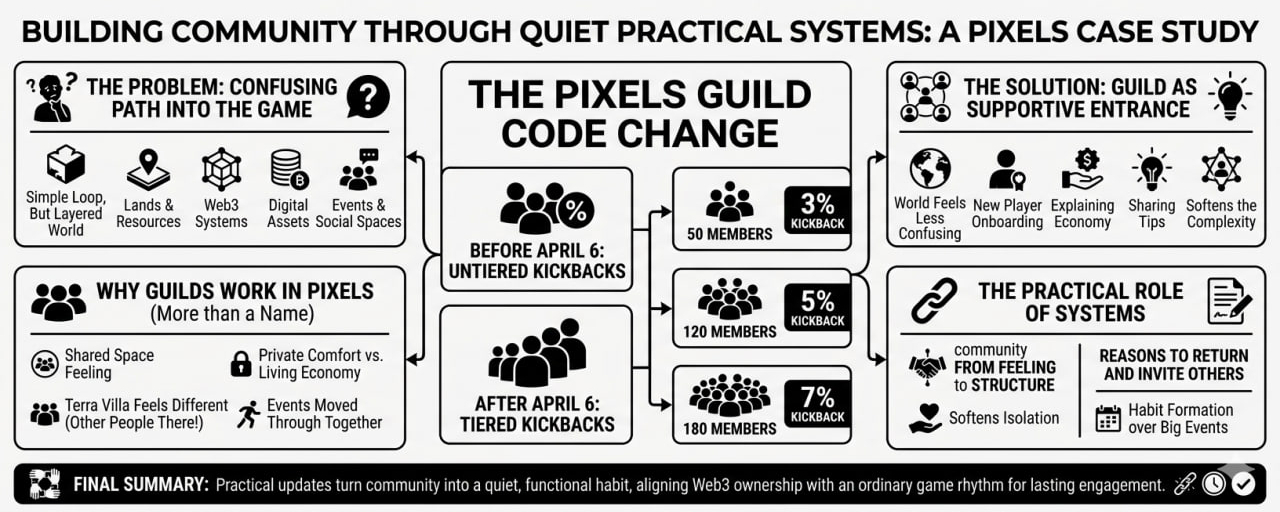
In the April 2 Rift of the Rabbits post, The Pixels Post also included a smaller update: starting April 6, Guild Code kickbacks became tiered by member count, with 50 members giving a 3% kickback, 120 members giving 5%, and 180 members giving 7%.
That is not the kind of update that instantly sounds dramatic.
But I think it says something about how Pixels understands its own community.
Pixels is a social casual Web3 game powered by the Ronin Network. It has farming, exploration, creation, crafting, and open-world play at the center of it. The official Pixels site frames it as a world where players can build, play with friends, manage crops, and create around digital collectibles.
On the surface, it can look like a farming game first. You move through the world. You gather materials. You follow tasks. You plant, harvest, craft, and return. But after a while, the social layer becomes harder to ignore. It is not always loud, but it is there. Players bring each other into routines. They share spaces. They talk about updates. They compare what works. They slowly form small circles around the game.
That is why the Guild Code change caught my attention.
A kickback system is not romantic. It is practical. It gives groups a reason to grow, organize, and stay active. It turns community from only a feeling into something with a structure around it. I do not mean that in a cold way. I actually think practical systems matter a lot in online games, because feelings alone do not always keep communities alive.
People need reasons to return.
They also need reasons to bring others with them.
In Pixels, a guild is not just a name floating above a group. It can become part of how players enter the game, how they learn, and how they understand what is worth doing. A new player may not understand the whole economy. They may not know which tasks matter, where to go, or why certain resources are important. But if they enter through a group, the world can feel less confusing.
That is where small community systems become useful.
They do not replace the game. They support the path into it.
I think this matters especially for a game like Pixels because the daily loop is simple but layered. Farming itself is easy to understand. Exploration is easy to understand. Crafting makes sense once you start doing it. But the whole world has more going on than a new player may expect. There are lands, resources, tasks, events, social spaces, digital assets, and Web3 systems underneath.
A group can soften that.
Someone explains where to start. Someone shares a tip. Someone points out an event. Someone reminds others to complete a task. It does not have to feel formal. It can be as simple as players helping each other understand the rhythm of the game.
What I notice is that Pixels often becomes more interesting when players are not isolated.
A farming game can work alone. Many do. There is comfort in private progress. But Pixels has always leaned into the feeling of shared space. Terra Villa feels different because other people are there. Events feel different because players move through them together. Land and resources feel different because they sit inside a living economy, not just a private save file.
Guilds fit into that same idea.
They give the social side a shape.
The tiered kickback update also makes me think about scale. A small group can still matter, but the system now gives larger groups a clearer benefit. That can encourage communities to grow beyond a few friends. It may push guilds to become more organized. It may also create pressure, and that is worth saying honestly. Any system tied to size can make smaller groups feel less powerful, or make some players focus too much on numbers.
That is the balanced part for me.
Not every community system is automatically good just because it rewards activity. The real value depends on how players use it. If guilds become only about chasing the highest tier, the feeling can become thin. But if the system helps active communities support players and stay connected, then it can add something real to the game.
That is usually the line Pixels has to walk.
The Web3 layer makes this more interesting, but also more delicate. In Web3 games, community often gets talked about in big terms. People say “ecosystem” and “ownership” and “incentives” until the words start feeling empty. But inside a game, community is much more ordinary. It is whether someone helps you understand a task. Whether people return tomorrow. Whether a group gives you a reason to stay when the game still feels new.
Pixels works better when the Web3 side stays close to that ordinary feeling.
Ownership can matter. Digital identity can matter. Assets and land can matter. Ronin can matter in the background. The Ronin marketplace describes Pixels as an open-ended world of farming and exploration where players gather resources, advance skills, build relationships, and connect blockchain ownership with progression.
The part I keep noticing there is “build relationships.”
That is not just decoration.
A game like Pixels needs those relationships because the core loop is built from small actions. Planting crops is simple. Completing tasks is simple. Gathering resources is simple. But those actions become stronger when they happen around other people, inside a world that keeps changing slowly.
Guild Codes and kickbacks are one small piece of that.
They are not the whole game. They are not the most emotional part. They may not even be something every player thinks about. But they show how Pixels can turn community into a practical habit. A reason to invite. A reason to organize. A reason to stay connected beyond one login.
I do not think this needs to be exaggerated.
It is just worth noticing.
Pixels is still evolving, and not every system will land perfectly for every player. Some people may prefer to play alone. Some may not care about guilds. Some may join a group only for the benefits and never feel attached to it. That is normal. Casual games always have different kinds of players moving through them.
But I think the Guild Code change points to something important about the game’s direction.
Pixels is not only trying to keep players busy. It is trying to give them reasons to gather around the same world. Sometimes that happens through events. Sometimes through farming routines. Sometimes through land, resources, or crafting. And sometimes through a small percentage change that quietly asks communities to become a little more active.
That is the kind of update I find easy to overlook at first.
But the more I think about it, the more it feels like part of the game’s slower rhythm.
Pixels keeps building small reasons for people to return together.
Still noticing the quiet group habits forming around
$PIXEL #pixel @Pixels