
I’ve been watching Pixels (PIXEL) for a while now, not with excitement, but with curiosity. New Web3 games tend to move fast—price jumps, volume spikes, people rushing in—but I’ve learned that early momentum doesn’t always mean something real is forming underneath. Right now, PIXEL sits in that typical range where its market cap and circulating supply are big enough to attract attention, but still small enough for narratives to push it around quickly. You can feel that in the trading—active, reactive, sometimes more emotional than rational.
But what actually keeps me looking at Pixels isn’t the price. It’s the idea behind it.
At its core, Pixels is trying to make something simple work in a blockchain environment: a game where people farm, explore, and trade—and those actions actually matter beyond just gameplay. Built on the Ronin Network, it removes a lot of the friction older blockchain games had. It feels lighter, easier, more natural. And that matters, because if a system feels forced, people don’t stay.
The interesting part is how it tries to turn everyday in-game actions into something more meaningful. Planting crops, collecting resources, trading items—these aren’t new ideas. But Pixels is attempting to give those actions a kind of permanence, where they become part of a shared economy that others can interact with. In a way, it’s similar to a small real-world market. People produce, people trade, and value comes from participation—not just from speculation.
At least, that’s the idea.
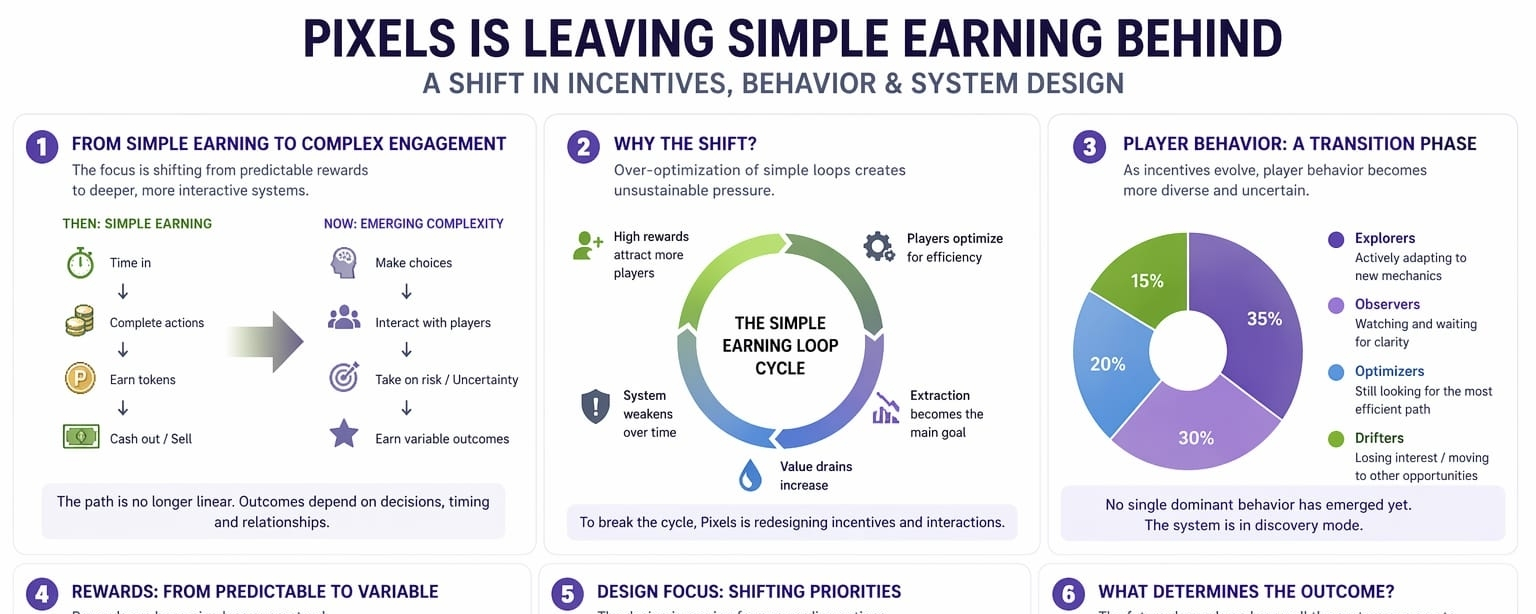
Where I slow down is when I ask: is the activity real, or is it just incentivized?
Crypto has a habit of creating systems where everything looks busy—lots of users, lots of transactions—but much of it is driven by rewards rather than genuine interest. If players are only there because they’re earning tokens, then the system can feel alive without actually being sustainable. And once those incentives slow down, so does everything else.
When I look at PIXEL’s price movement, I get the sense that the market is already trying to price in success. That’s normal. It happens with almost every new project that gains attention. But the actual proof—real players staying, real demand forming—that takes time. And usually, it takes longer than the market expects.
I also think about how value flows inside the game. Are players trading because they need items to progress, or because they expect those items to go up in value? If it’s the second, then the system leans more toward speculation than utility. And speculation can drive growth, but it rarely sustains it on its own.
Even the numbers we see—user activity, transactions—don’t always tell the full story. Early on, metrics can look strong because incentives are strong. What matters more is what happens later, when things calm down. Do people still log in? Do they still trade? Does the economy keep moving without being pushed?
That’s the part I’m paying attention to.
To be clear, Pixels isn’t doing anything wrong by growing this way. It actually feels more thoughtful than many earlier Web3 games that focused too heavily on rewards. This feels more like an attempt to build something people might actually enjoy first, and monetize second. But whether that balance holds is still an open question.
So for now, I’m just observing.
I’m watching how players behave over time. I’m watching whether the economy starts to feel natural instead of forced. I’m watching if activity stays consistent when the hype fades a bit.
Because in the end, the projects that last aren’t the ones that make the most noise at the start. They’re the ones that quietly prove themselves—through real usage, steady participation, and a system that keeps working even when no one is talking about it.
That’s what I’m waiting to see from Pixels.