
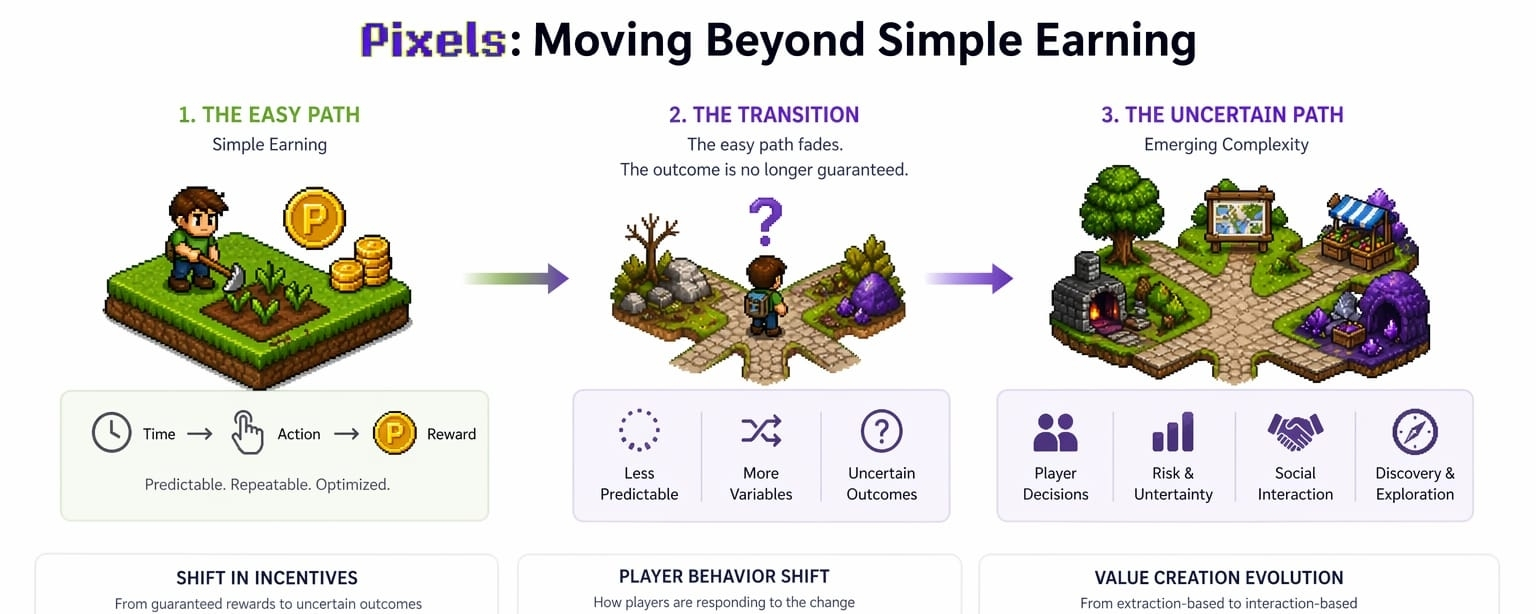
I’ve been watching Pixels (PIXEL) for a while now, not with hype, but with that quiet curiosity you get when something might turn into something real. I’ve seen enough Web3 games come and go to know that early excitement doesn’t mean much. What matters is what people are still doing when the noise fades.
Right now, PIXEL feels like it’s in that in-between phase. The token moves, volume comes and goes, and the market cap sits in that familiar early range where interest is clearly there—but conviction isn’t fully built yet. You can feel that it’s being watched, traded, rotated. But whether it’s truly being used… that’s still unfolding.
What pulls me in isn’t the price though. It’s the idea underneath.
Pixels isn’t trying to reinvent gaming with something overly complex. It’s doing something simpler—almost intentionally so. Farming, exploring, building, trading. Things people already understand. And maybe that’s the point. Instead of forcing users to learn a new system, it tries to plug ownership into behavior that already feels natural.
That’s where things either click… or fall apart.
Because in Web3, the hardest part isn’t getting users—it’s keeping them for the right reasons. If people are there just because rewards look good, they’ll leave the moment those rewards fade. We’ve seen that cycle before. Fast growth, fast decline. Activity that looks strong on the surface but doesn’t really mean anything underneath.
So the real question I keep asking is simple:
Are people playing Pixels because they want to… or because they feel like they should?
It sounds small, but it changes everything.
If someone logs in to check crops, trade items, or interact with others because they enjoy it, that creates a different kind of economy. It becomes slower, more organic, more real. But if every action is tied to maximizing returns, then the system starts to feel less like a world—and more like a strategy.
And strategies don’t build communities. They build exits.
To be fair, Pixels does a few things right. Running on Ronin makes it smoother, cheaper, easier to interact with. That removes a lot of the friction that used to kill these kinds of games early. But smooth infrastructure doesn’t guarantee meaningful activity. It just gives it a chance to exist.
What I’m really watching are the small behaviors.
Are players sticking around even when there’s no obvious reward spike?
Are items being traded because they’re useful, not just rare?
Are people building something over time, or just cycling through quick gains?
These things don’t show up in price charts, but they show up in patterns. And patterns tell you whether something is alive—or just moving.
There’s also a quiet risk here that doesn’t get talked about much. Sometimes, tokens grow faster than the worlds they represent. Price moves ahead, expectations build, and suddenly the system has to live up to something it hasn’t fully become yet. That gap can be dangerous.
Because if reality doesn’t catch up, attention moves on.
And attention is what’s holding most early-stage projects together.
I’m not saying Pixels will fail. I’m also not assuming it will succeed. It just feels… unfinished in a way that’s normal, but still important to acknowledge. There’s potential here, but potential isn’t proof.
So for now, I’m not focused on where PIXEL goes next in price. I’m more interested in what happens quietly behind the scenes. Are people actually building routines inside this world? Are they forming habits? Are they staying when there’s nothing forcing them to?
That’s the part that takes time.
Because in the end, the projects that last aren’t the ones that launch the loudest. They’re the ones that slowly, almost quietly, become part of people’s daily behavior—until one day, you realize they’re not just being traded anymore.
They’re being used.