
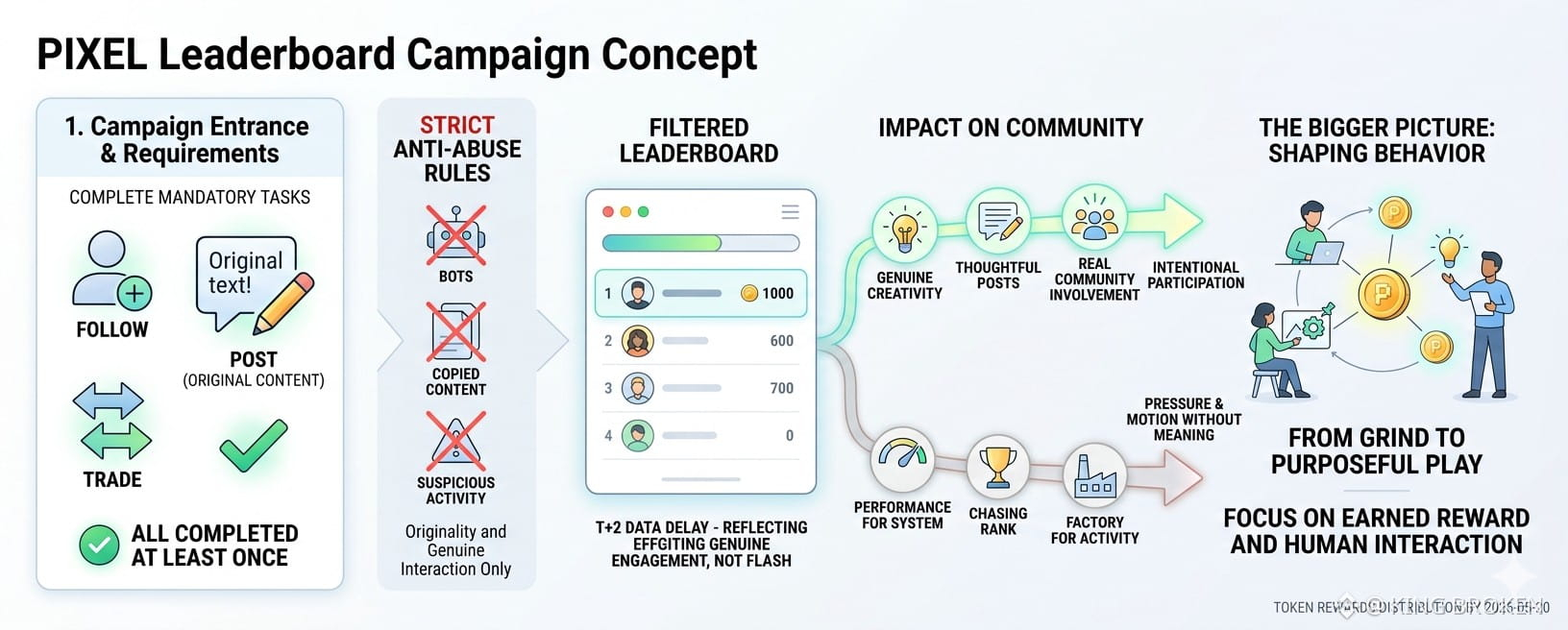
PIXEL’s leaderboard campaign feels less like a polished promo and more like a real test of who is actually showing up. On paper, it is simple: follow, post, trade, and earn a share of 7,500,000 PIXEL token rewards if you make it onto the board. But the details give it a different shape. This is not about noise for the sake of noise. It is about whether people can take part in a way that looks and feels genuine.
To qualify, you have to complete each task type at least once during the event. That means a follow, a post, and a trade. The post has to be original and relevant, not something copied, recycled, or thrown together just to tick a box. Posts tied to red packets or giveaways are not allowed, and anything that looks like bot activity, suspicious interaction, or fake views can get someone disqualified. Even old posts with high engagement cannot be repurposed for the campaign. The rules are strict because the campaign is trying to reward real participation, not shortcuts dressed up as effort.
What makes it more interesting is the way the leaderboard itself works. The data is shown with a T+2 delay, so the results are never fully live. What you see is always a little behind the present, like looking at the campaign through a window that has already moved on. That delay changes the feel of the whole thing. It turns the leaderboard into something closer to an unfolding story than a real-time race. And when the rewards are finally distributed by 2026-05-20, the event will feel less like a flash giveaway and more like a controlled experiment in how community energy gets measured.
That is where PIXEL’s bigger story comes in. Web3 games have spent years trying to figure out how to stay fun without becoming pure grind machines. The moment money enters the picture, the mood changes. Players start thinking about value, not just play. Every action gets watched a little more closely. Every reward has to justify itself. PIXEL seems to understand that tension, which is why the campaign leans so hard on originality and anti-abuse rules. It wants to draw a line between real community activity and the fake sparkle that often follows token campaigns.
There is something honest about that. A lot of crypto campaigns reward volume and call it engagement. This one feels more interested in whether people are actually paying attention. That is a small but important difference. It means the campaign is not only trying to create attention; it is trying to filter for intent. And in a space where bots, copied posts, and manufactured hype are so common, that matters.
There is also a bigger human side to all of this. Campaigns like this can be exciting because they give people a reason to join in, create, and trade with a little more purpose. They can make a token feel connected to a living community instead of a static asset. But they can also push people into performing for the system instead of participating in it. Once a leaderboard exists, people start chasing rank. Once rank becomes visible, people start comparing themselves. The fun part can slowly turn into pressure.
That is the part worth paying attention to. The real question is not just who wins the rewards, but what kind of behavior the campaign encourages along the way. If it brings out genuine creativity, thoughtful posts, and real involvement, then it does something useful. If it turns the community into a factory for polished activity, then it becomes another reminder of how easy it is for digital systems to confuse motion with meaning.
Still, there is a reason campaigns like this keep appearing. People like being recognized. They like seeing effort turn into something tangible. They like the feeling that a post, a trade, or a small act of participation might actually count for something. PIXEL’s campaign is built around that instinct, but it tries to keep the process guarded and selective. That balance is what gives it character.
In the end, the campaign is less about handing out tokens and more about shaping behavior. It asks people to show up properly, not loudly. To participate, not just imitate. To treat the reward as something earned, not something grabbed. And that makes the whole thing feel a little more human than the average crypto promo.
