I’m waiting. I’m watching. I’m looking. I’ve been seeing the same question everywhere lately: Okay, but how much can it really handle? I follow the numbers, but I also follow the weird quiet moments toothe slight delay before a wallet confirms, the RPC pause nobody mentions, the way traders retry a transaction and act like nothing happened. I pay more attention to what stays stable when things get messy, not what looks smooth during empty hours.
OpenLedger keeps getting grouped into the “AI blockchain” wave, but I don’t think that label explains much anymore. Every project wants AI attached to its name right now. Most of them stop at branding. What caught my attention with OpenLedger was that the infrastructure actually points toward something functional instead of just sounding futuristic. The whole network seems built around the idea that data, models, and AI agents should have ownership, attribution, and some kind of economic layer attached to them.
That sounds clean in theory. In practice, it creates a very different type of pressure on a chain.
People still reduce blockchain performance to one TPS number, and honestly that’s where most conversations become useless. A network can survive short bursts and still struggle during real activity. Live usage is uneven. Traffic comes in waves. Bots retry failed transactions. Shared accounts become hotspots. Indexers lag behind. Wallet confirmations start feeling inconsistent. None of that shows up in the headline metrics projects love posting.
What matters more is how the system behaves when multiple things compete for state changes at the same time.
That’s the part I keep thinking about while watching OpenLedger develop. AI workloads are naturally unpredictable. Dataset uploads, model interactions, attribution records, agent activity, reward distributionsthose don’t arrive in a perfect flow. They spike. They overlap. Sometimes the chain stays quiet for hours and then suddenly everything hits together.
And when that happens, compute power alone doesn’t save you.
The bottlenecks usually appear somewhere else first. Networking delays. Signature verification. Scheduler pressure. State contention. RPC reliability. Parallel execution limits. That’s where chains start revealing their real shape.
DeFi already exposed this problem years ago. During liquidations or volatile market moves, everybody tries touching the same state simultaneously. Hot wallets get hammered. Oracles update rapidly. Bots fight for execution priority. Transactions fail and retry repeatedly. Fees become strategy instead of cost. The actual pressure isn’t theoretical anymoreit becomes behavioral.
I think OpenLedger will eventually face similar moments once AI agents and financial activity begin mixing together in larger volume.
That’s why I care less about benchmark screenshots and more about the everyday builder experience. Right now, the network still feels early, and honestly I don’t mean that negatively. You can still see the visible plumbing underneath the ecosystem. Public endpoints occasionally hesitate. Explorer updates sometimes feel slightly behind live activity. Wallet flows aren’t completely invisible yet. But weirdly, I trust projects more when I can still see the rough edges instead of everything being overproduced for appearance.
The architecture also feels intentionally optimized toward responsiveness and accessibility. That usually means trade-offs somewhere else. Low-latency systems almost always require tighter coordination between validators, infrastructure providers, or execution paths. Faster confirmation experiences can feel great for users, but they also concentrate pressure into fewer operational layers.
Every chain chooses its compromise differently.
Some prioritize openness even if performance becomes chaotic under stress. Others tighten coordination to keep execution predictable. You can usually feel which direction a network leans just by spending enough time using the wallets, bridges, dashboards, and public RPCs.
And honestly, bridge friction tells me more about a chain’s maturity than marketing ever will.
A blockchain can advertise speed all day, but if assets moving in and out feels awkward, users notice immediately. That’s usually where systems reveal whether they’re genuinely ready for scale or still stabilizing underneath. The uncomfortable truth is that chains rarely break at consensus first. They break at the edges. RPCs slow down. Indexers drift. Wallets desync. Explorers stop matching reality in real time.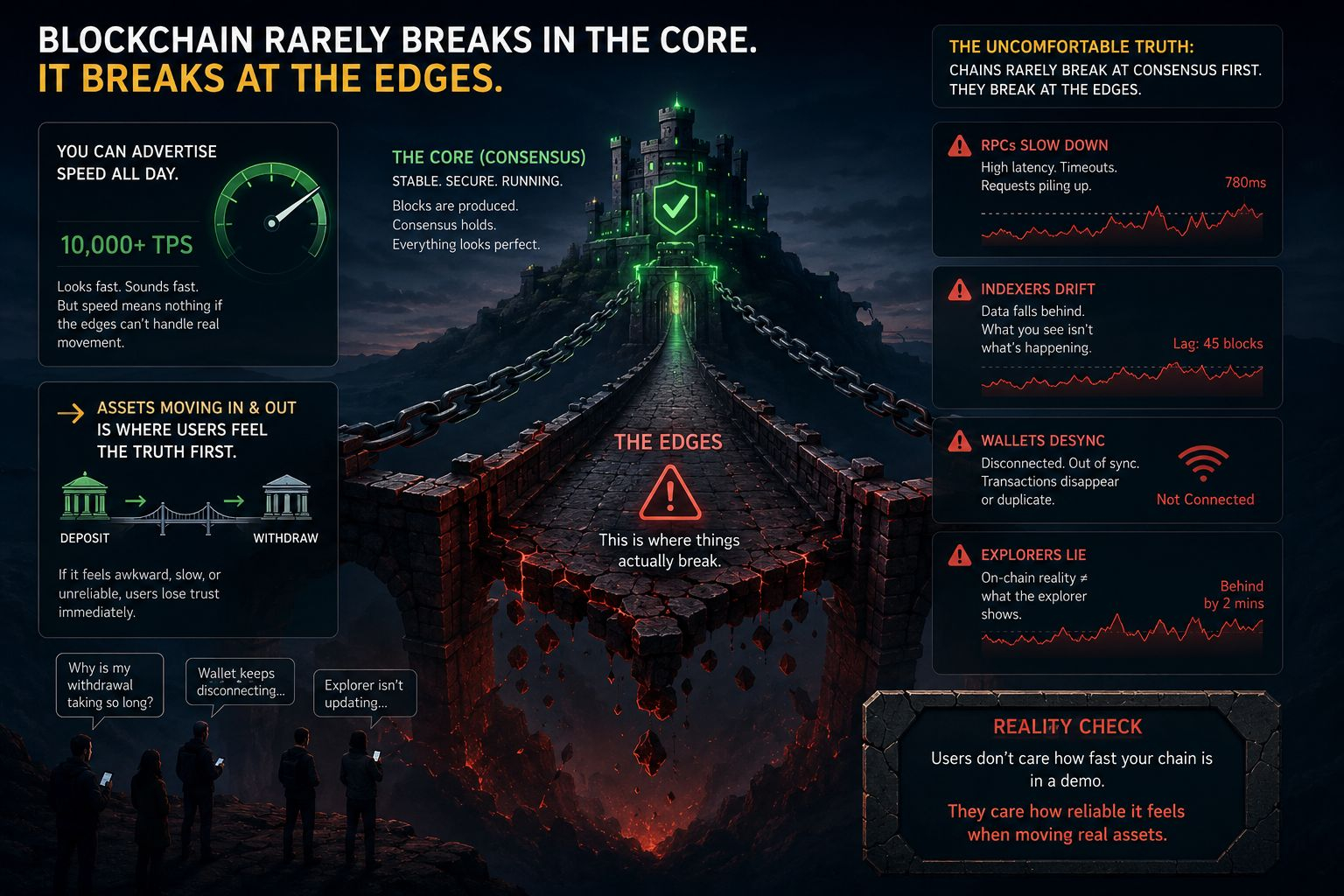
That edge pressure matters even more for OpenLedger because attribution is central to the whole design. If the network is positioning itself around ownership of models, data, and agent outputs, then consistency becomes extremely important. People need confidence that records remain reliable during heavy activity, not just during calm conditions.
And that’s the part I’m still watching carefully.
Not the headlines. Not the partnership graphics. Not the AI buzzwords.
I’m watching how the network behaves during imperfect conditions. I’m watching whether builders can rely on public infrastructure without constantly adding workarounds. I’m watching whether explorer data stays close to real-time when activity increases. I’m watching whether transactions still feel predictable once retries and congestion start appearing naturally.
Because eventually every chain reaches the same moment where synthetic testing stops mattering.
Real usage always arrives messy.
Over the next few weeks, the biggest signals for me will be RPC consistency during spikes, bridge reliability under heavier traffic, and whether indexer delays begin widening once more users interact with the network simultaneously. If those layers stay stable while activity grows, trust grows naturally too.
Not because somebody posted a giant TPS number.
Because the chain keeps acting normal when people stop using it carefully.