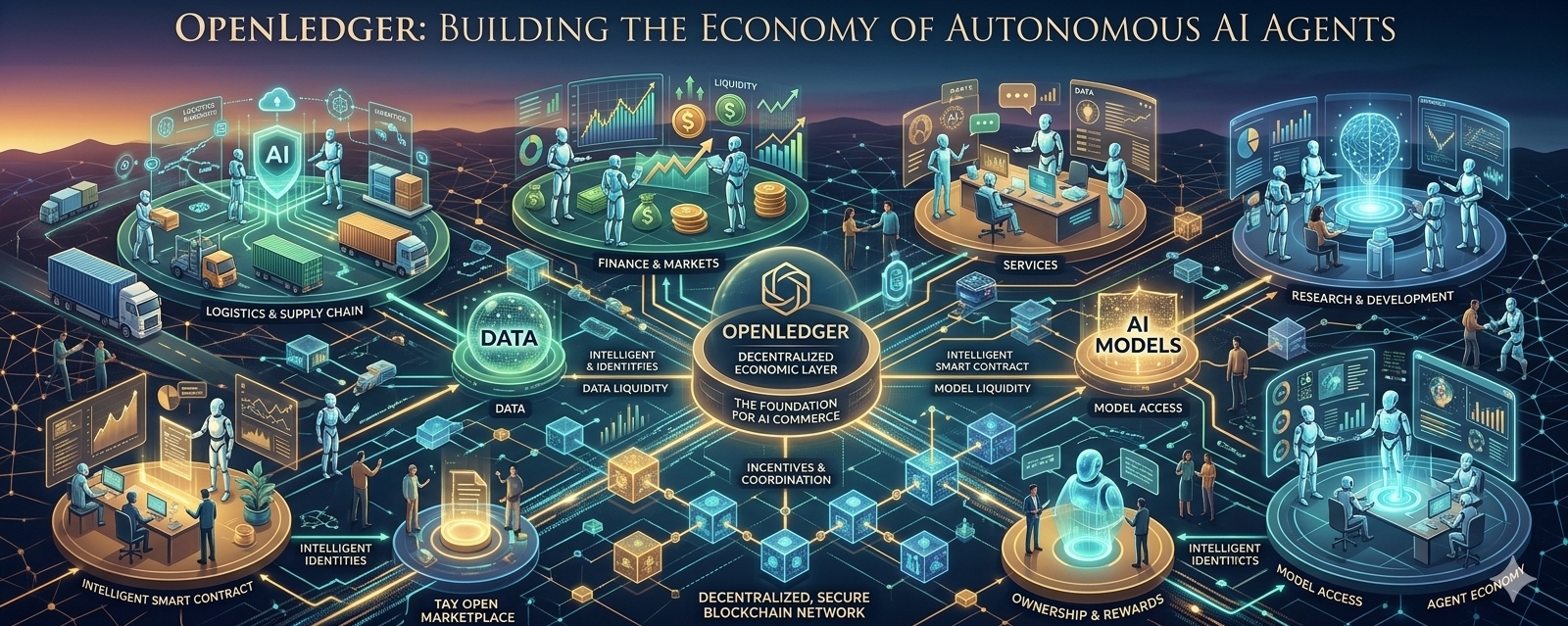
A few years ago, the idea of AI agents making money on their own sounded like something pulled from a futuristic tech podcast. Interesting to think about, maybe even exciting, but still far enough away that nobody needed to take it seriously. Most AI systems were basically assistants, useful in short bursts but heavily dependent on humans at every step.
Lately, though, I’ve started noticing a subtle shift.
Not the loud kind that dominates headlines for a week and disappears. A quieter one.
AI systems are slowly moving from being tools people occasionally use into systems that continuously perform tasks in the background. They answer customer emails while teams sleep. They organize inventory data before warehouse staff arrive in the morning. They review documents, summarize meetings, process workflows, and increasingly make small operational decisions without waiting for human input every few seconds.
And the more this happens, the more one question keeps surfacing in my mind:
If AI agents eventually become economically useful on a large scale, who actually owns the value they create?
That’s the part of the conversation most people still avoid.
Everyone talks about how powerful AI models are becoming. Far fewer people talk about the infrastructure underneath them, the systems deciding who gets rewarded, who controls the data, and who benefits financially when autonomous software starts generating real economic output.
That’s what made OpenLedger interesting to me.
Not because it promises some dramatic AI future. The internet already has enough exaggerated promises floating around. What caught my attention instead was the fact that OpenLedger seems focused on something more foundational: building an economic layer around AI agents, data, and models before those systems become deeply embedded into everyday industries.
And that feels surprisingly important.
Right now, most AI ecosystems operate in a fairly one-sided way. Millions of people contribute value constantly through data, interactions, corrections, behavior patterns, and usage, but ownership stays concentrated around the platforms controlling the infrastructure. The people helping improve these systems rarely participate in the upside in any meaningful way.
That imbalance becomes much bigger if AI agents eventually function less like software and more like digital labor.
Imagine a logistics company using autonomous AI agents to coordinate warehouse movement in real time. Or a hospital network relying on specialized agents to organize patient records and reduce administrative delays. Even small businesses are beginning to experiment with AI systems that handle scheduling, invoicing, customer communication, and repetitive operational work.
None of this requires science fiction.
It’s already starting to happen, just quietly and unevenly.
The interesting thing is that once AI systems begin creating consistent economic value, they stop feeling like ordinary software. They become assets. Persistent ones. Systems that can potentially generate revenue continuously instead of being used once and forgotten.
That’s the space OpenLedger appears to be positioning itself around.
The project talks about creating liquidity for data, models, and AI agents through blockchain infrastructure. At first glance, that can sound like typical crypto language. But underneath it is a fairly serious question: if intelligence itself becomes part of the digital economy, how do contributors participate fairly in the value being created?
Because right now, AI development is becoming increasingly centralized.
The strongest models require enormous compute power, massive datasets, and infrastructure that only a handful of companies can realistically afford. Smaller developers, independent researchers, and niche builders often end up dependent on systems they do not own and pricing structures they cannot influence.
OpenLedger seems to be exploring whether decentralized infrastructure can create a more open marketplace around AI participation itself, where builders, data providers, model contributors, and autonomous agents can all interact economically inside the same ecosystem.
Of course, this is where healthy skepticism matters.
Crypto has a habit of making coordination sound easier than it actually is. Incentive systems work beautifully in diagrams and much less perfectly in real life. Open ecosystems can attract speculation faster than genuine utility. Governance becomes messy. Short-term behavior often overwhelms long-term thinking.
And AI introduces even more uncertainty because measuring the quality or value of intelligence is not always straightforward.
So no, OpenLedger is not guaranteed to solve these problems.
But I do think it is asking more relevant questions than many projects currently chasing attention in the AI space.
Because the future of AI may not simply depend on which company builds the smartest model.
It may depend on who builds the fairest systems around ownership, incentives, coordination, and access.
That’s a much harder problem.
And probably a more important one.
What makes this particularly interesting is how invisible the transition could become. People still imagine the AI economy as something dramatic, humanoid robots replacing workers overnight or fully autonomous companies appearing out of nowhere. Reality will probably look much more ordinary.
AI agents will quietly slide into existing systems first.
Warehouses will become slightly more optimized. Supply chains slightly more predictive. Customer support slightly more autonomous. Small businesses will deploy specialized AI agents that handle repetitive work behind the scenes. Independent creators may eventually operate entire digital businesses supported by autonomous systems generating recurring income in the background.
Most people may not even notice the shift happening in real time.
But beneath that transition sits an uncomfortable economic question: if autonomous systems begin producing measurable value continuously, who captures that value?
The platform?
The developers?
The data contributors?
The businesses deploying the systems?
Or the networks coordinating everything together?
Projects like OpenLedger are interesting because they are attempting to design infrastructure around those questions before the answers become economically unavoidable.
That doesn’t mean the model will succeed. It doesn’t mean decentralization automatically wins. Most users still prioritize convenience over philosophy, and large technology companies already have enormous advantages in AI infrastructure.
But it does mean the conversation is evolving.
The internet is slowly entering a phase where intelligence itself becomes programmable, monetizable, and economically active. And once that happens, ownership stops being a side discussion.
It becomes the entire discussion.
That’s why OpenLedger feels worth watching right now, not as a guaranteed breakthrough, but as part of a broader attempt to rethink how value might move in a world increasingly shaped by autonomous AI systems.
And honestly, that future no longer feels as distant as it did even a year ago.
@OpenLedger #openleadger $OPEN