Most conversations around AI stay on the surface, model performance, benchmarks and flashy applications. But the deeper I look, the more I think the real story is unfolding somewhere else and that is infrastructure.
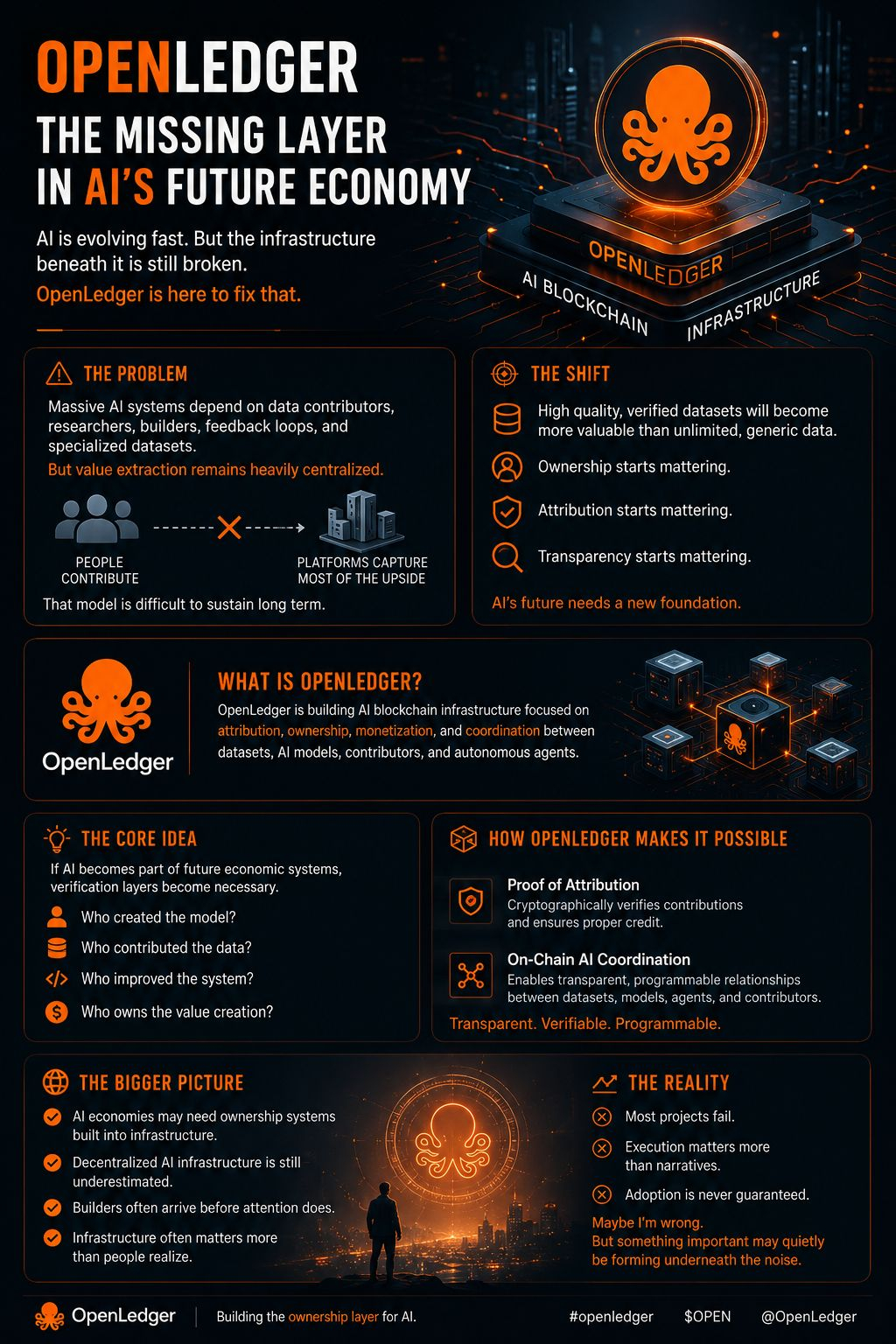
Right now, the AI ecosystem feels incomplete. These systems rely on a massive network of contributors, data providers, researchers, developers and users feeding constant feedback. Yet, when it comes to value, it’s still heavily centralized. People contribute, but platforms capture most of the upside. That imbalance doesn’t look sustainable long term.
As AI evolves, the game is starting to shift. It’s no longer just about having more data, it’s about having better, verified, high-quality datasets. And with that comes a new layer of importance: ownership, attribution, and transparency. Knowing who contributed, what and who should benefit, starts to matter a lot more.
That’s where @OpenLedger caught my attention.
OpenLedger is building what looks like a foundational layer for AI economies, combining blockchain with AI coordination. The focus is clear: attribution, ownership, monetization and coordination between datasets, models, contributors and even autonomous agents.
The idea itself is simple, but the implications are big.
If AI becomes embedded in future economic systems, then verification layers become essential. Not optional. Questions like who created the model, who supplied the data, who improved it, and who owns the value, these can’t be left as black-box assumptions anymore.
OpenLedger introduces concepts like Proof of Attribution and on-chain coordination to make these relationships transparent and programmable. That’s a shift from trust-based systems to verifiable ones.
And this goes beyond speculation.
If AI economies scale the way many expect, ownership frameworks will likely need to be built directly into the infrastructure, not controlled behind closed platforms. That’s where something like OpenLedger starts to make more sense.
Of course, most projects don’t succeed. Execution always matters more than narrative, and adoption is never guaranteed. But one pattern keeps repeating, infrastructure often gets overlooked early, and builders tend to arrive before attention does.
Decentralized AI infrastructure still feels underestimated.
Maybe this is nothing.
Or maybe something important is quietly forming underneath all the noise.