
Market was doing that flat, sideways thing today. Nothing really moving. I'd refreshed my portfolio maybe four times in ten minutes, which is never a good sign — that's the kind of boredom that makes you do dumb trades. So instead I closed the app and started messing with one of those AI chat tools, asking it to rewrite an email.
And it gave me back something genuinely good. Better phrasing than I'd have come up with. And I caught myself thinking — wait, where did it learn to write like that? Somebody wrote the original. A lot of somebodies. None of them got a cent for it.
That's not a new complaint, I know. People have been mad about AI scraping data for a while. But here's where it actually clicked for me, and it's a slightly uncomfortable angle.
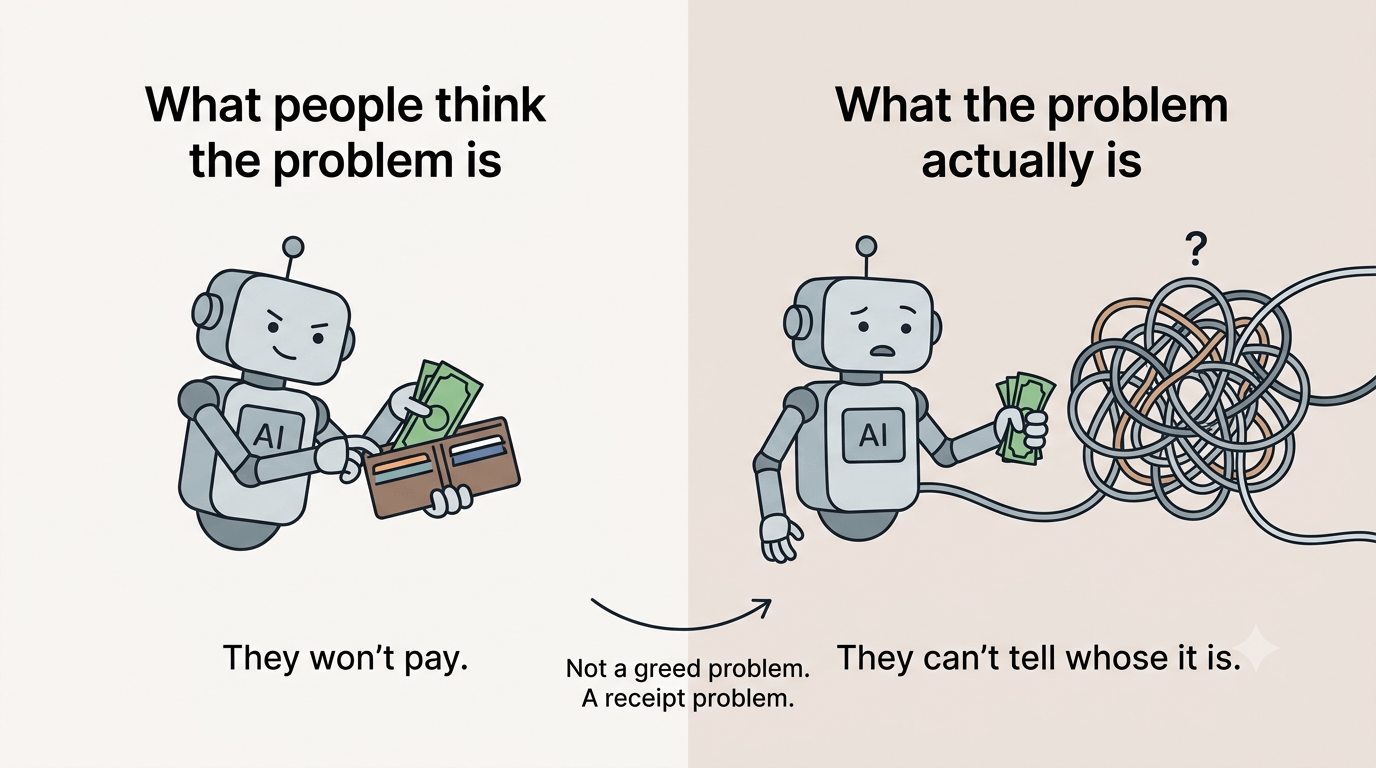
Everyone frames this as a theft problem. "AI companies are stealing your data, they should pay you." And so the assumed fix is also a payment problem — make them pay. License the data. Cut a check. Done.
But that's not actually the hard part. Paying people is easy. Companies pay for things constantly.
The reason they don't pay you isn't that they're cheap. It's that nobody can prove your specific contribution mattered. Once your blog post, your forum comment, your dataset gets blended into a model with a billion other things, it dissolves. There's no receipt. The model produces an answer and you genuinely cannot point at it and say "that sentence — that's mine, 0.3% of it." The attribution doesn't exist. So even a company that wanted to pay you fairly... couldn't. There's no mechanism. The money has nowhere to land.
That reframing is what got me. It's not a greed problem. It's a plumbing problem. And greed problems and plumbing problems get solved completely differently.
So out of curiosity I went down a rabbit hole and ended up on OpenLedger, which is one of the projects trying to build that missing plumbing. Their whole pitch is something called Proof of Attribution — a cryptographic method that traces AI outputs back to their original data sources. The idea being, you contribute data, and smart contracts automatically pay contributors using the token when their data is used. They keep calling it "Payable AI," and describe the whole thing as Hugging Face meets YouTube — meaning your data is the upload, and you get a cut when it gets "watched." Bitcoin News + 2
And on paper that's the exact missing piece. Not "make them pay" — but "build the receipt that makes paying even possible."
But here's the part that bothers me, and I'm genuinely not settled on it yet.
Attribution at the input stage seems doable — you logged the data, fine. But attribution at the output stage is where I get skeptical. When a model generates an answer, untangling which fraction of which contributor's data "influenced" it... that's not a clean accounting problem. Model internals are messy. Influence isn't a tidy percentage. I worry that what gets measured is some approximation of influence that's good enough to look fair but loose enough to argue about. And the moment real money flows through an approximation, people start gaming it. Spamming low-value data to farm the attribution rewards. I thought "well, they probably weight by quality" — and they say they do, low-quality contributions get penalized — but quality scoring is also an approximation. It's approximations all the way down.
So I'm not fully convinced it holds under pressure. Under no money, it's elegant. Under serious money, every soft edge becomes an attack surface.
Still — and this is why I didn't just close the tab — even an imperfect receipt is infinitely more than zero receipt. Right now the number is literally zero. A flawed attribution system that pays contributors something traceable is a different universe from the current one, where the honest answer to "who made this AI smart" is "nobody knows and nobody's asking."
Who does this actually matter to? Probably not the casual poster. It matters most to the people sitting on genuinely valuable specialized data — medical researchers, niche domain experts, people whose 500 careful annotations are worth more than 500,000 random tweets. Those are the people currently getting absorbed for free. And it matters when AI training data finally gets regulated or litigated into needing real provenance — at that point whoever already built the plumbing is suddenly standing in a very good spot.
Anyway. I still don't know if the attribution math survives contact with real adversaries. That's the open question I can't shake. Market's still flat too — maybe that's the actual tell, everyone waiting around for something to be provable before they commit.
I'll just watch how this one ages.
@OpenLedger #OpenLedger $OPEN