I’ve been writing about crypto long enough to have developed a reflex.
Whenever a project mashes together the two most fashionable words in tech—today that’s “AI” and “blockchain”—my first instinct is to roll my eyes. I’ve seen this before. In 2017 it was “the decentralized Uber.” In 2021 it was “the metaverse economy.” Most of those ideas generated more PowerPoint slides than actual users.
So when OpenLedger landed on my radar, I expected the usual: a grand narrative, a shiny token, and a lot of promises about changing everything.
That’s the standard script.
But the more I looked at it, the more I found myself thinking: hold on, this one is at least asking the right question.
And it’s a question that matters.
Artificial intelligence is making some companies obscenely valuable. NVIDIA became a market giant because everyone suddenly realized that data and computing power are the new oil and pipelines. OpenAI, Anthropic, and others are building products that may reshape entire industries. Fine. That part is obvious.
What’s less obvious is this: the people who create the raw material behind these systems—researchers, doctors, lawyers, analysts, educators—are often paid once and then cut out of the upside entirely.
Their work becomes fuel.
Someone else owns the engine.
I was speaking with a radiologist last year who had spent months helping annotate medical images for a machine learning project. The pay was decent, but that was it. One invoice. Done. If the model eventually becomes part of a product worth hundreds of millions, she won’t see another rupee, dollar, or cent.
That doesn’t sit right with me.
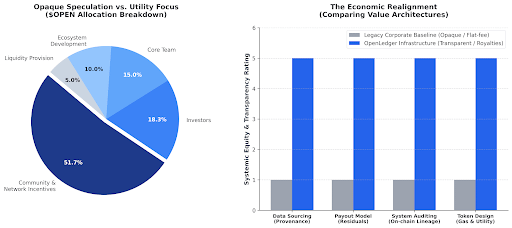
OpenLedger is built around a very simple idea: if your data, model, or expertise helps an AI product make money, you should keep getting paid.
Not once.
Repeatedly.
Like royalties.
And suddenly the project becomes much easier to understand.
Forget the blockchain jargon for a moment. Think about the music industry. Every time a song is streamed, the rights holders receive a cut. OpenLedger wants to bring a similar structure to AI. If your contributions materially improve a model, and that model powers something commercially useful, you should participate in the economics.
Honestly, that seems less like a crypto fantasy and more like common sense.
The blockchain, in this case, is just the bookkeeping system. It keeps track of who contributed what and how rewards are split. That’s it.
Nothing mystical.
And that’s exactly how infrastructure should feel.
The best technology is boring.
People don’t brag about TCP/IP. Nobody posts celebratory threads about database replication. Stripe became valuable not because payments are exciting, but because it made a painful process fade into the background.
That’s the ideal outcome here.
If OpenLedger succeeds, users won’t care that there’s a blockchain involved. They’ll care that they contributed something valuable and got paid fairly, without chasing invoices or negotiating one-off licensing agreements.
That’s a much stronger story than “faster transactions.”
One aspect of OpenLedger I genuinely like is its focus on attribution.
In plain English, attribution means figuring out whose contribution actually mattered.
And this is where the dream collides with reality.
Say ten different datasets are used to train an AI model. One dataset improves accuracy dramatically. Another adds almost nothing. How do you measure that? How do you reward the right contributors? And how do you stop bad actors from uploading recycled garbage just to farm tokens?
These are not small technical details.
They are the entire business model.
I’ve watched plenty of blockchain projects with elegant theories collapse under the weight of messy real-world incentives. Token economics can look beautiful on a whitepaper and fall apart the moment actual humans get involved.
Humans are wonderfully creative when money is on the table.
So yes, I’m impressed by the concept. But I’m also cautious. Maybe more than cautious.
Because attribution in machine learning is hard. Really hard.
If OpenLedger solves that, it will have built something genuinely useful.
If it doesn’t, the whole thing becomes another well-intentioned experiment that sounded smarter than it worked.
That’s the honest truth.
The timing, though, is excellent.
Despite the headlines around giant models like GPT, many businesses don’t need an all-purpose digital genius. They need a system that performs one job exceptionally well. A hospital wants a model that spots abnormalities in scans with high accuracy. A law firm wants software that understands local regulations, not Shakespeare and song lyrics.
In practice, specialized models are often more valuable than general ones.
And they depend on specialized data.
Which is scarce.
And expensive.
And usually created by people whose expertise took decades to develop.
OpenLedger is trying to turn that expertise into an asset rather than a one-time service. That’s a subtle shift, but a powerful one.
The rise of AI agents makes the idea even more compelling. These agents are no longer science fiction demos. They’re already handling customer support, reviewing contracts, processing invoices, and automating repetitive office work.
In other words, they’re starting to earn money.
So the obvious question becomes: who should benefit?
Should all of the economic value flow to the company operating the agent? Or should some of it go back to the people whose data and models made that agent useful in the first place?
My instinct says the second model is fairer.
And probably healthier.
The OPEN token is the mechanism that keeps this economy moving. It handles payments, incentives, staking, and governance. But I’d caution readers not to get distracted by the token itself.
The token is not the story.
Usage is the story.
Without real contributors, real developers, and real paying customers, OPEN is just another ticker symbol in a market overflowing with narratives.
I’ve seen too many tokens searching for a purpose.
This one, at least, has a purpose.
Whether it can attract meaningful adoption is the question that matters.
That means investors should ignore the usual noise. Don’t obsess over price targets from anonymous accounts on X. Don’t confuse community enthusiasm with product-market fit.
Look at what’s being built.
Are researchers uploading valuable datasets? Are developers deploying specialized models? Are companies actually paying to use this infrastructure? Is economic activity happening for reasons other than speculation?
That’s where the signal is.
There are also plenty of ways this can go wrong.
Attribution may prove too complicated. Data marketplaces can become junkyards. Enterprises may hesitate to trust a young protocol with sensitive information. Regulators are still trying to understand who owns training data in the first place.
And crypto, as always, has a talent for turning thoughtful projects into casino chips.
That risk never disappears.
Still, I think OpenLedger is tackling one of the most overlooked issues in the AI economy: ownership.
Not in a philosophical sense.
In a practical one.
Who gets paid?
That question will matter more and more as AI moves deeper into medicine, finance, law, and research. These are industries built on highly specialized human knowledge. If that knowledge becomes the foundation of profitable AI systems, contributors deserve more than a one-time fee and a thank-you email.
They deserve a stake.
My view? Cautiously optimistic.
I don’t think OpenLedger is guaranteed to succeed. Far from it. The technical and economic challenges are substantial, and the crypto industry has a long history of overpromising.
But unlike many projects I’ve covered, this one doesn’t feel like buzzword soup.
It feels like a serious attempt to solve a real economic problem.
And if it works, the most remarkable thing about OpenLedger won’t be the token price, the marketing, or the technology itself.
It will be that the system fades into the background.
Quiet.
Dependable.
Almost dull.
And in infrastructure, dull is the highest compliment I can give.
That’s when you know it’s doing something that actually matters.