
 I keep thinking about something strange happening in AI right now.
The entire industry keeps telling people that AI is becoming more intelligent every month.
But almost nobody is asking a much more uncomfortable question:
What happens when users realize the AI itself may not be the most valuable part anymore?
What if the real value is the human knowledge quietly feeding these systems every single day?
That changes the conversation completely.
And honestly… I think OpenLedger may be one of the few projects positioning around that shift early enough.
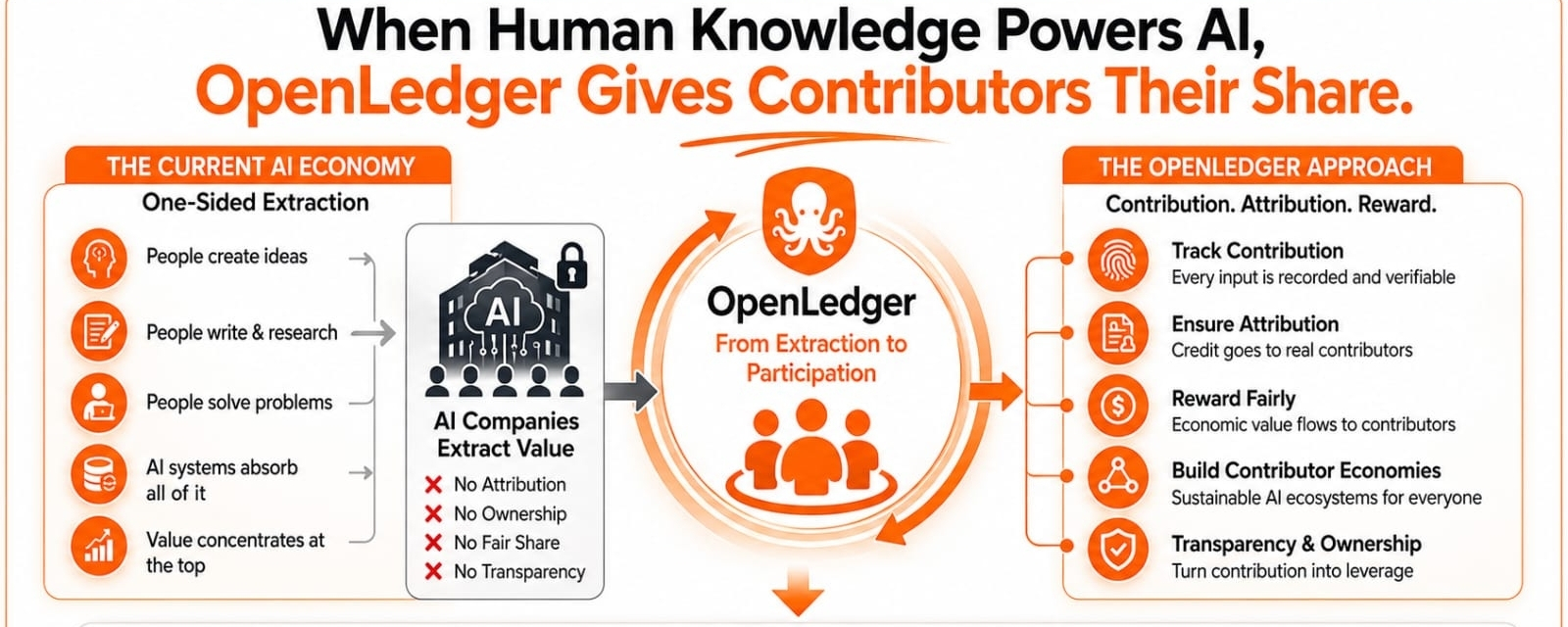
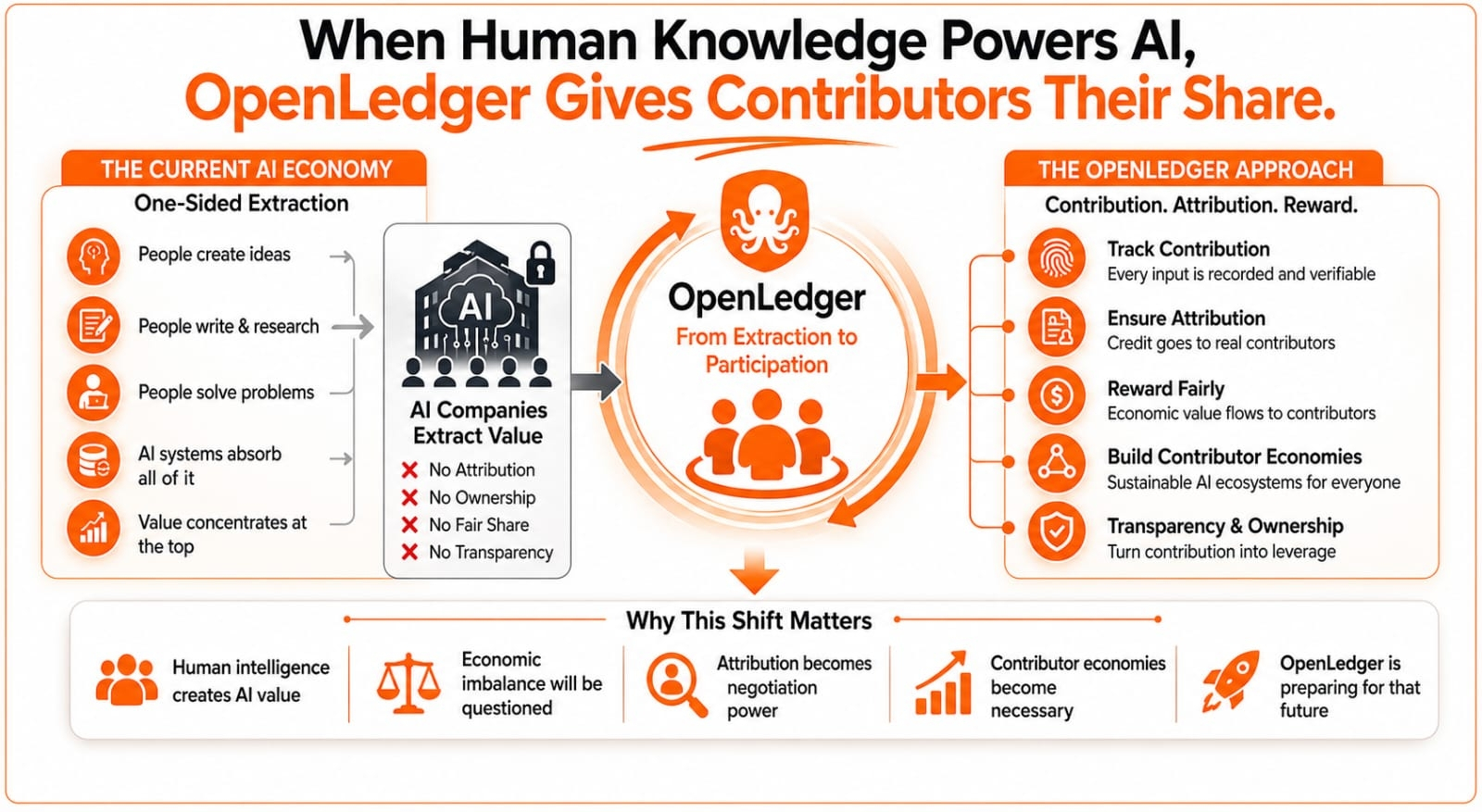
Because right now the AI economy works in a very one-sided way.
People create ideas.
People write.
People research.
People solve niche problems.
People generate expertise.
Then AI systems absorb all of it at massive scale while the economic value concentrates upward around the platforms training the models.
Most users still accept this because AI feels magical enough that they ignore the extraction happening underneath.
But that probably doesn’t last forever.
At some point contributors start noticing something uncomfortable:
The AI systems improving every month are improving because human intelligence keeps feeding them continuously.
That realization matters.
A lot.
Because once contributors understand they are part of the value creation process, ownership becomes a much bigger conversation.
Not theoretical ownership.
Economic ownership.
And this is exactly where OpenLedger starts feeling more interesting than a normal AI token narrative.
The project doesn’t seem focused on replacing human contribution with AI.
It looks much more focused on organizing, tracking, and rewarding contribution itself.
That’s a completely different market.
Most AI companies today optimize for intelligence extraction. They want more data, more interactions, more feedback loops, more behavioral input.
But OpenLedger seems to be betting that future AI ecosystems may eventually need contributor economies instead of extraction economies.
That distinction sounds small at first.
It isn’t.
Because extraction scales until contributors realize they have leverage.
History repeats this pattern constantly.
Social media platforms became massive before creators realized platforms were monetizing their audiences more effectively than the creators themselves.
Streaming platforms exploded before artists started questioning payout structures.
Ride-sharing scaled globally before drivers began pushing back economically.
AI may eventually reach a similar tension point.
And if that happens, systems capable of proving contribution and coordinating incentives become much more important.
That’s why OpenLedger keeps catching my attention lately.
Not because it feels loud.
Actually the opposite.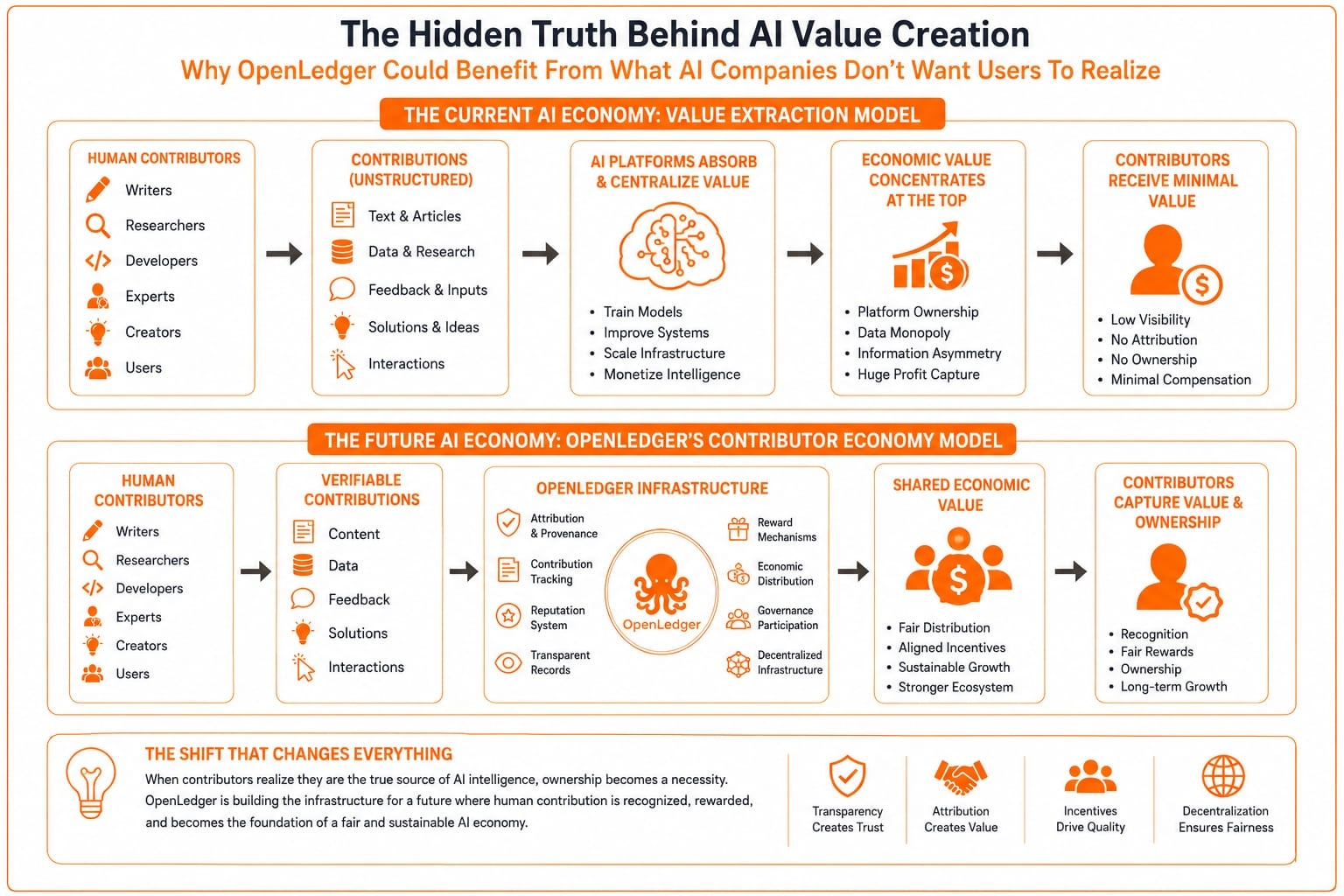
The ecosystem conversations feel unusually focused on coordination infrastructure rather than pure hype cycles. More discussion around how intelligence gets sourced. How contribution flows should work. How AI ecosystems eventually distribute value between models, datasets, agents, and users.
That type of conversation usually appears before markets fully understand why it matters.
And honestly, I think most people still don’t.
Right now the AI narrative is dominated by capability races. Faster models, larger ecosystems, autonomous agents, enterprise integrations.
Very few people are paying attention to the economic architecture underneath all of it.
But eventually someone asks the dangerous question:
If human contribution keeps improving AI systems…
why do contributors capture so little value?
That question alone could reshape huge parts of the industry over time.
Because once economic pressure enters AI ecosystems, transparency and attribution stop being “nice features.”
They become negotiation tools.
That’s the future OpenLedger seems to be quietly building toward.
Not simply decentralized AI.
Decentralized participation inside AI economies.
And there’s a big difference between those ideas.
Of course, this path is risky.
Markets often tolerate unfair systems much longer than people expect. Convenience usually wins early. Centralized AI companies already have enormous scale advantages. Most users still prioritize speed and product quality over ownership structures.
That reality cannot be ignored.
But I also think people underestimate how quickly attitudes change once economic imbalance becomes visible enough.
And AI is moving toward that visibility faster than most realize.
Because the smarter these systems become…
the more obvious it becomes that intelligence itself did not appear from nowhere.
Someone supplied it.
Someone trained it.
Someone contributed to it.
The moment the market starts caring who that “someone” is…
projects like OpenLedger stop looking experimental.
And start looking necessary.

#GoogleLaunchesGemini3.5Flash #Trump'sIranAttackDelayed #TrumpOrdersFedCryptoPaymentRailsReview @OpenLedger