
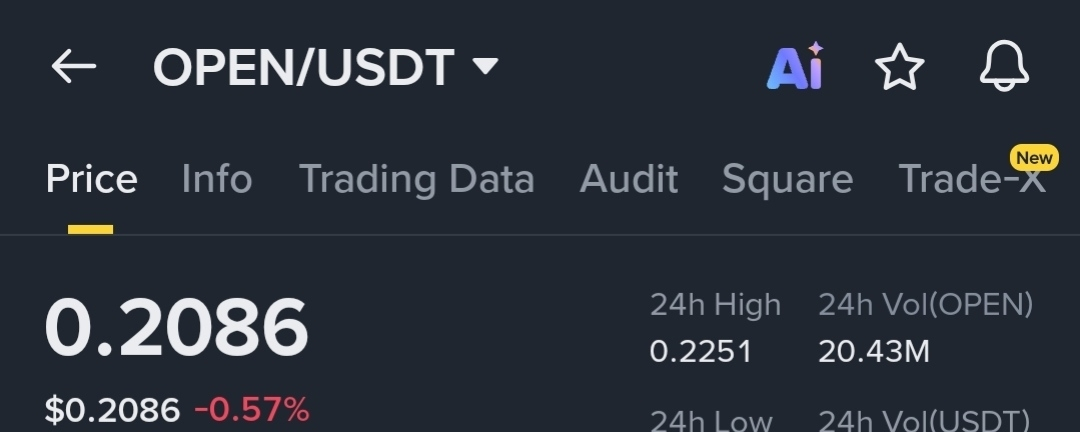
$OPEN Artificial Intelligence is growing at a breathtaking pace, but it faces a massive underlying problem: data centralization. Tech giants routinely scrape data, train massive models, and pocket billions in profits without compensating the actual creators. OpenLedger (OPEN) is stepping up as the first AI-native blockchain designed specifically to change this dynamic, turning data, models, and AI agents into liquid, monetizable assets.
By building an ecosystem where contribution meets compensation, OpenLedger is laying down the infrastructure for a decentralized, "Payable AI" economy.
What is OpenLedger?
Unlike general-purpose Layer-1 networks built primarily for Decentralized Finance (DeFi) or NFTs, OpenLedger is built from the ground up exclusively for the AI lifecycle. It functions as an Ethereum Virtual Machine (EVM)-compatible infrastructure, operating as an OP Stack rollup to ensure high-speed, cost-effective transactions.
Instead of adapting old blockchain frameworks to fit AI workloads, OpenLedger provides a dedicated environment where every step of an AI's growth—data curation, fine-tuning, and model deployment—is recorded securely on-chain.
Core Innovations: Empowering the AI Lifecycle
OpenLedger introduces several revolutionary pillars that bridge the gap between cryptographic infrastructure and practical AI development:
1. Proof of Attribution (PoA)
This is OpenLedger's flagship breakthrough. Proof of Attribution tracks exactly how specific datasets influence a trained AI model's output. When an AI agent performs a task or fields a query, the blockchain automatically traces the lineage of the data used to train it, distributing real-time reward settlements directly back to the original data contributors.
2. Model DataNets
DataNets are community-owned, collaborative data networks. Within a DataNet, users can collectively co-create, curate, and upload highly specialized datasets required for enterprise AI training. Instead of giving away valuable domain knowledge for free, users own a piece of the network they help build.
3. ModelFactory and OpenLoRA
To make decentralized AI deployment practical, OpenLedger offers a ModelFactory for no-code fine-tuning. Paired with OpenLoRA (Low-Rank Adaptation) tools, developers can fine-tune specialized models with immense cost efficiency, bypassing the prohibitive compute costs usually associated with legacy tech infrastructure.
The Token Utility and Future Outlook
At the beating heart of this infrastructure is the utility token. Launched in late 2025, $OPEN serves multiple critical functions across the network:
Gas & Transactions: Powering on-chain model training, dataset uploads, and AI agent deployment.
Economic Incentives: Rewarding data providers and node operators running distributed AI compute workloads.
Ecosystem Deflation: To combat the token dilution typical of tech startups, OpenLedger leverages enterprise revenue-fueled buybacks to tighten liquidity and boost long-term value.
Backed by prominent Web3 pioneers like Balaji Srinivasan (former CTO of Coinbase) and Sreeram Kannan (EigenLabs), the project has already secured high-impact integrations, partnering with LayerZero for omnichain liquidity and Story Protocol to secure legal intellectual property rights for AI training.
Conclusion
The current AI landscape is built on borrowed data and closed-source systems. OpenLedger represents a critical paradigm shift toward verifiable, fair, and community-owned intelligence. By enabling automatic on-chain monetization for data and models alike, isn't just another crypto asset—it is the financial engine for the future of decentralized AI. As enterprise adoption scales, OpenLedger stands firmly positioned to dominate the intersection of Web3 and Artificial Intelligence. #OpenLedger @OpenLedger