
Here’s a more human, less “written” version:
I keep seeing people talk about AI like it is magic.
Like it just arrived fully formed. Like the models somehow became smart by themselves. Like all this intelligence came from nowhere.
But I don’t buy that.
AI is built on people. On their work. Their data. Their mistakes. Their habits. Their documents. Their small decisions repeated over years. The stuff nobody claps for. The stuff sitting inside businesses, teams, research groups, private systems, messy folders, old workflows.
That is the part people skip.
They celebrate the output, but ignore the source.
And honestly, that feels broken.
Because if your data helps make a model better, why does someone else capture most of the value? If your model solves a real problem, why is it so hard to turn that into actual income? If your agent saves time inside a business, why does it still feel like just another tool waiting to be copied, buried, or forgotten?
This is where I think OpenLedger becomes interesting.
Not because it has AI in the name. Not because it has blockchain around it. I’m tired of both words being used like decoration.
OpenLedger caught my attention because it seems to be asking a better question.
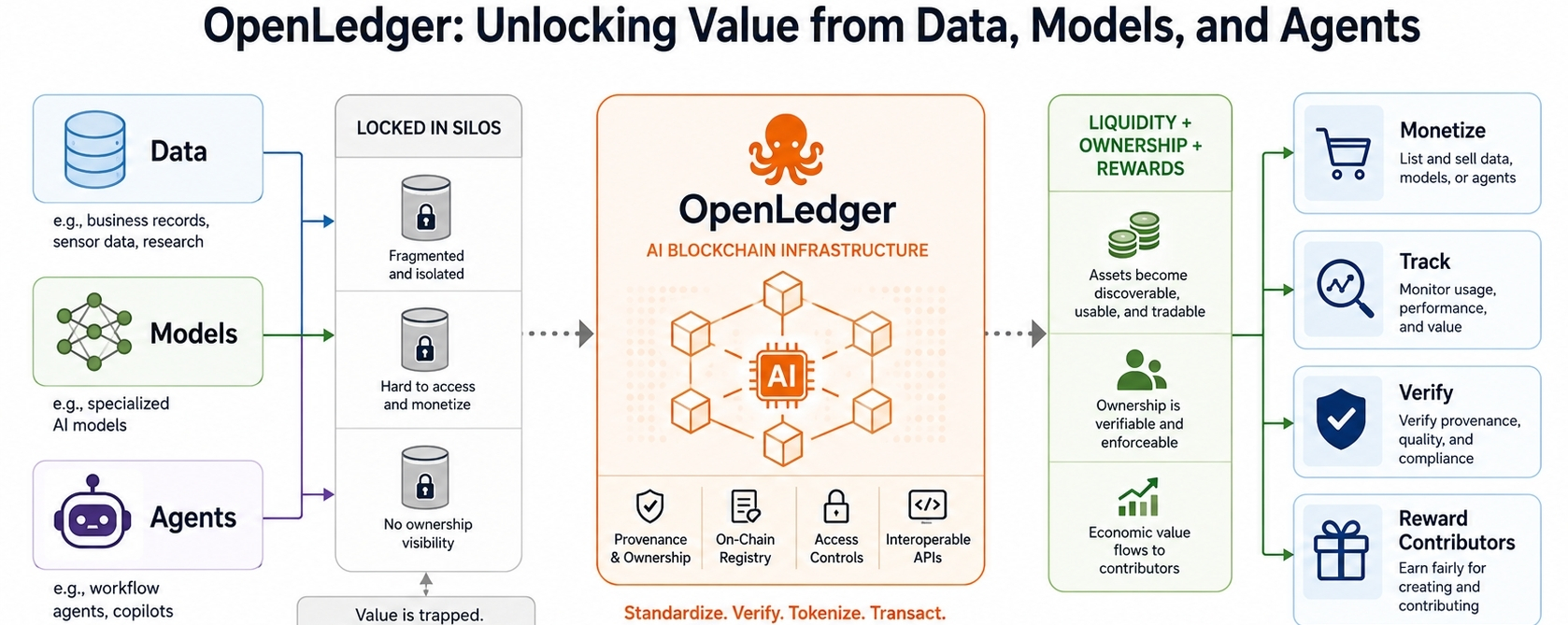
What happens when data, models, and agents are treated like real economic assets?
Not content. Not files. Not demos.
Assets.
Things that can be owned, used, tracked, priced, rewarded, and moved.
That sounds simple, but it changes the conversation.
A small company might have years of useful customer data. A developer might build an agent that actually fixes one painful workflow. A research team might have a model that is valuable in a very specific niche. In the current system, a lot of that value gets stuck. Or worse, it gets absorbed by someone bigger.
Not because the work is weak.
Because the rails are missing.
That is the difference I’m noticing with OpenLedger. It is not just trying to make AI sound more exciting. It is trying to make AI more usable economically. More liquid. More accountable. More connected to the people and systems creating the value in the first place.
And maybe that is not the loudest story.
But it feels like the real one.
The illusion is that AI is becoming open for everyone.
The reality is that most of the value is still locked behind platforms, private networks, and closed systems.
OpenLedger is pointing at that gap.
And I respect that.
Because the future of AI should not only reward the people who package intelligence nicely. It should also reward the people who make that intelligence possible.
That is why I’m paying attention to OpenLedger.
Quietly. Seriously.
Not as hype.
As infrastructure that might actually matter.
