
Market's been oddly flat today. Not the kind of flat where everyone's calm — the kind where you can feel people waiting for something. I ended up just opening a few tabs and going down a rabbit hole instead of watching candles.
I landed on @OpenLedger . Didn't plan to spend more than ten minutes on it.
An hour later I'm still sitting here turning one idea over in my head.
So the thing about AI development — and I say this as someone who's been watching this space for a while — is that the incentive structure has always felt a little off. Not broken, just… misaligned in a way that's easy to overlook if you're not paying attention.
Here's what I mean. Right now, if you contribute data to an AI model — you're a researcher, a developer, someone annotating datasets, whatever — your upside is basically zero after the handoff. You helped build something valuable, and then that value gets captured somewhere else. The model improves, the platform grows, and you get… a one-time payment if you're lucky.
People have been pointing this out for years. The response is usually: "yes, but that's just how it works."
OpenLedger seems to be operating from a different assumption. That "how it works" isn't actually fixed — it's just what everyone agreed to accept.
What they're building is an infrastructure layer where AI model contributions — data, compute, fine-tuning work — get tracked on-chain, and contributors receive tokens that represent ongoing stake in the models they helped create. Not just a payment. Stake. Meaning if the model grows in usage or value, the people who built it actually participate in that upside over time.
I had to sit with that for a second.
Because here's the part that tripped me up at first: I assumed this was just another data marketplace. "Upload your dataset, earn tokens." That kind of thing. I've seen twenty versions of that pitch.
But actually it's a bit different. The mechanism isn't just about rewarding data submission — it's about creating verifiable attribution at the contribution level, then tying token incentives to model performance downstream. So you're not just getting paid for what you put in. You're getting a share of what comes out.
That's a different idea. Or at least it should create a different behavior.
If contributors have ongoing stake in model performance, the incentive to submit good data — verified, high-quality, actually useful — goes up significantly. Because bad data that degrades the model now hurts the contributor too. The misalignment between "upload and leave" and "upload and care" closes.
But here's the part that bothers me.
This only works if model performance can actually be attributed back to specific contributions in a meaningful way. And that's… genuinely hard. AI models aren't linear. A dataset that seemed irrelevant at training time might end up mattering a lot after fine-tuning. Another one that looked critical might get diluted out entirely.
Attribution in complex systems is messy. And if the attribution layer isn't precise, the incentive layer isn't either — which means you're back to contributors gaming whatever metric gets used as a proxy.
I'm not saying they haven't thought about this. I'm saying I'm not fully convinced it holds under pressure, especially at scale, especially when the financial stakes go up and people start looking for edges.
That's the part I keep coming back to.
What I do think is real: the direction of the idea matters. The AI economy has a contribution problem. The people doing the hard, unglamorous work of building training infrastructure — data curation, annotation, evaluation — are structurally excluded from the value they create. If on-chain attribution even partially fixes that, the downstream effects are significant. You start attracting a different kind of contributor. Someone who's invested, not just transactional.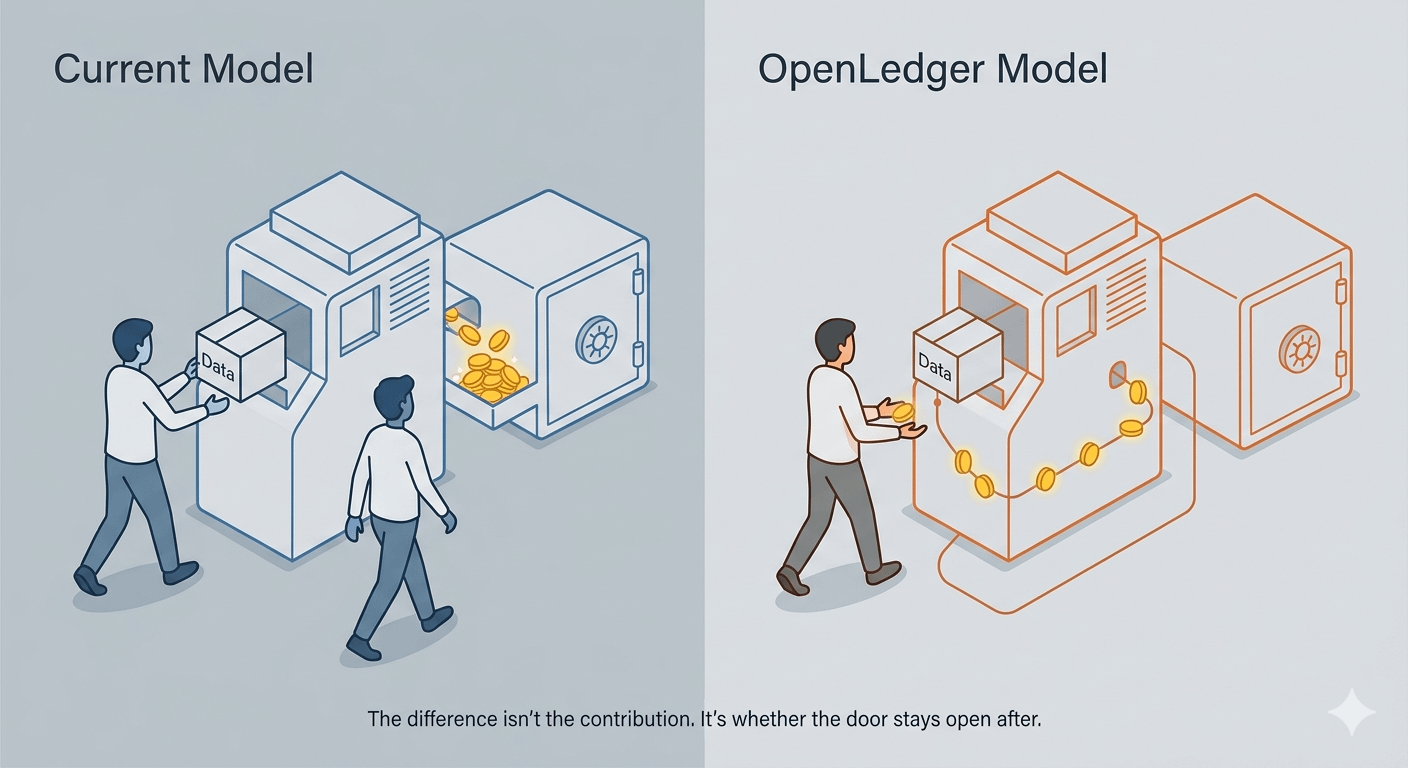
That changes what kind of models get built. And eventually, maybe, what kind of AI ecosystem exists.
Whether OpenLedger specifically executes on this — that's a different question. Early days, open questions, the usual caveats apply.
Anyway. Market's still flat. I've got three other tabs open I haven't touched.
I'll probably just keep watching how this one develops.