
If you have spent any time scrolling through crypto and tech timelines lately, you’ve probably noticed that the decentralized AI (DeAI) narrative is getting incredibly exhausting. Every other project claims to be revolutionizing the future of intelligence, but when you look under the hood, ninety percent of them are just doing the exact same thing: renting out clustered GPU power.
But renting out hardware doesn't fix the actual crisis staring the AI industry right in the face. The real bottleneck holding artificial intelligence back isn't compute power—it's data ownership, provenance, and screaming legal liabilities.
Right now, centralized tech titans are hitting a massive brick wall. They spent the last decade silently scraping the open internet without permission, and now publishers, artists, and massive enterprises are rightfully locking them out with multi-billion-dollar lawsuits. If an AI model cannot legally and transparently prove where its training data came from, major corporations simply cannot risk using it.
This massive compliance bottleneck is exactly why what @OpenLedger is building is so refreshing. They are shifting the focus away from generic computing marketplaces to build an EVM-compatible Layer 2 framework engineered specifically to serve as an accountable data pipeline for "Payable AI."
Breaking Down the Tech: It's About Infrastructure, Not Hype
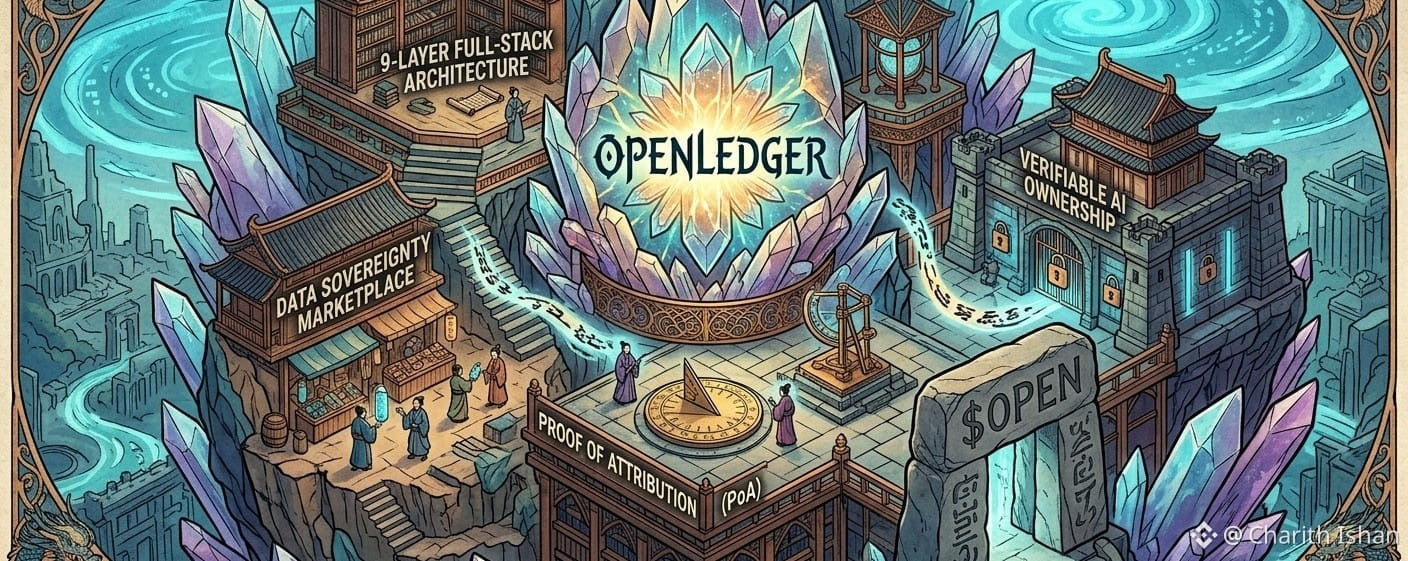
To move past the typical black-box model of artificial intelligence, @OpenLedger turns data, specialized models, and autonomous AI agents into transparent, composable on-chain assets. Instead of just talking about data sovereignty, they make it functional through three core architectural layers:
DataNets: Think of these as community-run data factories. Instead of scraping random, noisy internet garbage, DataNets allow specialized groups to securely compile, clean, and host domain-specific datasets—like highly complex medical journals, financial ledgers, or legal compliance documents.
ModelFactory: A visual, developer-friendly workspace that strips away the need for heavy coding. It allows teams to take foundational base models and fine-tune them directly against verified DataNet parameters without breaking a sweat.
OpenLoRA: Running thousands of specialized, fine-tuned AI models usually requires an astronomical amount of hardware. OpenLoRA solves this by managing thousands of specific model adapters on single GPU nodes, instantly cutting enterprise deployment overhead by roughly 90%.
The Real Innovation: Proof of Attribution (PoA)
The secret sauce that sets this ecosystem apart from standard web3 cloud storage networks is its proprietary Proof of Attribution (PoA) engine.
When an AI model trained on the network processes a request or generates commercial value, the PoA ledger works backward. It mathematically and cryptographically determines exactly which data contributions inside the original DataNet contributed to that specific output. The revenue generated from that query is then programmatically and instantly distributed via smart contracts directly back to the original data providers.
This completely changes the game. It doesn’t just give everyday creators a slice of the financial upside of AI development—it fully satisfies strict enterprise data provenance rules. This capability was recently reinforced through an integrated standard with Story Protocol, aligning programmable creative rights directly with on-chain execution loops so compliance is baked right into the code.
Real-World Economy for the Open Token
In a network built entirely on measurable utility, the native $OPEN token serves as the vital economic fuel driving everything forward. It isn't just a speculative ticker symbol; it's the mandatory asset required to pay for network gas, launch new DataNets, trigger model inferences, reward contributors, and secure the L2 network via validator staking.
As the team marches through its comprehensive nine-layer product roadmap—scaling up from basic data networks into fully decentralized autonomous agent marketplaces—on-chain transaction metrics are becoming a real gauge for genuine web3 adoption. True data sovereignty isn't about hiding information from the world; it’s about making sure that when information changes the world, the people who created it are recognized, protected, and paid cleanly. Keep an eye on how these independent DataNets scale over the coming months.