
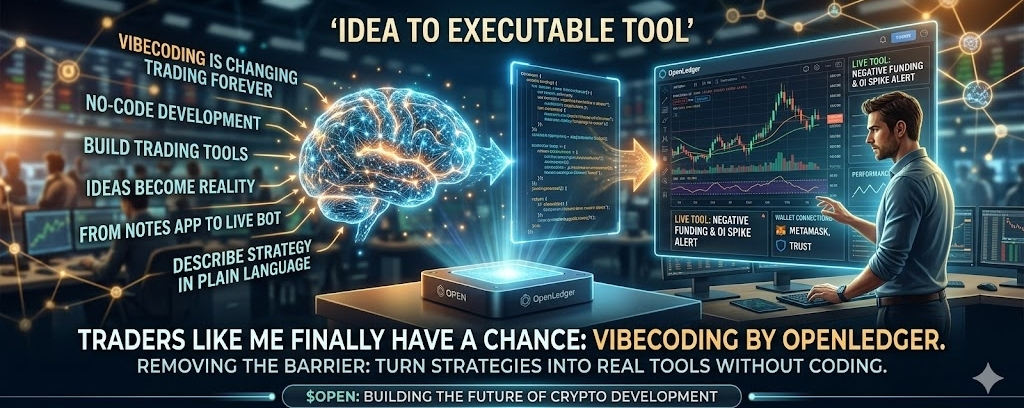
Most of my best trading ideas never make it past my notes app.
Not because the ideas are weak.
Not because they wouldn’t work.
But because building them into real tools always felt impossible for someone like me.
I’m a trader, not a developer.
That’s why the idea of “vibecoding” from Openledger caught my attention in a completely different way than most AI projects. This isn’t just another AI dashboard or chatbot story. It’s about removing the wall between having an idea and actually turning it into something usable.
For years, the crypto space has pushed the idea that AI can “write code for you.” And yes, AI can generate snippets or small functions. But creating a real trading tool is much harder than that. You still need APIs, wallet connections, hosting, chain integrations, security checks, and constant debugging when markets get volatile.
That’s the part most platforms ignore.
Vibecoding feels different because it aims at the difficult part — the messy real-world side of building.
As a trader, I constantly think of tools I wish existed. One example stayed in my head for months: an alert system that notifies me when funding rates flip negative while open interest suddenly rises across multiple exchanges.
The setup is simple in my mind.
The execution is not.
To build it manually, I’d need to manage exchange APIs, deal with rate limits, host servers, monitor delayed data feeds, and fix errors every time something breaks. That’s enough work to make most non-developers give up before even starting.
So the idea stayed in my notes, just like many others.
If vibecoding can truly let traders describe their strategy in plain language and turn it into something functional without becoming backend engineers, that changes everything. Suddenly, ideas don’t stay trapped in notebooks anymore.
A few years ago, this wouldn’t have been realistic.
Blockchain development was fragmented. Different chains had different standards. AI models made too many mistakes to trust with anything serious. Smart contract generation was unreliable, and building across ecosystems was painful.
Now the environment has changed.
Development tools have matured. Standards across chains are improving. AI models are smarter and more stable. For the first time, both the infrastructure and the intelligence are evolving together. That’s why this concept is appearing now instead of earlier.
Still, I don’t think people should blindly trust AI-built systems.
Easy building does not automatically mean safe building.
If an AI tool makes a wrong assumption about a smart contract or trading logic, the losses belong to the user, not the model. Markets punish mistakes very quickly. Fast development can sometimes hide weak thinking.
That’s why anything created through vibecoding still needs testing, small sizing, and careful validation before real capital touches it.
But even with those risks, there’s a major shift happening underneath all of this.
When building becomes easier, the advantage no longer belongs only to developers. The edge starts moving toward people with better ideas, stronger research, and more discipline.
Simple strategies will probably stop working faster because more people can build and deploy them quickly. Competition increases. But original thinking becomes even more valuable.
A trader who deeply understands their setup and can finally build around it gains a huge advantage over someone who only copies signals from social media.
That’s the real reason I’m paying attention to $OPEN.
Not because of hype.
Not because of short-term price action.
But because tools like this could genuinely change how traders operate.
For the token itself to matter long term, the platform has to create real value. It needs builders creating tools people actually continue using in live markets — not just temporary demos designed for attention.
The important questions are simple:
Are people building useful products?
Do those products survive real market conditions?
Does value flow back into the ecosystem?
Or is the entire idea just another short-lived narrative?
Eventually, the market will answer those questions.
Right now, I’m watching vibecoding less like a trade and more like an environmental shift. Because whenever the tools of a market change, the market itself changes too.
And if the barrier to building truly drops this much, the next generation of trading tools, strategies, and platforms will arrive faster than most people expect.
That alone makes it worth paying attention to.