
Most people think artificial intelligence is built by machines. The truth is far more human than that.
Every AI model learns from human behavior, human creativity, human conversations, human research, and human knowledge collected across the internet for years. Behind every smart response, every AI-generated image, and every automated system, there are millions of invisible contributors whose value was quietly absorbed into systems they do not own.
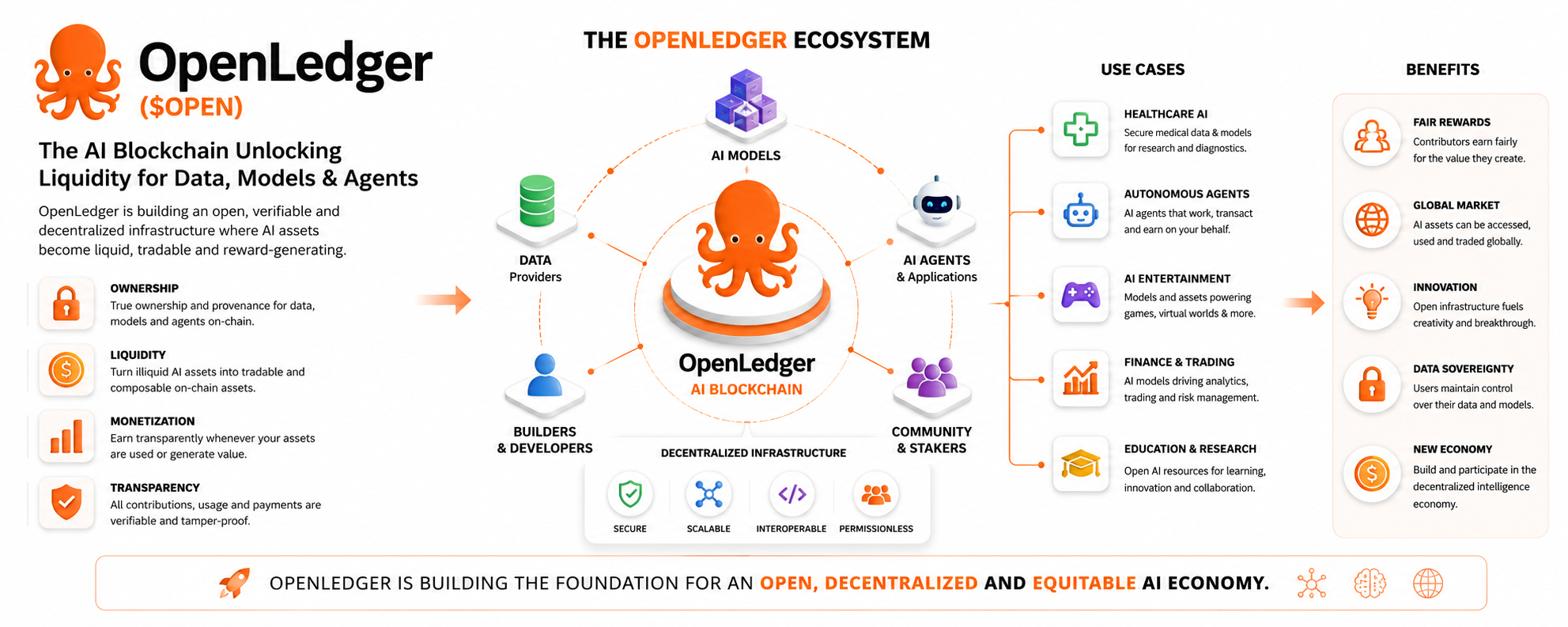
That is the reality OpenLedger ($OPEN) is trying to change.
What makes this project feel different is that it does not speak about AI as cold technology alone. It speaks about value, ownership, and fairness in a world that is rapidly becoming automated. While most companies are racing to build stronger AI systems, OpenLedger is asking a much deeper question that almost nobody talks about:
Who should benefit from the intelligence economy of the future?
Right now, the answer is painfully unbalanced. Large corporations collect data from users, train AI systems on top of it, and generate enormous profits while ordinary contributors remain disconnected from the rewards. People create the fuel, but centralized systems keep the engine.
OpenLedger wants to rebuild that relationship from the ground up.
Instead of treating data like something that disappears into private servers forever, the project sees it as an asset with real economic value. Instead of AI models being controlled by a few powerful companies, OpenLedger imagines a world where creators, researchers, developers, and even communities can participate directly in the growth of AI economies.
That idea feels powerful because it touches something bigger than blockchain.
It touches the future of digital ownership itself.
For years, the internet trained people to give away value for free. Every click, search, conversation, preference, and interaction became part of a system generating wealth somewhere else. Most users never questioned it because they never saw an alternative.
But artificial intelligence is changing the scale of this problem completely.
AI is no longer just software. It is becoming infrastructure for modern life. It will influence education, healthcare, finance, entertainment, business, communication, and even human decision-making. And if the foundation of AI remains centralized, then the future economy may become even more concentrated than the internet era ever was.
This is why OpenLedger feels important beyond the crypto space.
It introduces the possibility that intelligence itself can become open, transparent, and shared instead of hidden behind corporate walls.
The fascinating part is how naturally blockchain fits into this vision. Blockchain is not being used here simply for hype or token speculation. It becomes a trust layer for AI economies. A system where ownership can be verified, contributions can be rewarded, and value can move freely between participants without relying entirely on centralized control.
That creates opportunities that feel almost futuristic today but may become normal tomorrow.
Imagine an independent researcher uploading a specialized dataset and earning continuously whenever AI systems use it.
Imagine developers building AI agents capable of working autonomously across digital platforms while generating transparent on-chain income.
Imagine creators owning pieces of the intelligence they help produce instead of surrendering everything to large platforms forever.
OpenLedger is trying to build the rails for that type of world before the rest of the industry fully realizes where AI is heading.
And perhaps the most emotional part of this entire vision is that it gives ordinary contributors relevance again.
In many technology revolutions, power slowly moves upward toward larger institutions. But OpenLedger carries a different energy. It suggests that the future AI economy does not have to belong only to giant corporations with massive infrastructure and unlimited capital. It can also belong to builders, researchers, creators, small communities, and people whose contributions were previously impossible to value properly.
There is something deeply human about that idea.
Because at its core, artificial intelligence is still built from human intelligence.
The conversations people have today, the knowledge they share, the models they train, the systems they improve — all of it becomes part of tomorrow’s AI world. OpenLedger recognizes that reality and tries to create a structure where those contributions are not forgotten.
And maybe that is why the project stands out emotionally in a market full of noise.
It is not only talking about technology.
It is talking about dignity in the digital age.
A future where intelligence is not extracted from people silently, but where people can finally participate in the value of what they help create.
The strongest takeaway from OpenLedger is simple but powerful:
The next generation of wealth may not belong to those who simply own platforms. It may belong to those who understand how to connect human intelligence, AI systems, and decentralized ownership into one living economy. OpenLedger is attempting to build that bridge before the rest of the world catches up.
