I’ve been watching the crypto market closely lately and one thing keeps standing out to me. The industry still moves fast, people still chase hype, and social media still turns every new narrative into a temporary obsession, but underneath all of that noise there’s a different kind of conversation starting to form. It feels more serious now. More thoughtful. People are slowly beginning to care less about empty excitement and more about what actually has a place in the future.
That’s probably why @OpenLedger caught my attention in the first place.
At first glance it’s easy to dismiss another AI related crypto project because honestly the market is flooded with them right now. Every week there’s a new platform promising to revolutionize AI, decentralize intelligence, or reshape the digital economy. After a while the words begin to lose meaning because most projects sound almost identical. But sometimes there are projects that feel connected to a bigger shift already happening around the world instead of simply trying to benefit from a trend.
That’s the feeling I had while thinking about OpenLedger.
The world is changing very quickly because of artificial intelligence. You can feel it everywhere now. Search engines are changing. Content creation is changing. The way people work, communicate, learn, and even think online is slowly evolving because AI systems are becoming part of everyday life. What used to feel futuristic suddenly feels normal. And honestly, I think most people still underestimate how large this shift will become over the next few years.
But there’s another side to this conversation that people rarely talk about enough.
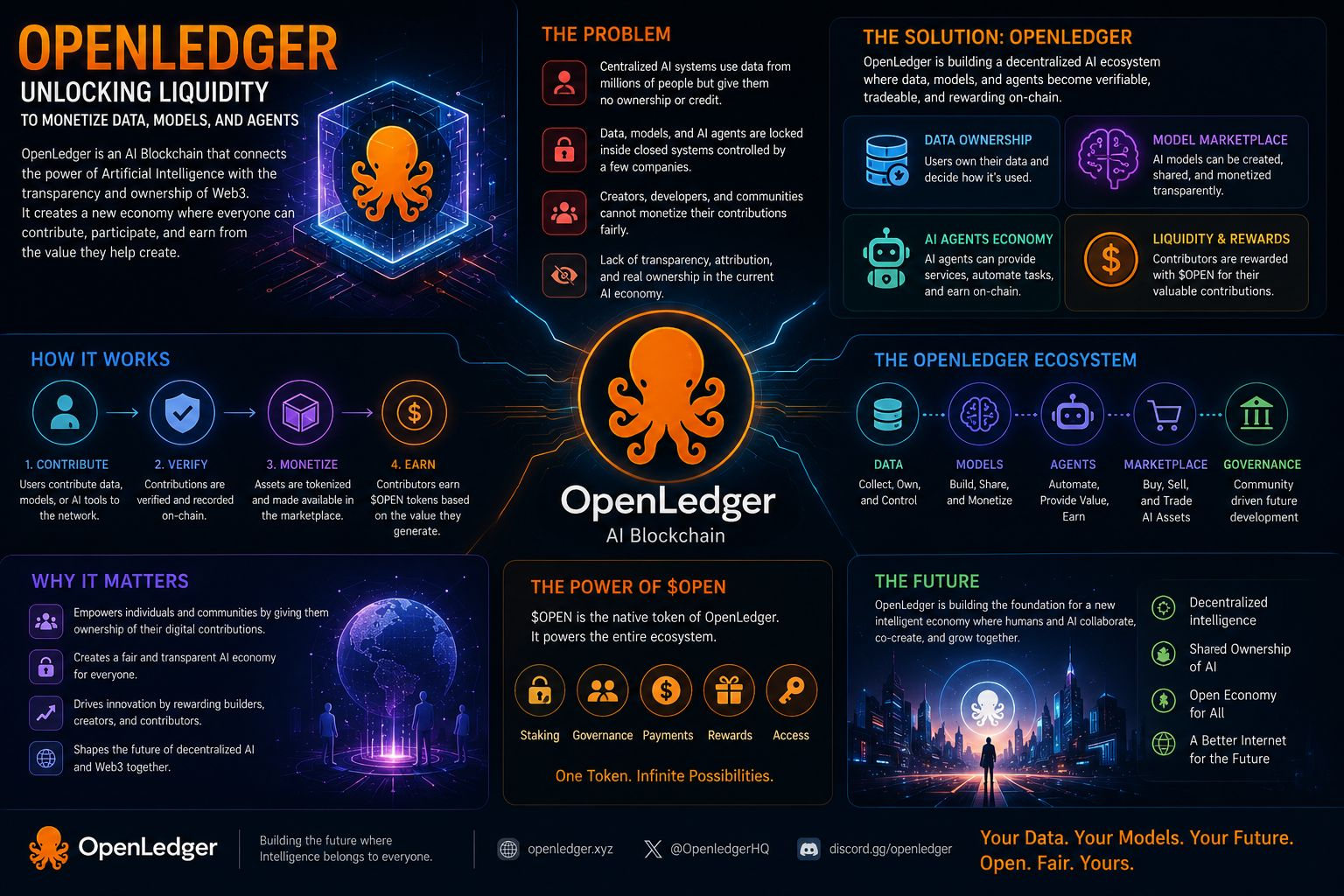
AI systems do not appear from nowhere. They are built on enormous amounts of data, human interaction, online behavior, conversations, research, creativity, and constant participation from millions of people across the internet. Every time someone writes, searches, reacts, teaches, or contributes online, value is being created somewhere in the background. The strange reality is that most people generating this value never truly own any part of it.
That imbalance has quietly become one of the biggest stories in technology.
For years the internet trained people to give everything away for free. Attention became a product. Personal behavior became data. Communities became fuel for algorithms. Most users accepted this without thinking deeply about it because that’s simply how the modern internet evolved. Large platforms collected information, improved systems using that information, and built massive businesses around it while ordinary users stayed disconnected from the value they helped create.
I think this is exactly where projects like OpenLedger become important to watch.
What makes the idea interesting is not just the AI connection itself. It’s the attempt to build an ecosystem where data, models, and digital intelligence can become assets people actually participate in instead of simply contributing to silently in the background. That changes the conversation from pure technology into something much more human. It becomes a discussion about ownership, incentives, participation, and how value flows across the internet in the future.
And honestly, this feels like a natural direction for crypto to move toward.
Blockchain technology spent years searching for stronger real world relevance beyond speculation cycles. There were moments when the industry felt disconnected from everyday people because too much focus was placed on price movements instead of meaningful utility. But AI creates a situation where blockchain infrastructure suddenly makes practical sense again because questions around transparency, attribution, ownership, and contribution become extremely important.
That’s why the timing feels bigger than people realize.
The market itself is changing emotionally too. I’ve noticed investors becoming more careful than they used to be. During older cycles almost any narrative could attract massive attention overnight. People chased concepts before products even existed. But now there’s more skepticism in the air. More caution. People still get excited, but they also want proof. They want to understand whether projects can survive after the initial attention disappears.
That’s a healthy shift honestly.
Because hype has never been difficult to create in crypto. Attention can be manufactured very quickly. Influencers can create trends overnight. Communities can become emotional in both directions within hours. But sustainable adoption is something completely different. Building technology that people continue using quietly over time is much harder than creating temporary excitement online.
This is why execution matters so much now.
I think many investors have learned painful lessons from previous cycles. They’ve seen projects dominate conversations for months only to slowly disappear when momentum faded. They’ve watched ecosystems collapse because there was nothing underneath the marketing. And because of that, people are paying closer attention to fundamentals again even if social media still pretends hype is everything.
When I look at OpenLedger through that lens, what interests me most is not whether it trends for a few weeks. What matters is whether the ecosystem can create real alignment between contributors, developers, users, and the value being generated through AI systems. Because if that alignment works properly, it creates something much stronger than speculation alone.
It creates participation.
That word keeps staying in my mind lately because I think the future internet will revolve around participation more than passive consumption. People no longer want to exist only as users feeding large invisible systems. They want ownership. They want transparency. They want to feel connected to the value they help create online.
Crypto always promised some version of that future, even if the industry sometimes lost its way during speculative periods.
Now AI is bringing those conversations back into focus again.
And the truth is, AI itself is still in a very early phase. Most people are only interacting with the surface level products right now. They see chatbots, image generation, automation tools, and content systems, but underneath those products there’s an enormous infrastructure race already happening. Data pipelines, computational systems, intelligent agents, decentralized participation, and model development are becoming some of the most valuable areas in technology.
The projects positioning themselves early around those systems could eventually become very important if they execute correctly.
But again, execution is everything.
I keep coming back to that because the market has matured enough to understand that good ideas alone are never enough. Vision matters, but building matters more. Communities matter, but retention matters more. Narratives attract attention, but utility is what keeps ecosystems alive during difficult periods.
I’ve also noticed something else recently. The strongest projects are often not the loudest ones. Usually the projects constantly screaming for attention burn out the fastest because they depend entirely on momentum. The ones that survive are normally building steadily while the market moves through emotional cycles around them.
There’s a kind of patience required now that didn’t exist in older crypto environments.
People are beginning to understand that real infrastructure takes time. Real adoption takes time. Changing how digital systems work globally is not something that happens overnight no matter how exciting the narrative sounds online.
That’s another reason why OpenLedger feels connected to a broader industry direction rather than just another short term trend. The intersection between AI and blockchain feels inevitable at this point because both industries are fundamentally dealing with questions around value, coordination, intelligence, and digital ownership.
The next generation of the internet probably will not be controlled entirely by one side alone.
AI without transparency creates trust problems. Massive centralized intelligence systems create power imbalances. Meanwhile blockchain without practical integration risks becoming disconnected infrastructure without meaningful everyday relevance. Together, though, they begin solving problems for each other in ways that feel much more realistic than people once imagined.
That’s why I think this current phase of the market is more important than many people realize.
We are moving beyond the stage where crypto only wants to disrupt finance. Now the industry is beginning to position itself around digital intelligence itself. Around data ownership. Around participation economies. Around systems where people can contribute to AI driven ecosystems while remaining connected to the value creation process instead of being separated from it.
That is a very different future from the internet most people grew up using.
Of course none of this guarantees success for any individual project. Crypto remains unpredictable. Competition remains brutal. Most projects will fail regardless of how interesting the narrative sounds today. That reality never changes.
But every once in a while there are projects that appear during moments where the direction of technology itself is shifting. Projects that feel aligned with larger transformations already happening quietly underneath the surface.
OpenLedger feels like one of those projects to me right now.
Not because it promises instant results or unrealistic dreams, but because the ideas behind it seem connected to real problems that are becoming harder to ignore as AI expands deeper into everyday life. Questions around ownership, contribution, participation, and value distribution are not going away. If anything, they will probably become even more important over time.
And honestly, I think the market is only beginning to understand how large this conversation could eventually become.
Right now everything still feels early, emotional, and uncertain. There’s still noise everywhere. There’s still speculation everywhere. But beneath all of that, there’s also genuine evolution happening across the industry.
That’s the part I keep paying attention to now.
Not the loudest headlines. Not the fastest pumps. Not the daily hype cycles. Just the projects quietly positioning themselves around where technology and human behavior seem to be heading together.
And when I look at the relationship forming between AI, ownership, and blockchain infrastructure, it feels very clear to me that this story is only beginning.