
Sometimes markets fall in love with labels before they understand the machinery underneath them.
We have seen this many times before. A new technology appears, investors find the easiest word to describe it, and suddenly everything gets compressed into one clean narrative. Cloud. Metaverse. DeFi. AI. The label becomes useful for attention, but dangerous for analysis.
Because once a project gets placed inside a hot category, people stop asking harder questions.
They ask, “Is this an AI coin?”
They do not ask, “Who actually needs this system enough to use it repeatedly?”
That difference matters a lot to me when I look at OpenLedger and the $OPEN token.
At first glance, OpenLedger can easily be described as an AI blockchain. That is the simple version. It fits the market’s current language. AI is hot. Data is valuable. Agents are becoming more important. So the quick story becomes: OpenLedger helps monetize data, models, and agents.
But I think that explanation is too flat.
The deeper question is not whether OpenLedger belongs to the AI narrative. The deeper question is whether it can become part of the economic layer behind AI systems.
That is a much harder thesis.
And honestly, that is where $OPEN becomes interesting.
In AI, everyone talks about models. Bigger models. Faster models. Smarter agents. Better outputs. But the more I watch this space, the more I feel the real bottleneck may not be intelligence itself.
Maybe the next bottleneck is attribution, ownership, pricing, and accountability.
If AI systems are trained on data, improved by feedback, powered by agents, and deployed across businesses, then value is being created from many invisible contributors. Datasets, model builders, domain experts, agent developers, infrastructure providers, and users may all play a role.
But most markets are not built to reward invisible contribution.
That is the gap OpenLedger seems to be targeting.
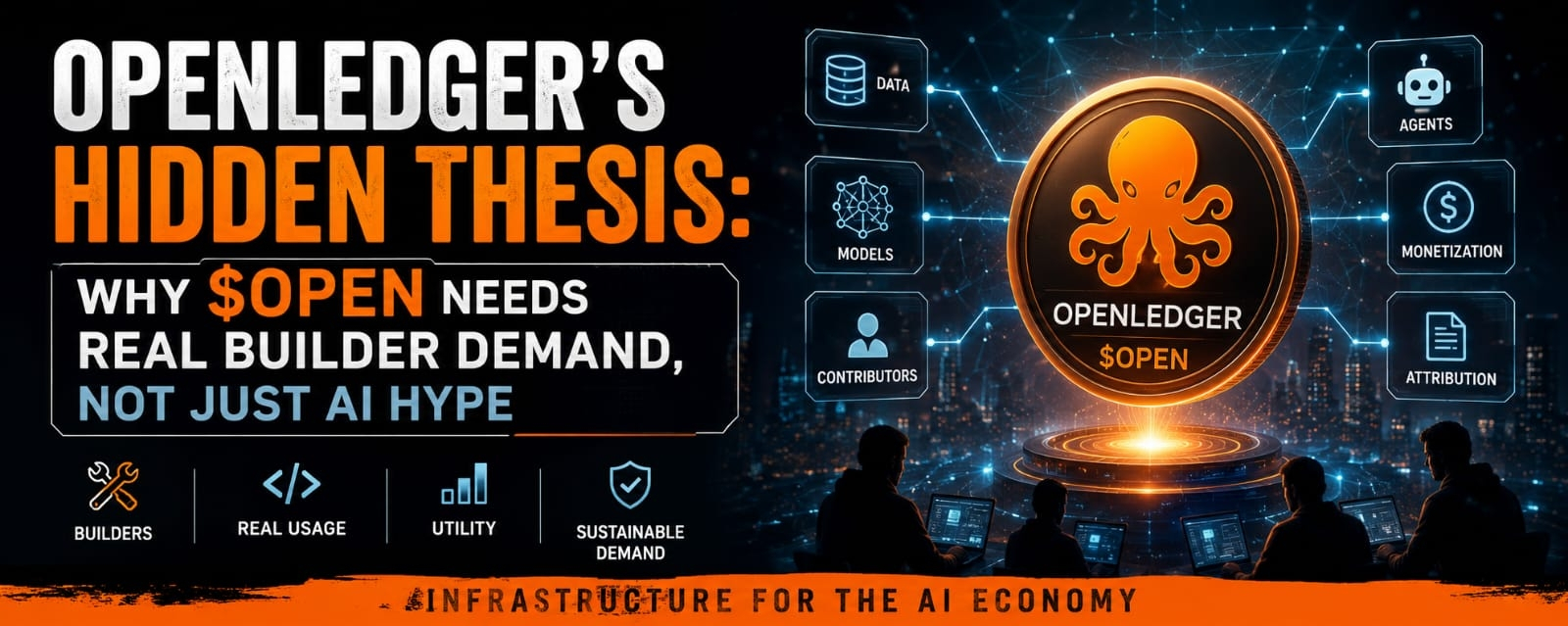
The market may look at $OPEN as another token riding the AI wave. But the hidden thesis is different. If OpenLedger actually becomes useful, token demand should not come from people simply rotating into the next AI narrative. It should come from builders who need the network to publish, verify, monetize, and coordinate AI-related assets.
That is a more serious demand model.
Narrative demand is temporary. Builder demand is structural.
A trader may buy because “AI coins are moving.” But a builder uses because the system solves something painful. That difference decides whether a token has short attention or long-term utility.
For example, imagine a developer creating a niche AI agent trained on financial research data. The question is not only whether the agent works. The real business question is: who owns the data, how is the model monetized, how are contributors rewarded, and how can outside users trust the value chain?
Or imagine an institution using AI agents for compliance, trading support, legal review, or customer intelligence. They may not care about crypto culture. But they will care about auditability, attribution, incentives, and risk.
If OpenLedger can make those things programmable, then its role becomes more than “AI blockchain.” It becomes market infrastructure for AI value exchange.
That is the part I think many people may underprice.
But I also do not think this is automatic.
The risk is clear. Many crypto projects describe big infrastructure visions, but real usage never arrives. Builders may experiment, but not stay. Institutions may watch, but not integrate. Token design may sound elegant, but still fail to create durable demand.
And AI itself is moving fast. A better attribution system, a cheaper data marketplace, or a more trusted enterprise solution could challenge the thesis. OpenLedger has to prove it is not just explaining a problem beautifully. It has to prove it can become the place where serious builders actually solve that problem.
That is why I would not look at $OPEN only through price action or hype cycles.
I would watch developer activity. Real integrations. Data providers. Agent marketplaces. Model monetization. Transaction quality. Whether usage feels organic or promotional.
Because if the demand for $OPEN depends only on AI attention, then it is just another narrative trade.
But if demand starts coming from builders who need OpenLedger to make AI assets liquid, traceable, and monetizable, then the market may be looking at it too simply.
For me, the real thesis is quiet but important:
$OPEN is not just betting on AI growth.
It is betting that AI value will need its own economic settlement layer.
And if that turns out to be true, the market may only understand OpenLedger after the builders arrive.
