
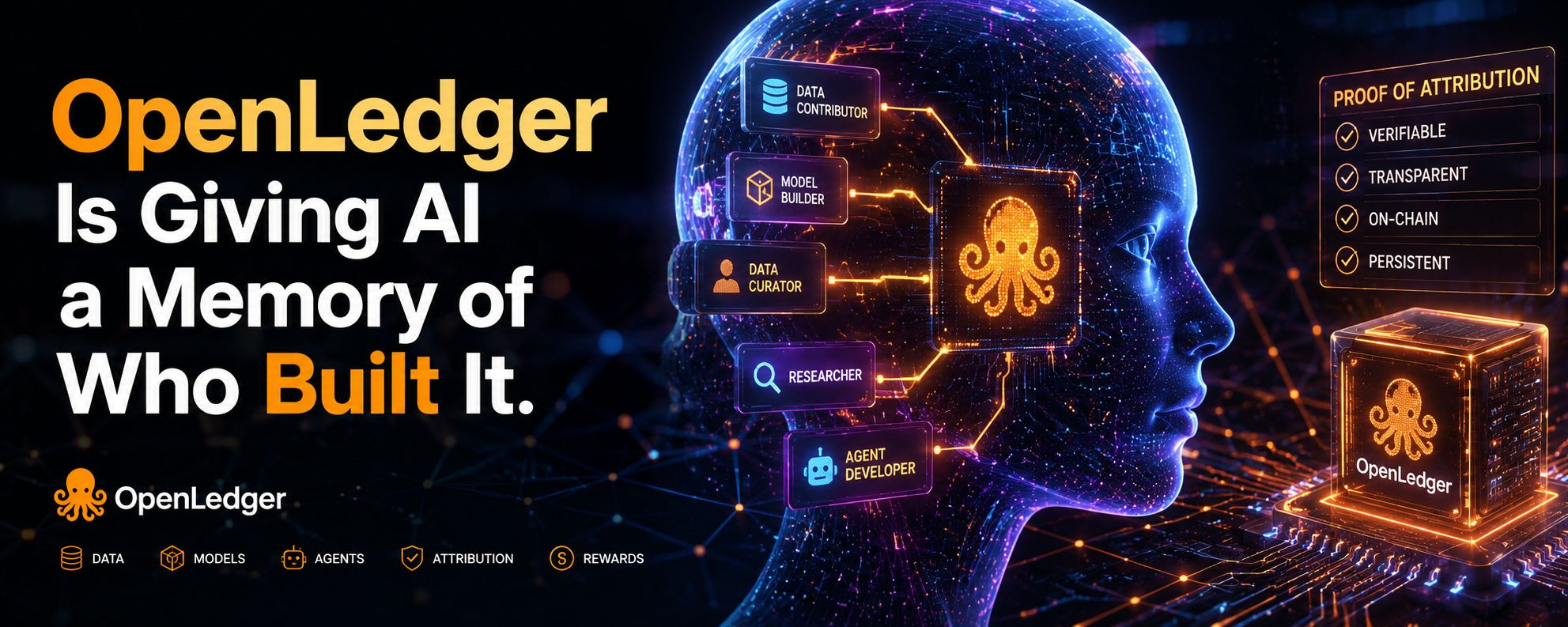

The first time I looked at OpenLedger, I did not think about it as another AI token. That label feels too easy now. Every cycle creates a few words that become so common they stop carrying meaning, and “AI blockchain” is quickly becoming one of them. What made OpenLedger more interesting to me was not the technology headline. It was the uncomfortable problem sitting underneath it: AI keeps getting smarter, but the people and inputs that make it smarter often disappear from the story.
Most of us meet AI at the cleanest possible point. We type a prompt, receive an answer, judge whether it is useful, and move on. The process feels instant. But behind that answer is a messy chain of work. Someone created the data. Someone cleaned it. Someone labeled it. Someone corrected bad outputs. Someone added domain knowledge that only an experienced person would notice. Someone fine-tuned a model for a specific use case. Someone tested the system again and again until it became reliable enough to feel natural.
That hidden work is easy to ignore because good AI is designed to hide its own complexity. The better the final product becomes, the less visible the contributors become. That is the strange part. AI can turn thousands of small human and machine contributions into one polished response, but the economic memory of those contributions is usually weak. Value moves upward to the model, the app, or the company, while the inputs behind the intelligence become background material.
This is where OpenLedger’s idea feels different to me. It is not only trying to monetize data, models and agents as separate assets. It is trying to make the path between them traceable enough that value can move back through the chain. In simple words, OpenLedger is asking whether intelligence should have a memory. Not memory in the chatbot sense, but economic memory. A way to remember who contributed what, how that contribution improved the system, and why it deserves to earn when the system creates value.
That is why I think the project is more interesting when viewed through Datanets. A Datanet is not just a storage bucket with a crypto wrapper around it. The stronger version of the idea is closer to a living knowledge garden. A community, expert group, creator, developer or data owner can build a specialized pool of information around a specific domain. That knowledge can then support models, agents and applications. If the knowledge stays useful, it should keep mattering economically. If it becomes stale, noisy or low quality, the market should eventually notice.
This matters because the old data-marketplace model has always felt incomplete to me. Selling data like a static file does not match how AI value is actually created. A dataset is not valuable only because it exists. It is valuable because it improves behavior, reduces mistakes, adds context, or helps a model perform better in a real workflow. OpenLedger’s approach becomes meaningful if it can move the market away from “who uploaded data” toward “whose contribution actually helped intelligence become more useful.”
That sounds small, but it changes the incentive structure. If contributors only get paid once, the incentive is to package information and move on. If contributors can keep earning when their data or model work continues to influence useful outputs, the incentive shifts toward maintenance, quality and specialization. This is a much healthier direction for AI. A living dataset should be treated differently from a dead archive. A carefully maintained expert Datanet should not be valued the same as a large but lazy pile of generic information.
I also like the way this reframes models. Crypto discussions around AI often focus on access to large models, but I think the next valuable layer may be smaller and more specialized. The world does not only need one giant model that knows a little about everything. It needs models that understand narrow domains deeply enough to be trusted. Finance, law, gaming, medicine, research, logistics, creative IP and DeFi all have details that general AI can miss. OpenLedger becomes more relevant if it helps these specialized models form around high-quality knowledge networks instead of treating intelligence as one universal product.
The agent layer makes this even more important. Agents are not just chat windows. They can search, route, decide, transact and execute tasks. Once agents start interacting with markets, the source of their intelligence matters. A developer may want to know whether an agent used licensed data. A business may want to know whether an answer came from a trusted model or an unknown source. A creator may want their IP used under clear rules instead of being absorbed silently. In that kind of world, attribution is not just about giving credit. It becomes part of trust, compliance and payment.
This is why Proof of Attribution is the heart of OpenLedger for me. The name can sound like a simple credit system, but I see it as something deeper. Credit is what you give after the work is done. Attribution, if it works properly, keeps the contribution attached to future value. It says that if a model, dataset or agent helped produce useful intelligence, the network should not forget it the moment the output appears.
Of course, this is where the hard part begins. AI attribution is not clean. A model does not behave like a calculator where every output can be traced neatly to one input. One small expert correction may improve thousands of future answers without appearing directly in any single response. A massive dataset may look influential by size but add little real insight. A niche dataset may be small but extremely important in a high-value domain. OpenLedger’s challenge is not simply to prove that data was present. The real challenge is to measure influence in a way that feels fair enough for builders and contributors to trust.
That is also where I think the project’s risk sits. If attribution becomes too mechanical, people may optimize for what the system can measure instead of what actually improves intelligence. If rewards flow to volume instead of quality, OpenLedger could recreate the same noise problem that already exists across many data platforms. But if the system can reward meaningful contribution, then it starts to look less like a crypto incentive experiment and more like infrastructure for a new AI supply chain.
The recent activity around OpenLedger matters because it shows the project trying to move this idea beyond theory. Mainnet progress, Datanets, agent infrastructure, attribution design, and work around licensed or community-owned knowledge all point toward one consistent direction. The project is not only saying that data has value. It is trying to build the rails for that value to be tracked, used and paid for when models and agents create demand.
For OPEN, this distinction is important. A token does not become valuable just because it is attached to AI. It becomes valuable if it sits inside a real loop of usage. Gas fees, inference payments, contributor rewards, model interactions, agent activity and governance all need to connect to actual demand. Without that, OPEN is just another symbol floating above a big narrative. With real usage, it becomes the coordination asset for a market where intelligence has traceable inputs.
My personal view is that OpenLedger should be judged by a very practical question: can it make small but valuable contributors visible? Can a niche expert earn because their knowledge improves a model? Can a community-owned Datanet become more valuable as it stays useful? Can a creator license IP into AI without losing control of the economic trail? Can an agent use intelligence with a known history instead of relying on a black box? These are not flashy questions, but they are the questions that decide whether the idea has substance.
The reason I find OpenLedger worth watching is because it focuses on a part of AI that usually feels invisible. Everyone talks about the final model. Fewer people talk about the long road that made the model useful. In my opinion, the next serious AI economy will not only reward the interface that answers the question. It will also reward the hidden work that made the answer possible.
OpenLedger is trying to build a market around that hidden work. Not by treating AI as magic, but by giving the magic a receipt. If it can make attribution credible, useful and hard to game, then it may help shift AI from a system that absorbs contribution into one that remembers contribution. And in a world where intelligence is becoming abundant, the rarest asset may not be the answer itself. It may be the proof of where that answer came from.