
Market felt slow today. One of those afternoons where you keep refreshing charts and nothing really moves, so you start clicking around just to feel productive. I ended up half-watching a podcast, half-scrolling through random project pages.
That's how I ended up back on OpenLedger.
I'd seen $OPEN mentioned a few times this week, mostly the usual "AI + blockchain" pitch, and honestly I almost scrolled past it again. I've kind of developed an allergy to that phrase. Every other launch in 2026 has been some flavor of it.
But then I read one line on their docs that kind of stuck with me. Something about attributing AI outputs back to the data that trained them. And I sat there for a second because… wait. That's actually a different framing than what I assumed.
See, here's what I thought OpenLedger was. I assumed it was another "decentralized compute" play. Rent your GPU, earn tokens, the same story we've heard since 2023. And maybe parts of it touch that, I'm not gonna pretend I read every page. But the actual idea underneath is weirder.
The pitch is basically: when an AI model gives you an answer, you should be able to trace which pieces of training data contributed to that answer. And whoever contributed that data gets paid. Every time. Forever.
Okay. Stop. Let me think about why that's interesting.
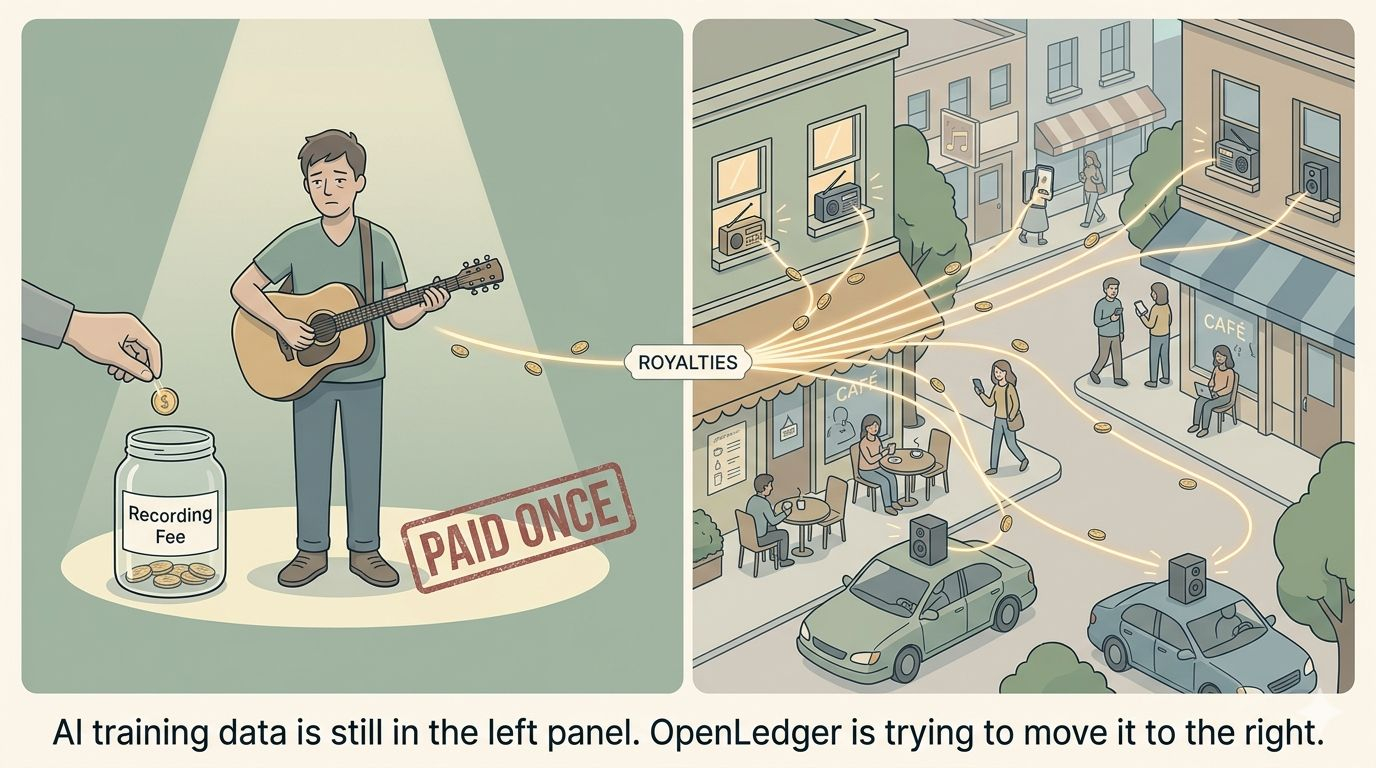
Right now, if you contribute data to train a model, you get paid once. Maybe. If you're lucky. Then the model goes on to generate billions of responses and you see zero of it. The economic relationship ends the moment training ends.
OpenLedger is trying to make that relationship continuous. The model gives an answer, the chain figures out roughly which data shaped that answer, and value flows back. Not as a vague gesture — as actual onchain attribution.
And the thing that clicked for me is… this isn't really an "AI project." It's a property rights project. It's trying to do for data what music royalties did for songs. The model is just the delivery mechanism.
That's a different angle than "we're decentralizing OpenAI." That's almost mundane. This is more like — you're building the rails for a class of asset that doesn't really exist yet in any liquid form.
But here's the part that bothers me.
Attribution in machine learning is genuinely hard. Like, mathematically hard. When a large model generates text, the contribution of any single training example is diffuse. You can approximate it, sure. There are techniques. But "approximate" is doing a lot of heavy lifting when you're paying out real money on it. Who decides the weights? What happens when contributors gamify the attribution score? I don't have a clean answer to that yet, and I don't think the team does either, fully. Some of this is gonna be figured out live.
And there's the other thing — for any of this to matter, you need models people actually use being run on this infrastructure. Not toy models. Real ones. That's a massive go-to-market lift in a space where the incumbents have ten-figure war chests and zero interest in onchain attribution slowing them down.
So I'm not sitting here thinking $OPEN is a sure thing. I'm sitting here thinking the frame is interesting in a way most AI tokens aren't. Most AI tokens are betting compute will get decentralized. OpenLedger is betting that data lineage will become an asset class. Those are very different bets with very different timelines.
I think the people who'll care about this first aren't retail. It's smaller specialized model builders — the ones training on niche datasets where attribution is actually tractable because the data is bounded. Medical, legal, code, that kind of thing. If it works there first, it earns the right to scale up. If it tries to start with general-purpose models, I think it dies in math problems before it dies in market problems.
Anyway, I might be reading too much into one docs page. That happens when the market gets boring. You start treating every tab you have open like it deserves a thesis.
Probably gonna go make coffee and see if anything actually moves before close.
@OpenLedger #OpenLedger