
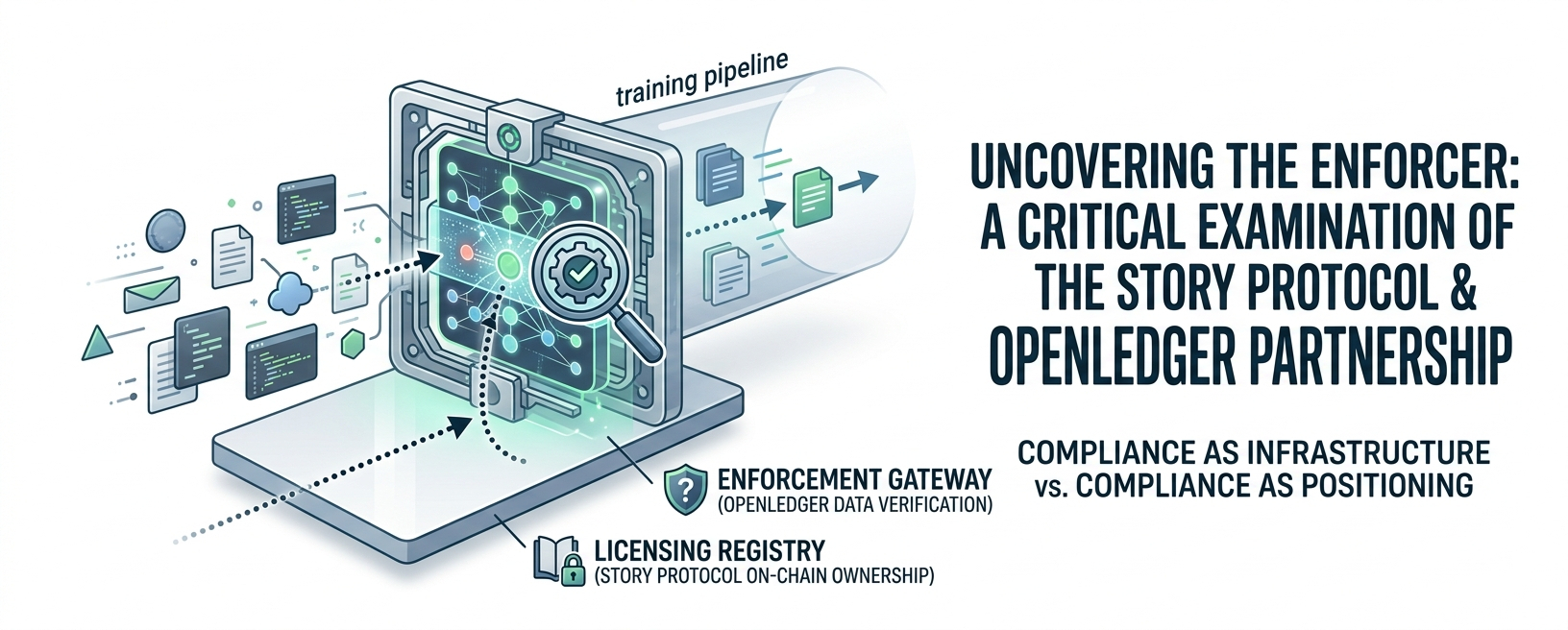
i spent a few hours last week going through the story protocol and openledger integration announcement from january 2026. not the headline. the actual mechanics underneath it. the announcement said openledger would enforce licensed AI training standards meaning when data gets contributed to a datanet, the system would verify that the contributor actually has the right to contribute it. that sounded significant enough that i wanted to understand exactly where that verification happens in the contribution flow.
so i opened the datanet interface and tried to trace it.
i found the contribution upload. i found the on-chain hash. i found the attribution record. what i couldn't find and i looked through the documentation three times was the specific step where openledger checks whether the data being uploaded is covered by a story protocol license before it enters the training pipeline. there's a described integration. there's a partnership announcement. what isn't publicly visible is the enforcement mechanism itself. not the concept. the actual gate that stops unlicensed data from entering a datanet and getting attributed as if it belonged there.
that gap bothered me more the longer i sat with it. 🔍
here's why it matters specifically to openledger's structure. the entire compliance infrastructure thesis the reason the story protocol partnership is significant, the reason the january announcement got attention, the reason openledger is positioning itself ahead of eu ai act enforcement depends on one thing being true. that the data inside openledger's datanets is actually licensed. not claimed to be licensed. actually verified as licensed at the point of entry. if the verification step is real and running, openledger has built something that almost no other AI infrastructure protocol has a provably clean data layer that enterprises can use without legal exposure. if the verification step is described but not enforced, the compliance positioning is marketing rather than infrastructure.
i've watched this distinction matter in a different context. ftx had compliance language everywhere. terms of service. user agreements. jurisdictional frameworks. what it didn't have was the actual enforcement of those frameworks at the operational layer. the gap between described compliance and enforced compliance was invisible until it wasn't. i'm not comparing openledger to ftx the situations are completely different and the scale is incomparable. but the pattern of compliance as positioning versus compliance as mechanism is one i've learned to look for specifically, and the story protocol integration triggered that pattern recognition for me.
the honest strength here is real and i don't want to understate it. openledger is the only AI blockchain that has actually partnered with a licensing registry to build this kind of infrastructure. story protocol's on-chain ownership layer is legitimate. the vision of an AI training environment where every dataset is verifiably licensed and every contributor is automatically compensated is genuinely differentiated from anything else being built right now. if the enforcement mechanism exists and is running, the compliance infrastructure thesis isn't just marketing it's a structural moat that gets stronger as regulatory pressure increases. the eu ai act timeline alone could make this the most important piece of infrastructure in the AI data space within two years.
what i'm genuinely uncertain about is whether the integration is at the enforcement layer or the framework layer. those are different things. a framework layer means openledger and story protocol have agreed on standards and built the technical bridge which is real and valuable. an enforcement layer means that bridge actively blocks unlicensed data from entering datanets before it gets attributed and rewarded which is what the compliance positioning requires to be true. one of those is infrastructure. the other is a roadmap item dressed as infrastructure. i couldn't determine from public documentation which one shipped in january, and that single question is the one i'd want openledger to answer publicly before i'd trust the compliance thesis enough to weight it heavily in any analysis of where this protocol goes next.
