
Market's been weirdly noisy lately. Not in a good way — just a lot of narratives competing for attention, most of them recycled. I was half-reading someone's thread about AI tokens when I stopped and went down a different rabbit hole entirely.
I ended up looking at @OpenLedger .
Not because it was trending. Just because someone mentioned it in passing and said something vague like "it's trying to coordinate AI systems." I didn't even know what that meant. So I kept reading.
And somewhere in there, something clicked — but not in the direction I expected.
Here's the thing people seem to get wrong when they look at OpenLedger: they frame it as an infrastructure play. Another layer. Another protocol trying to make AI more transparent or verifiable. And sure, technically, that description isn't wrong.
But that framing misses what's actually interesting about it.
What I kept coming back to is this: OpenLedger isn't really about making AI readable. It's about making AI accountable in a way that other AI systems can act on.
That's a completely different problem.
Right now, when people talk about AI coordination — multiple agents working together, multi-model pipelines, autonomous systems handing tasks off to each other — the assumption is that the bottleneck is capability. Make the models smarter. Make the APIs faster. Build better orchestration layers.
But that's not actually the bottleneck.
The bottleneck is trust. Specifically: how does one AI system know whether to trust the output or action of another AI system?
Humans solve this badly and slowly. We use reputation, credentials, social context. None of that maps cleanly to a world where agents are executing in milliseconds.
What OpenLedger seems to be building toward is an on-chain record layer where AI actions — decisions, outputs, validations — leave verifiable traces. Not for human auditors. For other systems. So that an agent downstream in a pipeline can actually query: did something that claims to be reliable actually behave reliably, historically, under these conditions?
I thought at first this was just provenance tracking. But actually it's closer to a credit score for AI behavior. Except one that lives on-chain and doesn't require a centralized authority to issue it.
That's the part that stuck.
But here's the part that bothers me.
The vision is clean. Maybe too clean.
Because for this to actually function — for agents to be querying each other's behavioral histories and making trust decisions in real time — you need the data to be standardized, comprehensive, and adversarially robust. And right now, none of that exists at scale.
You could just as easily end up with a layer that looks like coordination infrastructure but is actually just a ledger that sophisticated actors learn to game. If you can predict what gets recorded and what gets weighted, you can optimize for the record rather than the behavior.
I'm not fully convinced this holds under pressure. Especially in environments where the incentives are high enough that actors will actively try to manipulate whatever trust signal you've built.
There's also a timing question. The multi-agent world this is designed for — the one where coordination at machine speed actually requires this kind of infrastructure — isn't fully here yet. Which means OpenLedger is either early in a way that becomes foundational, or early in a way that becomes a historical footnote.
I genuinely don't know which one.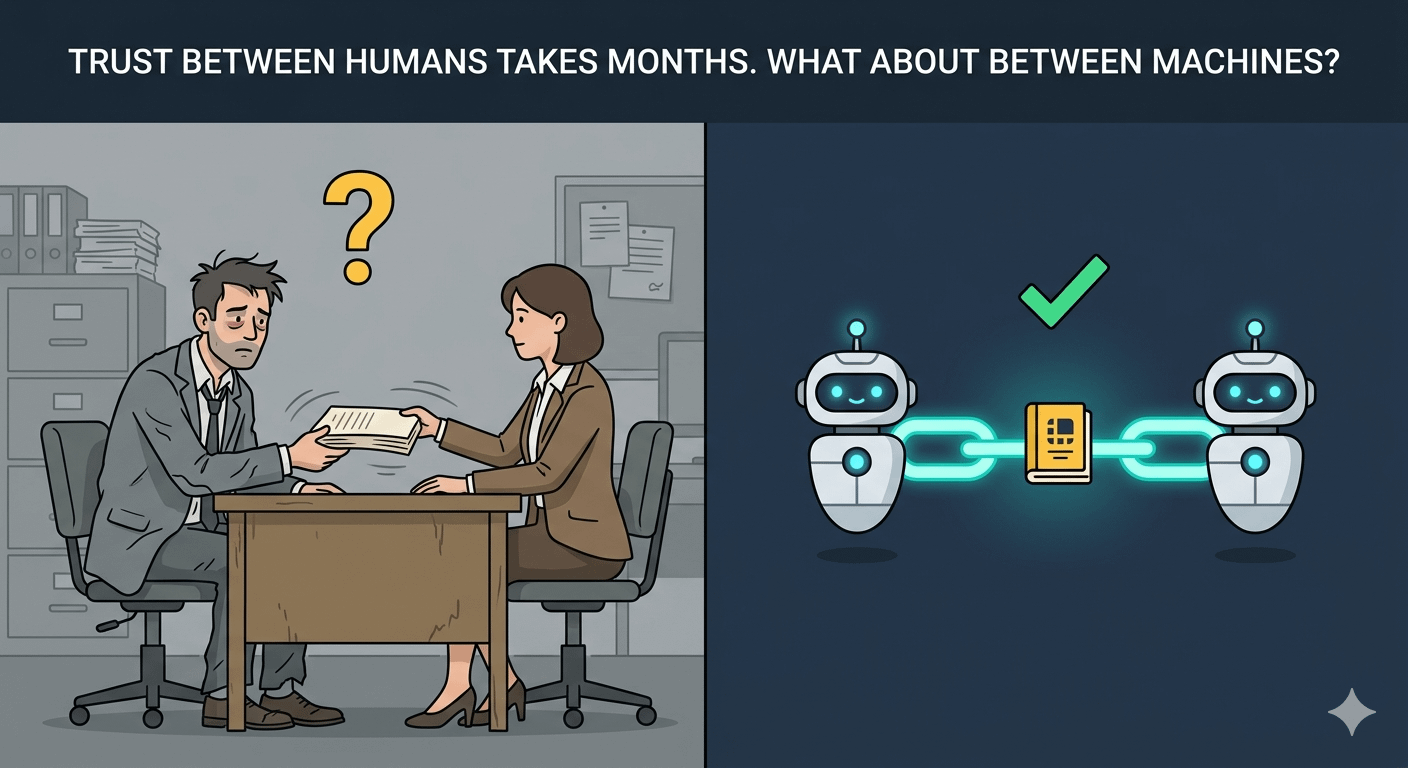
What makes me keep thinking about it, though, is that the alternative is worse. If AI systems are going to coordinate at scale — and they are, in some form — the coordination layer gets built by someone. And whoever builds it shapes what "trustworthy AI behavior" means in practice. That's not a small thing.
Right now most people are watching the model benchmarks and the chip race. The infrastructure for how AI systems actually relate to each other is getting built quietly, and nobody's really arguing about what it should look like yet.
OpenLedger might not be the answer. But the question it's asking feels more important than most of what I've been reading lately.
Anyway. Charts are still doing whatever they're doing. I'll probably just sit with this one for a while.