
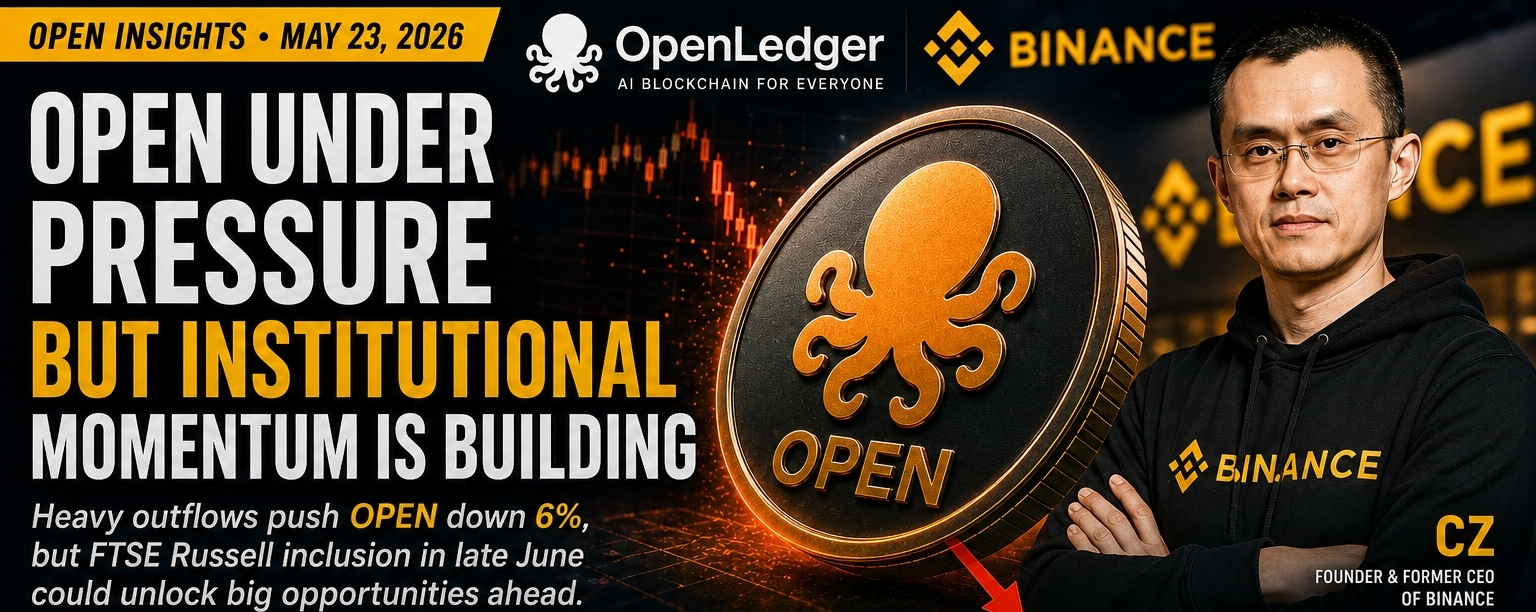
The last 24 hours have been rough for OPEN holders. I’ve been watching the charts, tracking liquidity movement, and following updates surrounding the ecosystem, and the market clearly shifted into defensive mode. OPEN dropped around 6% during the session, falling toward the 0.187 area as heavy capital outflows overwhelmed short-term bullish narratives. On the surface, it looks like another painful correction inside the AI crypto sector. But after digging deeper into the broader picture, I think the situation is more complex than simple panic selling.
What makes the current setup interesting to me is the timing. The decline is happening while OpenLedger continues strengthening its long-term institutional visibility and expanding its position within the decentralized AI infrastructure narrative. Normally, projects entering major visibility cycles receive speculative inflows. Instead, OPEN is experiencing the opposite. Traders are exiting aggressively, whales appear to be rotating capital elsewhere, and sentiment across AI-linked altcoins has become increasingly fragile.
I’ve seen similar conditions before across emerging crypto sectors. Markets often become disconnected from fundamentals during periods of fear, especially when liquidity conditions tighten and short-term traders dominate price action. Right now, OPEN feels trapped between two competing realities. One side sees the future of decentralized AI coordination and long-term institutional integration. The other side sees immediate downside pressure, massive future token unlocks, and uncertainty surrounding adoption speed.
The strongest short-term bearish factor remains capital outflows. Net flows over the last 24 hours showed sustained selling pressure dominated by large transaction exits. When whales begin moving liquidity out of smaller-cap ecosystems during uncertain market phases, the impact becomes amplified because liquidity depth is thinner than larger assets like BTC or ETH. That’s exactly what appears to be happening now.
I’ve always believed that flow data tells a more honest story than social media sentiment. Communities can remain optimistic for weeks while liquidity quietly disappears underneath them. In OPEN’s case, price weakness aligned directly with aggressive outflows, confirming that this wasn’t just retail panic. Larger holders were actively reducing exposure.
At the same time, technical indicators reached levels that usually attract attention from experienced traders. The short-term RSI dropping toward 25.4 signals extreme oversold conditions. Whenever momentum becomes this stretched to the downside, markets often enter stabilization phases even if broader bearish conditions remain intact.
Personally, I never treat oversold readings as automatic buy signals. Crypto markets can remain oversold longer than people expect. But historically, when RSI collapses this aggressively while a project still maintains strong long-term narratives, volatility tends to increase dramatically. That creates opportunities for both rapid rebounds and deeper liquidation cascades.
What’s fascinating about OPEN is that the project’s long-term institutional story actually improved this month despite the selloff. FTSE Russell officially initiated its June 2026 reconstitution process, and discussions surrounding index-related exposure have quietly expanded across institutional circles. (lseg.com)
I think many retail traders underestimate how important institutional recognition can become for infrastructure-focused ecosystems. Passive index flows don’t usually create explosive overnight rallies, but they often establish long-term liquidity foundations. Inclusion narratives help legitimize ecosystems in the eyes of larger investors who otherwise avoid high-volatility emerging sectors.
The problem is that institutional narratives operate on slower timelines than crypto speculation. Traders want immediate price appreciation. Index exposure works gradually. Because of that mismatch, markets often ignore institutional developments until liquidity actually arrives.
I’ve noticed something similar happen repeatedly in previous cycles. Early-stage infrastructure projects receive major announcements, yet price continues falling because traders focus entirely on current market conditions instead of future positioning. Months later, sentiment suddenly reverses once larger capital allocators begin participating.
Whether OPEN eventually follows that path remains uncertain, but the current disconnect between price action and institutional visibility is impossible to ignore.
From a technological perspective, OpenLedger continues targeting one of the fastest-growing areas inside crypto: decentralized AI infrastructure. (openledger.xyz) The project’s core mission revolves around monetizing data, models, and AI agents through blockchain-based attribution systems.
That idea matters because the AI economy currently suffers from massive ownership and compensation problems. Most artificial intelligence systems rely on enormous datasets and distributed computational resources, yet contributors rarely receive transparent rewards proportional to their value creation.
OpenLedger is attempting to solve that imbalance by creating blockchain infrastructure where datasets, models, and agent activity can be tracked and monetized on-chain. In theory, this creates a fairer AI economy where contributors earn measurable value instead of centralized corporations capturing most profits.
I find that narrative compelling because it addresses a real structural issue rather than simply attaching “AI” branding onto another speculative token. The combination of blockchain transparency and AI attribution has genuine long-term potential if execution succeeds.
Still, execution risk remains substantial.
One issue I keep coming back to is adoption complexity. Decentralized AI coordination sounds powerful conceptually, but onboarding users into technically advanced ecosystems is extremely difficult. Most developers and businesses prioritize simplicity over ideological innovation. If integration requires steep learning curves or complicated attribution mechanisms, adoption slows dramatically.
I’ve experimented with enough blockchain-based AI tools to understand this challenge personally. The technology can be impressive while the user experience remains frustrating. That disconnect often limits mainstream traction even when the underlying infrastructure is genuinely innovative.
OpenLedger’s long-term success probably depends less on theoretical capability and more on whether the ecosystem becomes simple enough for broader developer participation.
Another concern involves tokenomics. The projected 330 million token unlock scheduled for September 2026 continues hanging over the ecosystem like a cloud. Supply expansion events this large can fundamentally reshape market dynamics regardless of technological progress.
According to current circulating supply estimates, the unlock could more than double available market supply. (coinmarketcap.com) Even strong ecosystems struggle under that kind of dilution pressure unless adoption growth accelerates fast enough to absorb incoming liquidity.
I think that’s one reason many traders remain cautious despite believing in the AI infrastructure narrative. Future supply shocks create uncertainty around long-term valuation stability.
Crypto markets are extremely sensitive to dilution risk because traders constantly calculate future sell pressure. Large unlock schedules often suppress rallies long before tokens actually enter circulation. Markets price expectations early.
Beyond tokenomics, there’s also the issue of systemic liquidity vulnerability tied to AI-managed vault systems. OpenLedger’s ecosystem discussions increasingly reference automated capital management frameworks utilizing ERC-4626 vault structures.
On paper, automated AI-driven capital allocation sounds efficient and innovative. In practice, synchronized de-risking behavior can become dangerous during periods of market stress. If multiple autonomous systems simultaneously reduce exposure during volatility spikes, liquidity can evaporate quickly.
I think many people underestimate how fragile automated ecosystems become under pressure. Human traders panic emotionally, but algorithmic systems can trigger chain reactions at machine speed. In smaller ecosystems with thinner liquidity profiles, those reactions become amplified.
This is especially important because AI-agent infrastructure remains relatively untested during major prolonged bear markets. We still don’t fully understand how autonomous treasury systems behave under extreme stress conditions.
Despite all these risks, I’m not bearish on the broader AI-blockchain sector itself.
Actually, I think decentralized AI infrastructure may become one of the defining narratives of the next crypto expansion cycle. Capital continues flowing toward projects focused on compute markets, data monetization, autonomous agents, and decentralized model coordination.
The reason is simple: artificial intelligence is becoming economically central across nearly every industry. As AI systems expand, demand for decentralized ownership, transparent attribution, and permissionless coordination increases alongside them.
That’s why OpenLedger still attracts attention even during aggressive corrections. The project operates inside a sector many investors believe has multi-year growth potential.
What I find psychologically interesting right now is how quickly market sentiment changed. Only weeks ago, excitement around AI-linked crypto ecosystems dominated trading conversations. Now many traders appear exhausted, frustrated, and uncertain
This emotional shift is common during emerging-sector corrections. Early hype attracts momentum traders. Once volatility arrives, weak conviction disappears rapidly. But historically, some of the strongest long-term opportunities emerge precisely during these emotionally negative periods.
I’m not saying OPEN automatically rebounds from here. Markets don’t reward optimism alone. But sentiment-driven selling often overshoots underlying reality, especially in high-volatility sectors.
Another factor worth monitoring is how macro crypto conditions evolve over the next month. AI infrastructure tokens rarely move independently from broader market liquidity. If Bitcoin stabilizes and risk appetite improves across altcoins, oversold AI ecosystems could recover quickly.
On the other hand, if broader crypto conditions deteriorate further, smaller infrastructure projects like OPEN may face another wave of de-risking regardless of ecosystem progress.
That’s why I’m paying close attention not only to OpenLedger-specific developments but also to broader liquidity conditions across AI and infrastructure sectors.
I’m also watching whether developers continue building despite market weakness. In crypto, sustained development activity during bearish periods often matters more than short-term price performance. Teams that continue expanding infrastructure through difficult conditions usually emerge stronger once market sentiment improves.
OpenLedger’s positioning around AI data monetization and agent coordination still gives it a unique angle inside the decentralized AI landscape. The challenge now is proving the ecosystem can maintain growth momentum while navigating heavy selling pressure and future supply expansion.
One thing I’ve learned from years in crypto is that markets rarely move in straight lines. Strong narratives experience brutal corrections. Weak projects sometimes rally irrationally. Emotional reactions dominate short-term price movement far more than most people admit.
Right now, OPEN sits directly inside that emotional conflict.
Bears see capital outflows, dilution risk, adoption friction, and systemic liquidity vulnerabilities. Bulls see oversold momentum, institutional visibility expansion, decentralized AI infrastructure growth, and long-term monetization potential.
Both sides have legitimate arguments.
Personally, I think the next several weeks are critical. If outflows begin slowing while institutional narratives continue strengthening into June’s FTSE Russell implementation period, sentiment could stabilize faster than expected. Oversold conditions combined with improving liquidity often create violent recovery rallies in crypto markets.
But if selling pressure persists and traders continue pricing in future unlock fears aggressively, OPEN could remain trapped inside a prolonged consolidation or even experience deeper downside.
For now, the market clearly prioritizes fear over future opportunity.
Still, some of the most important accumulation phases in crypto history emerged during periods where narratives looked strongest fundamentally while prices looked weakest emotionally.
Whether OPEN eventually becomes one of those stories depends entirely on execution, adoption growth, liquidity management, and the ecosystem’s ability to survive upcoming supply pressures without losing long-term investor confidence.
I’m staying cautious, but I’m definitely still watching closely.