

I was scrolling through OpenLedger activity late at night when one update made me stop for a second and reread it carefully.
OctoClaw v1.0.1.
Not a governance proposal. Not another roadmap graphic. Not a token announcement dressed up as “ecosystem growth.”
An actual desktop release.
A downloadable AI agent client connected to the OpenLedger network.
Maybe that sounds minor, but it changed the way I looked at the project almost immediately.
Most blockchain ecosystems spend months talking about infrastructure without ever reaching the point where the technology feels tangible. You interact with dashboards, wallets and staking pages, but very little feels like software built for normal usage.
OctoClaw felt different.
Not because the idea itself is revolutionary. AI agents are everywhere now. Every week another framework launches claiming to automate research, execution or content generation more efficiently than the last one.
What caught my attention was the layer underneath it.
The more I read about how OpenLedger structured OctoClaw around its Proof of Attribution system, the less this looked like a simple AI productivity tool.
It started looking more like an accountability system disguised as an agent framework.
And I think that difference matters.
The basic pitch is easy to understand. One interface where an AI agent can handle workflows across different model providers without forcing users into separate tools for every task.
Simple enough.
But OpenLedger’s architecture adds another process beneath the visible workflow itself.
Normally, AI tools stop at execution.
You request something. The model responds. Task finished.
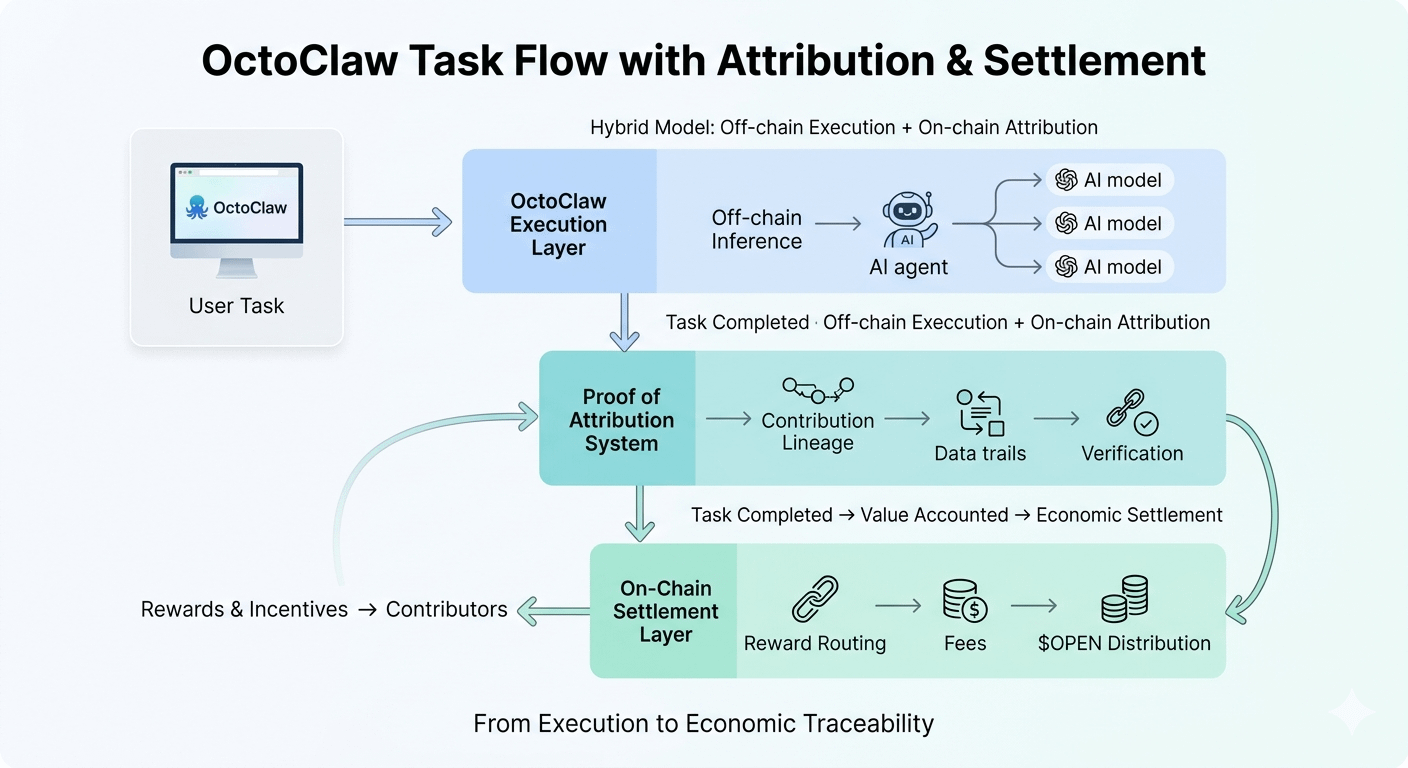
Here, execution appears to trigger another chain entirely.
The output gets linked back toward attribution data. Contribution history gets processed. Reward routing activates through the network. Settlement happens through the protocol layer.
In other words, the task is not just being completed.
It is being accounted for.
That idea stayed in my head because most AI infrastructure today still focuses almost entirely on capability.
Better outputs. Faster models. More autonomous systems.
Very little attention goes toward tracking how value moves after generation happens.
And honestly, that may become the harder problem long term.
Especially once AI systems move deeper into financial products, enterprise operations and automated decision environments where accountability starts mattering as much as raw performance.
That is where OpenLedger feels slightly different from a lot of other AI + crypto projects.
It is not only trying to coordinate execution.
It is trying to coordinate attribution.
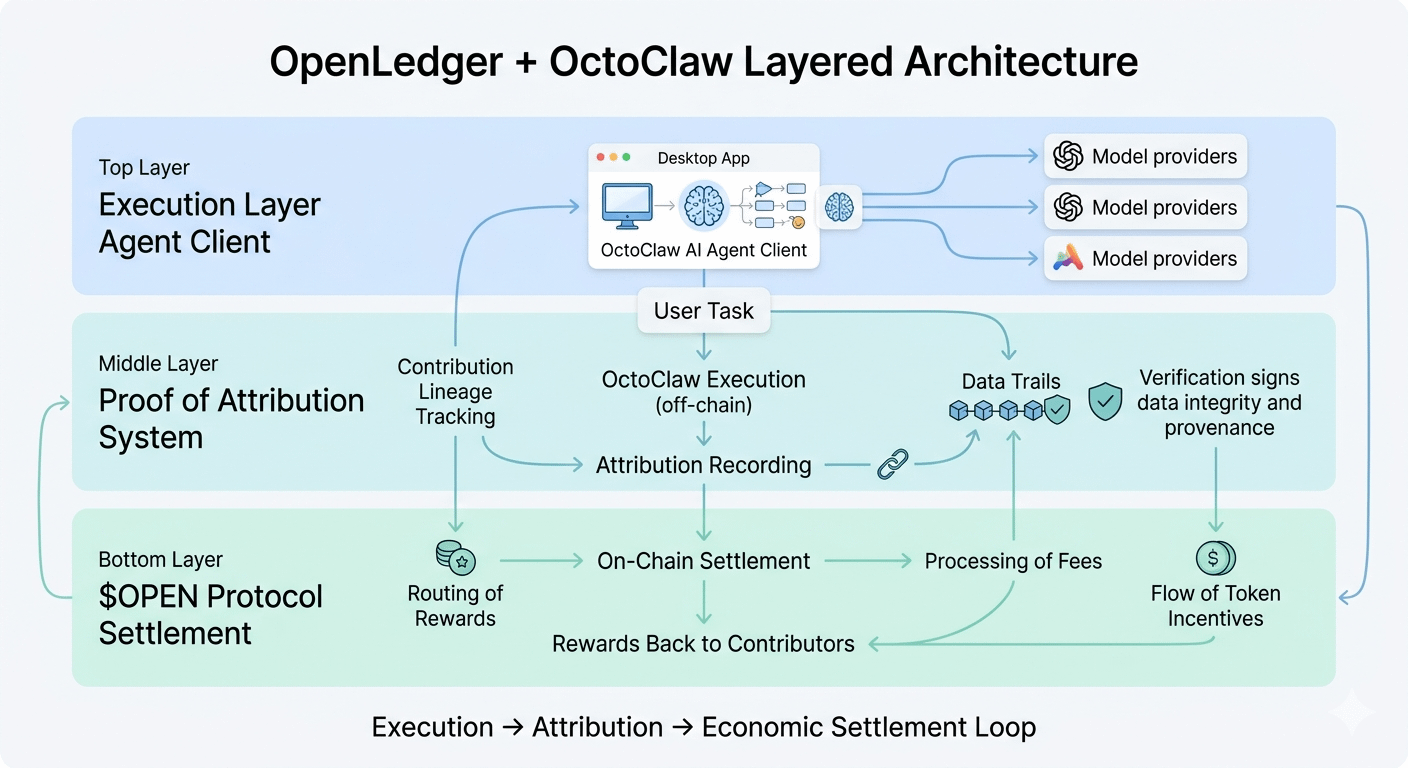
The architecture seems built around three connected layers.
First comes the execution layer itself through OctoClaw.
Underneath that sits the Proof of Attribution system processing contribution lineage.
Then below that is the settlement layer where rewards, fees and incentives move through $OPEN.
Each layer depends on the next one.
The agent completes work. The attribution system records economic contribution. The protocol routes value back through participants.
At least conceptually, it is a very clean loop.
But this is also where I became more cautious while reading deeper into it.
Because systems always look cleaner in diagrams than they do under real conditions.
OctoClaw still operates across a hybrid structure where most inference happens off-chain while settlement and attribution move through OpenLedger’s Layer 2 environment.
That design choice is practical. Running large-scale AI execution fully on-chain would be painfully inefficient right now.
Still, hybrid systems create another dependency: trust in the bridge connecting off-chain execution with on-chain verification.
And those bridges are usually where complexity starts accumulating quietly.
The documentation explains the architecture smoothly, but real usage environments tend to expose edge cases very quickly.
That does not mean the design is flawed.
It just means accountability systems become difficult once scale enters the picture.
I kept thinking about this while looking at reports around autonomous agent activity connected to the network.
Big numbers always sound impressive in crypto.
But activity volume alone does not explain much.
The more important question is whether attribution itself remains meaningful as usage scales.
Because there is a difference between agents generating workflow traffic and agents generating economically valuable attribution signals.
One measures throughput. The other measures whether the coordination model actually works.
And I am not sure that distinction is fully visible from the outside yet.
The Claw Wallet release earlier this year made me think the team understands these risks at least partially. Features like isolated key management and malicious contract monitoring suggest they know autonomous agents introduce new security assumptions once execution and settlement become linked.
That matters.
But attribution accuracy is still a separate challenge entirely.
AI systems do not preserve clean contribution trails naturally. Data gets transformed constantly through training pipelines, filtering systems, retrieval layers and optimization methods.
Tracing influence sounds simple in theory. In practice it becomes blurry very fast.
Which is why I think OpenLedger is attempting something more difficult than most people realize.
Not just decentralized AI tooling.
Economic traceability for machine-generated outputs.
That is a very different category of problem.
And maybe the market still sees only the surface layer because the interface is easier to understand than the accounting infrastructure underneath it.
Most users will probably evaluate OctoClaw based on convenience: Does it work well? Is the workflow smooth? Can it replace other tools?
Fair questions.
But I suspect the more important test happens deeper in the stack.
Will developers actually build around attribution as a meaningful layer? Or will it slowly fade into background infrastructure nobody pays attention to unless something breaks?
That is the part I still keep thinking about.
Because if AI systems eventually become deeply integrated into economic activity, attribution may stop being optional metadata.
It may become necessary infrastructure.
And if that happens, OctoClaw could end up being remembered less as an AI client and more as the first visible interface into OpenLedger’s larger coordination system underneath.