
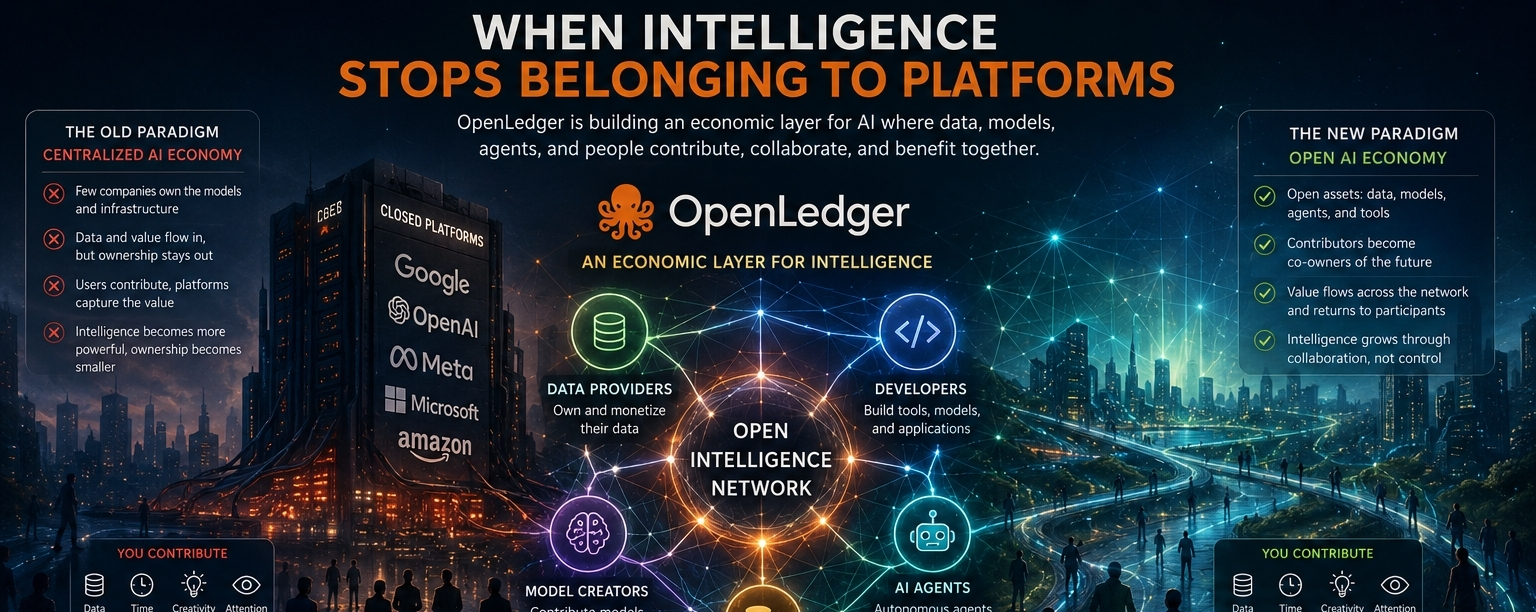
@OpenLedger There is a quiet pattern repeating itself across the AI industry. The technology becomes more powerful, the narratives become bigger, but ownership keeps becoming smaller. A few companies train the models, control the infrastructure, absorb the data, and everyone else participates from the edges. Most people interacting with AI today are contributing value to systems they will never truly own. That imbalance is slowly becoming normalized, which is why projects like OpenLedger feel interesting in a way that goes beyond market excitement or trend cycles.
OpenLedger does not seem obsessed with selling AI as magic. Its direction appears more focused on something quieter and probably more important: building an economic layer around intelligence itself. Instead of treating AI like a closed product, the project leans toward the idea that data, models, and autonomous agents could become open assets that different participants can contribute to and benefit from. In a space filled with projects chasing attention, that shift in philosophy stands out.
What makes the idea compelling is not complexity, but perspective. Most AI conversations revolve around capability — which model is smarter, faster, cheaper, or more human-like. OpenLedger seems more concerned with coordination. Who owns the inputs that make AI valuable? Who benefits when systems improve? And can intelligence evolve through a network rather than through a single centralized platform? Those questions matter because the future AI economy may depend less on individual models and more on the ecosystems surrounding them.
The structure behind the project appears to revolve around turning contributions into something economically visible. Data providers, developers, model creators, and agents all become part of the same environment instead of existing as invisible background labor. The blockchain layer is not simply there for branding purposes; at least conceptually, it acts as a mechanism for tracking participation, distributing incentives, and allowing interactions between different AI components to happen in a more open way. The ambition is not merely to build another AI application, but to create infrastructure where intelligence can circulate between contributors instead of remaining trapped inside corporate silos.
That is also where the token begins to matter. In many crypto projects, tokens feel disconnected from reality, inserted into systems that would function perfectly well without them. OpenLedger only works long term if the economic layer feels natural rather than forced. If agents, models, and datasets are genuinely interacting inside the ecosystem, then a native asset used for coordination and value exchange starts to make sense. But that balance is fragile. A token can either reinforce a productive network or distort it completely through speculation and short-term incentives. The difference usually depends on whether people are staying because the system is useful or because rewards temporarily exist.
Human behavior will probably determine the outcome more than the technology itself. Sustainable networks are built when participants want to improve the ecosystem because their future is connected to it. Weak networks attract extraction. This is especially difficult in crypto, where many users are conditioned to move quickly from one incentive structure to another. OpenLedger’s challenge is creating an environment where contribution compounds over time instead of collapsing once the initial momentum fades. AI systems naturally improve through accumulated interactions, refined models, and growing datasets, so there is at least a philosophical alignment between long-term participation and the nature of the product itself.
What makes the project feel genuinely worth watching is timing. AI is moving toward a world where autonomous agents, data ownership, and machine coordination could become entire economies of their own. Most companies are approaching that future through centralization. OpenLedger is experimenting with the opposite direction before the rules are fully established. That does not guarantee success, but it does make the project intellectually relevant.
At the same time, the risks are real and impossible to ignore. Centralized AI companies possess enormous advantages in compute, capital, distribution, and research talent. Open systems are often slower, messier, and harder to coordinate. There is also the danger that decentralized contribution models attract noise faster than quality. Incentives can create activity very quickly, but meaningful ecosystems require trust, consistency, and actual utility. Many projects discover too late that participation driven only by rewards disappears the moment rewards weaken.
There is also a larger uncertainty hanging over the entire AI sector. Nobody fully knows what the infrastructure layer of artificial intelligence will look like five years from now. The technology is evolving too quickly. Entire assumptions about data, models, and compute could change. That means projects like OpenLedger are operating inside an environment where experimentation is necessary, but permanence is far from guaranteed.
Maybe that is the healthiest way to view it. Not as a finished system destined to dominate, but as an early attempt to rethink who benefits from intelligence in the first place. In a market crowded with noise, certainty, and exaggerated promises, there is something refreshing about projects that are at least trying to explore deeper structural questions. OpenLedger may succeed or fail, but the idea behind it reflects a broader shift already beginning to happen — the realization that the future of AI will not only be about how intelligent machines become, but about whether the value they create remains open or disappears into a handful of closed platforms once again.