
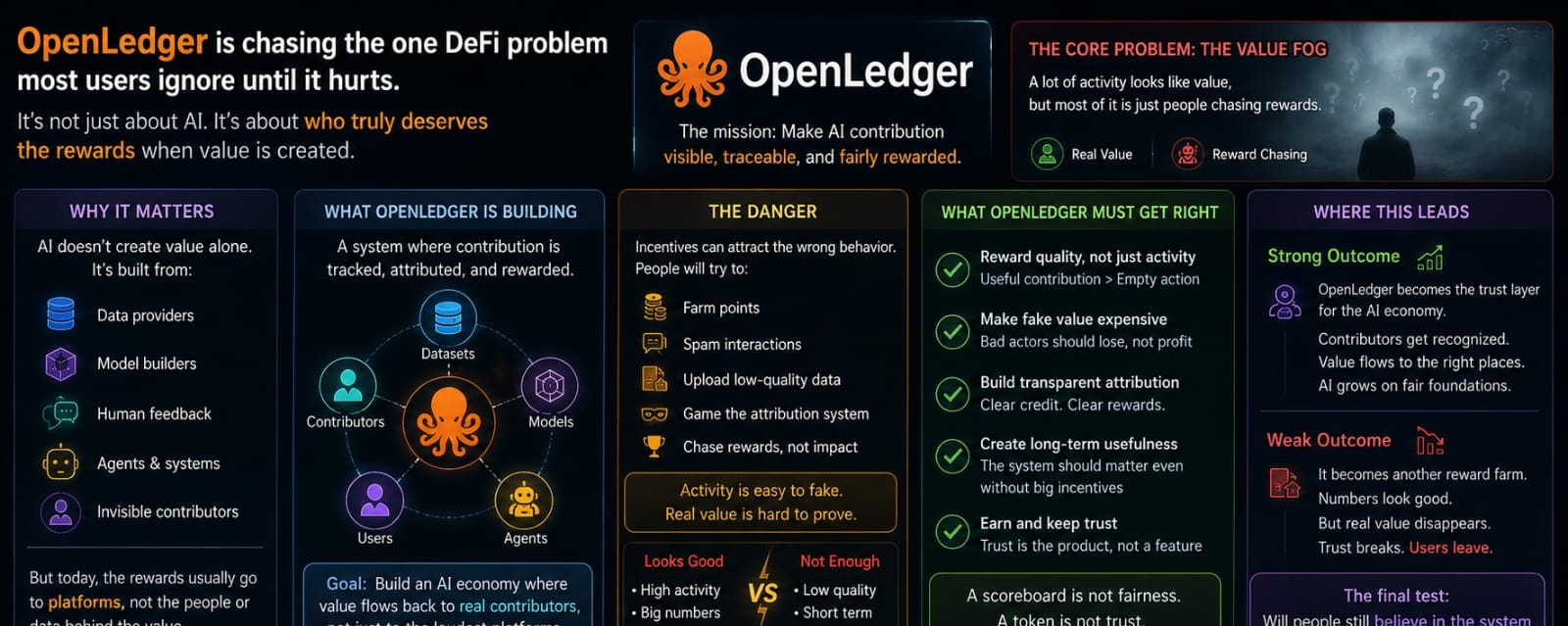
I’m watching OpenLedger closely, but not because the hype around it is loud. Hype is cheap in crypto. What interests me is that OpenLedger is trying to touch a problem most people only care about after they lose money, miss rewards, or realize the system never really knew who created the value in the first place.
That is where OpenLedger becomes interesting.
Not because it has another AI story.
Not because it uses big words around data, agents, or attribution.
Not because the market likes anything with AI attached to it.
I’m watching because OpenLedger is dealing with something more uncomfortable.
Who actually deserves to get paid when AI creates value?
That sounds simple until real users enter the system.
Crypto users do not behave like calm philosophers. They behave like traders, farmers, hunters, early adopters, and sometimes professional opportunists. Give people rewards, and they will study the rules. Give them points, and they will optimize. Give them a future token story, and they will turn every action into a strategy.
This is the problem OpenLedger has to survive.
I call it the Value Fog.
Value Fog is what happens when a project sees a lot of activity, but nobody is fully sure how much of it is real value and how much of it is people moving because rewards might be waiting.
OpenLedger is trying to clear that fog.
The project’s whole idea is built around making AI contribution more visible. Data should not just disappear into a model. Human input should not become invisible. Useful contributors should not be treated like background noise. If someone helps improve an AI system, that contribution should be traceable, measurable, and maybe even rewarded.
That is a strong idea.
But it is also a dangerous one.
Because the moment OpenLedger starts rewarding contribution, people will try to manufacture contribution.
That is not hate. That is just crypto.
We saw it in DeFi. Liquidity looked real until incentives slowed down. Volume looked healthy until people admitted half the action was reward chasing. Communities looked loyal until the airdrop was done. Everyone said “ecosystem growth,” but sometimes it was just users farming the system as efficiently as possible.
OpenLedger has to avoid becoming that same pattern with AI.
And that is not easy.
Because AI contribution is harder to measure than DeFi liquidity.
In DeFi, at least you can see the pool. You can see the liquidity. You can see capital enter and leave. It may be mercenary, but it is visible.
With OpenLedger, the value is more subtle.
A dataset may help a model.
A user may improve an output.
A contributor may add something useful.
An agent may depend on a piece of information.
A feedback loop may become valuable over time.
But how do you know what truly mattered?
That is the hard part.
OpenLedger is trying to build around attribution, and attribution sounds clean when it is written in a roadmap. In reality, attribution is messy. People argue over credit. People overstate their role. People find ways to look useful. People chase systems that reward visible action, not quiet quality.
So the real question is not whether OpenLedger can attract users.
It probably can.
The real question is whether OpenLedger can attract useful behavior.
That is a very different thing.
A user clicking around is not the same as a contributor adding value. A wallet interacting with a system is not the same as real demand. A campaign creating activity is not the same as a network becoming necessary.
OpenLedger needs to prove that its economy is not just busy.
It needs to prove it is honest.
That is why I think the project is worth watching from the sidelines. It is not trying to solve a fake problem. AI really does have a hidden value problem. A lot of people, datasets, and small contributions help create intelligence, but the final reward usually moves toward the platform, the model, or the app.
OpenLedger is saying that this hidden layer should matter.
That feels right.
But feeling right is not enough.
Crypto history is full of projects with good intentions and broken incentive loops. The idea starts clean. Then rewards arrive. Then users begin optimizing for the reward instead of the mission. Then the system has to decide whether it wants real value or just impressive numbers.
This is where OpenLedger will be tested.
If OpenLedger rewards useful contribution, it becomes serious infrastructure for the AI economy. It can give data providers, builders, agents, and contributors a reason to participate in a system where value does not just flow upward and disappear.
But if OpenLedger mostly rewards activity, then it risks becoming another farming layer with better language.
That difference matters.
Because OpenLedger is not only selling participation. It is asking people to believe that contribution can be tracked fairly. It is asking users to believe that rewards can follow real value. It is asking the market to trust that its system knows the difference between someone helping the network and someone gaming it.
That is a big promise.
And in crypto, big promises get attacked by human behavior.
People will test OpenLedger.
They will look for shortcuts.
They will farm whatever can be farmed.
They will try to turn attribution into a scoreboard.
They will chase rewards before they care about the deeper mission.
OpenLedger has to be ready for that.
The project cannot just count actions. It has to judge quality. It cannot just reward presence. It has to reward usefulness. It cannot just create a points economy and hope real value appears later.
That is how weak systems break.
What makes OpenLedger interesting is that it is trying to build trust before the AI economy gets even more chaotic. As AI agents, datasets, models, and users start interacting more directly, the question of who created value will become harder to ignore.
OpenLedger wants to be part of that answer.
Maybe that becomes important.
Maybe it becomes another overbuilt system waiting for real demand.
I’m not ready to call it either way.
But I do think OpenLedger is aiming at a real wound in the market. AI needs better attribution. Crypto needs better incentives. Contributors need better visibility. And users need systems that do not confuse noise with value.
That is the whole tension.
OpenLedger could become a serious trust layer for AI contribution.
Or it could become another place where people perform value because the reward system makes performance profitable.
The idea is strong enough to watch.
The risk is obvious enough to stay skeptical.
Because OpenLedger will not be judged by how many people show up when incentives are exciting.
It will be judged by whether people still trust the system when the easy rewards stop doing the convincing.