
I personally see OpenLedger’s Proof of Attribution as a very important idea because it tries to solve something most people ignore in AI: where the data comes from, who contributed it, and who should get credit when that data becomes useful.
For me, this is not just another blockchain feature. It feels bigger than that. AI is growing fast, and every model depends on data. But the people behind that data are usually invisible. Their work helps train systems, improve answers, and create value, yet most of the time they receive no recognition. That is why I am watching this topic closely. It shows how AI may become more transparent, more fair, and more connected to real ownership.
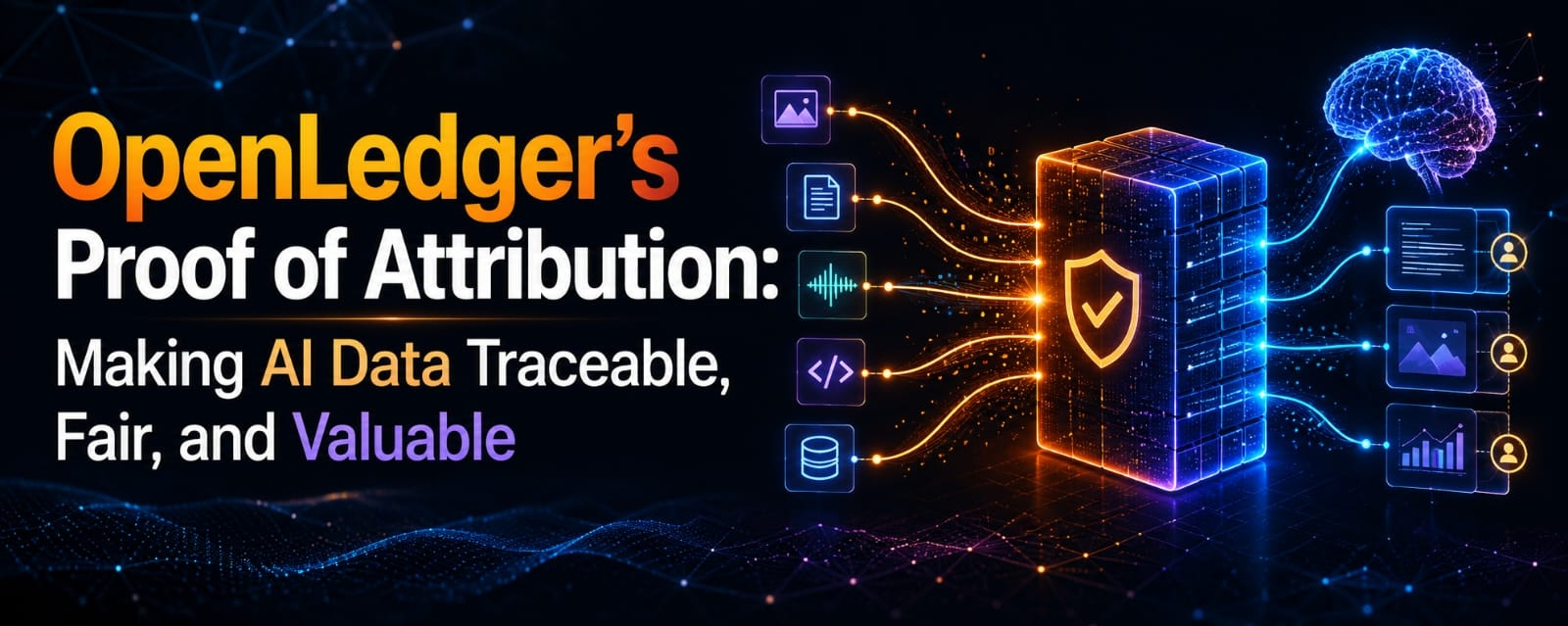
In simple words, OpenLedger’s Proof of Attribution is about making AI data traceable. It tries to show which data helped an AI model produce a result. Instead of data going into a model like a black box, the system creates a record of contribution. This means if someone provides useful data, and that data helps an AI model perform better or generate a better answer, the contribution can be identified.
This matters because AI today is built on massive amounts of information. Some of it comes from public sources, some from communities, some from experts, and some from private datasets. But once that information enters an AI system, it becomes very hard to know what influenced what. OpenLedger is trying to create a structure where data is not just used and forgotten. It becomes part of an economic system where contribution can be tracked and potentially rewarded.
The process is not too hard to understand if we break it down.
First, data contributors provide information. This could be research data, industry data, community knowledge, or any useful dataset that can improve AI models. Then developers or AI systems use this data to train models or improve their performance. After that, when the AI model gives an output, Proof of Attribution helps connect that output back to the data that influenced it.
That connection is the main point.
If a dataset plays a role in improving an AI result, the system can recognize it. And if it can recognize it, then it can also create a path for reward. This is where the idea becomes powerful. Data is no longer just a raw material that big systems consume. It becomes something with ownership, value, and economic meaning.
A simple example can make this clearer. Imagine a group of financial analysts provides high-quality market data to an AI system. Later, that AI system gives better insights because of their data. In the usual model, nobody really knows whose data helped. The analysts may get nothing after sharing valuable information. But with Proof of Attribution, their contribution could be traced. If their data helped the AI output, they could receive credit or rewards.
That changes the relationship between data creators and AI builders.
It also creates a stronger reason for people to contribute better data. If contributors know their work can be tracked and valued, they may be more willing to share specialized information. This can improve AI quality because better data usually means better results.
But this idea is not only about rewards. It is also about trust.
Right now, many people use AI without knowing how answers are formed. They do not know what information shaped the response or whether the source was reliable. A system like Proof of Attribution can help make AI more accountable. It can give users and builders more confidence because there is a clearer record behind the output.
Still, there are challenges.
Attribution in AI is not simple. AI models learn from many pieces of data at the same time, so it can be difficult to measure exactly how much one dataset contributed to one answer. Privacy is another issue. If data is sensitive, the system must protect it while still proving that it had value. There is also the challenge of adoption. Even a strong idea needs developers, projects, and users to actually use it in real products.
So I do not see this as a finished solution that automatically fixes everything. I see it as an important step.
OpenLedger’s Proof of Attribution points toward a future where AI data is not hidden in the background. It becomes visible. It becomes measurable. And maybe most importantly, it becomes economically traceable.
In my view, this is where the AI economy needs to go. If AI is going to create huge value from human knowledge, then the people and communities behind that knowledge should not stay invisible forever. They should have a way to prove their contribution and benefit from it.
That is why I think this topic matters. It is not only about OpenLedger. It is about the future of AI ownership, data fairness, and decentralized intelligence. AI will keep growing, but the real question is whether that growth will be fair for everyone who helps build it. OpenLedger’s Proof of Attribution is trying to answer that question, and for me, that makes it worth watching closely.
