
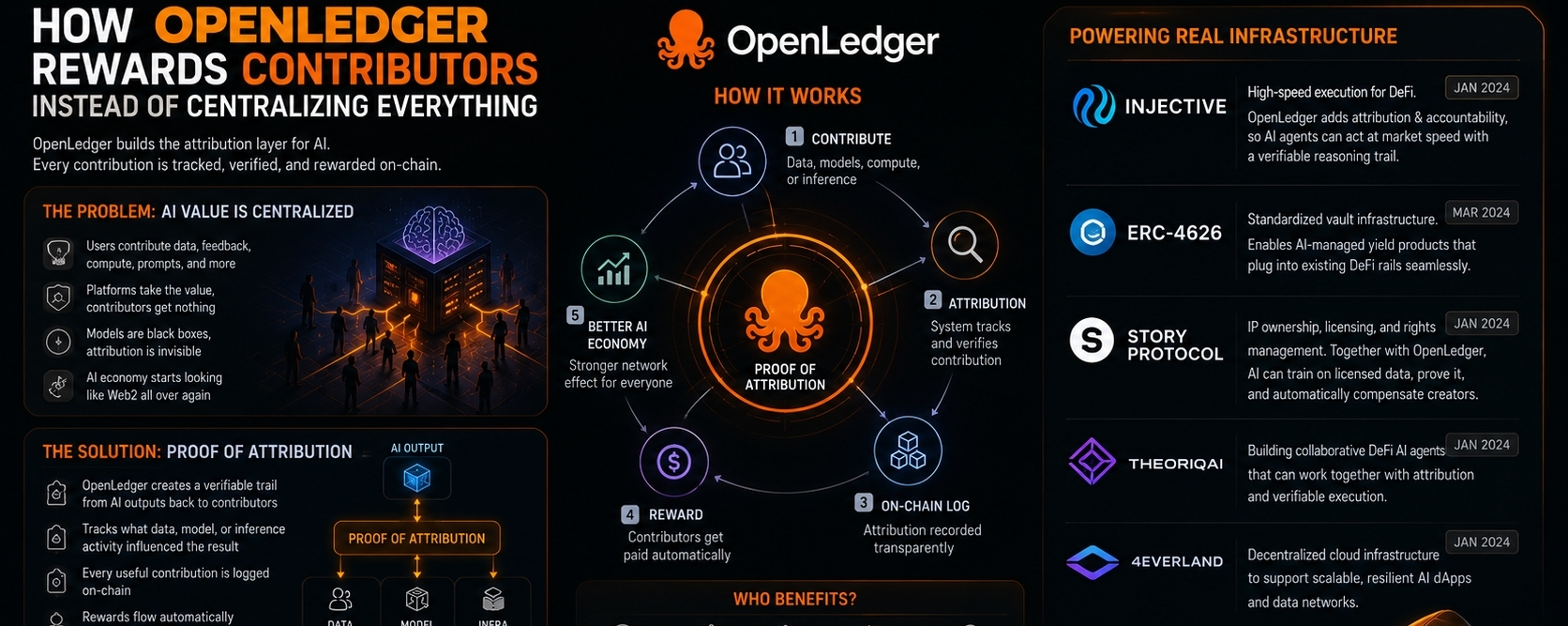
Most AI projects today talk about decentralization, but when you look closer, the value flow still feels incredibly centralized.
The models get smarter because millions of people contribute data, feedback, compute, prompts, or behavior patterns. But almost none of those contributors actually own anything meaningful in the stack. The platforms absorb the value, the users become invisible, and the AI economy slowly starts looking like Web2 all over again.
That is probably the biggest thing OpenLedger is trying to challenge.
Not by building another generic AI chain, but by redesigning how contributions are tracked and rewarded from the infrastructure level.
The core idea is surprisingly simple: if your data, model, or inference activity helps generate value, the network should be able to prove that contribution and compensate you automatically.
Sounds obvious. But technically, that is a hard problem.
Most AI systems today are basically black boxes. You can see the output, but tracing exactly why the model responded a certain way is messy. Which dataset influenced the answer? Which contributor improved the model? Which retrieval layer supplied the information? Usually nobody knows for sure.
OpenLedger’s entire architecture is built around solving that attribution layer. They call it Proof of Attribution. Instead of treating AI outputs like magic, the system creates a verifiable trail connecting model behavior back to the underlying contributors.
That changes the economics completely.
In the OpenLedger design, contributors are not just donating data into a void. Every useful contribution becomes part of an on-chain reward system. If a model uses your dataset during training or inference, attribution gets logged and rewards can flow back automatically through the network.
That matters more than people realize.
Right now, most AI ecosystems are extraction machines. Big labs collect massive datasets, train proprietary models, and centralize nearly all the upside. OpenLedger is trying to build something closer to an open AI economy where contributors, model creators, validators, and infrastructure providers all participate in value creation instead of just feeding a central entity.
Whether that actually scales is another question. But at least the incentive structure makes sense.
The interesting part is how they are connecting this attribution model into real DeFi infrastructure instead of keeping it theoretical.
The Injective integration back in January was probably the clearest signal. Injective already specializes in extremely fast on-chain execution environments. OpenLedger layers attribution and accountability on top of that. So theoretically, AI agents can execute DeFi actions at market speed while still leaving behind a verifiable reasoning trail.
That combination feels important.
Because the biggest issue with autonomous AI agents in finance is not speed anymore. It is trust.
Institutions are not going to hand capital to black-box agents that cannot explain decisions. If AI is eventually managing liquidity, hedging positions, routing trades, or optimizing yield automatically, somebody needs to provide transparency at the infrastructure layer.
OpenLedger seems very aware of that.
Then came the ERC-4626 adoption in March. On paper, that sounds like a boring technical update. In reality, it says a lot about where they think the market is heading.
ERC-4626 is basically standardized vault infrastructure for DeFi. Instead of building weird isolated systems, protocols can plug into common vault mechanics that wallets, aggregators, and other applications already understand.
OpenLedger adopting that standard suggests they are thinking beyond experimentation. They want AI-managed capital systems that integrate cleanly into existing DeFi rails instead of forcing developers into custom architectures.
That is usually what serious infrastructure projects do. They reduce friction instead of adding complexity.
The Story Protocol partnership was another underrated move.
This is where the attribution thesis becomes bigger than just DeFi. Story focuses heavily on IP ownership, licensing, and programmable rights management. OpenLedger provides the AI execution and verification layer underneath. Together, they are pushing toward a future where AI models can train on licensed datasets while proving where information originated and automatically compensating creators.
Honestly, that could become extremely relevant over the next few years.
The legal pressure around AI training data keeps increasing. Regulators and creators are already questioning how models source information and who deserves compensation. If governments eventually demand verifiable attribution systems, infrastructure like this might move from “interesting niche” to “necessary middleware.”
That does not mean OpenLedger automatically wins.
There are still real risks here.
Attribution at scale is computationally hard. Measuring influence across massive AI systems is not trivial. Incentive systems can also get manipulated if low-quality contributors try gaming rewards. And like most infrastructure plays, OpenLedger may end up being incredibly important without ever becoming a mainstream retail narrative.
That happens all the time in crypto.
The market often rewards flashy consumer applications long before it rewards backend infrastructure. Meanwhile the actual rails quietly compound underneath.
Still, the ecosystem they are assembling does not look random. Injective for execution. Story for IP infrastructure. AI attribution systems. ERC-4626 compatibility. Decentralized data networks. Contributor reward mechanics. It all points toward the same long-term direction.
An AI economy where value does not just accumulate at the center.
Maybe that future takes years to arrive. Maybe the market moves somewhere else entirely. Crypto is unpredictable enough that both outcomes are possible.
But if AI agents eventually become a real economic layer on-chain, then attribution probably stops being optional. Somebody will need to track where intelligence came from, who contributed to it, and how rewards should flow back across the network.
OpenLedger is betting that infrastructure layer becomes one of the most important parts of the stack.
Hard to know if the market fully sees it yet.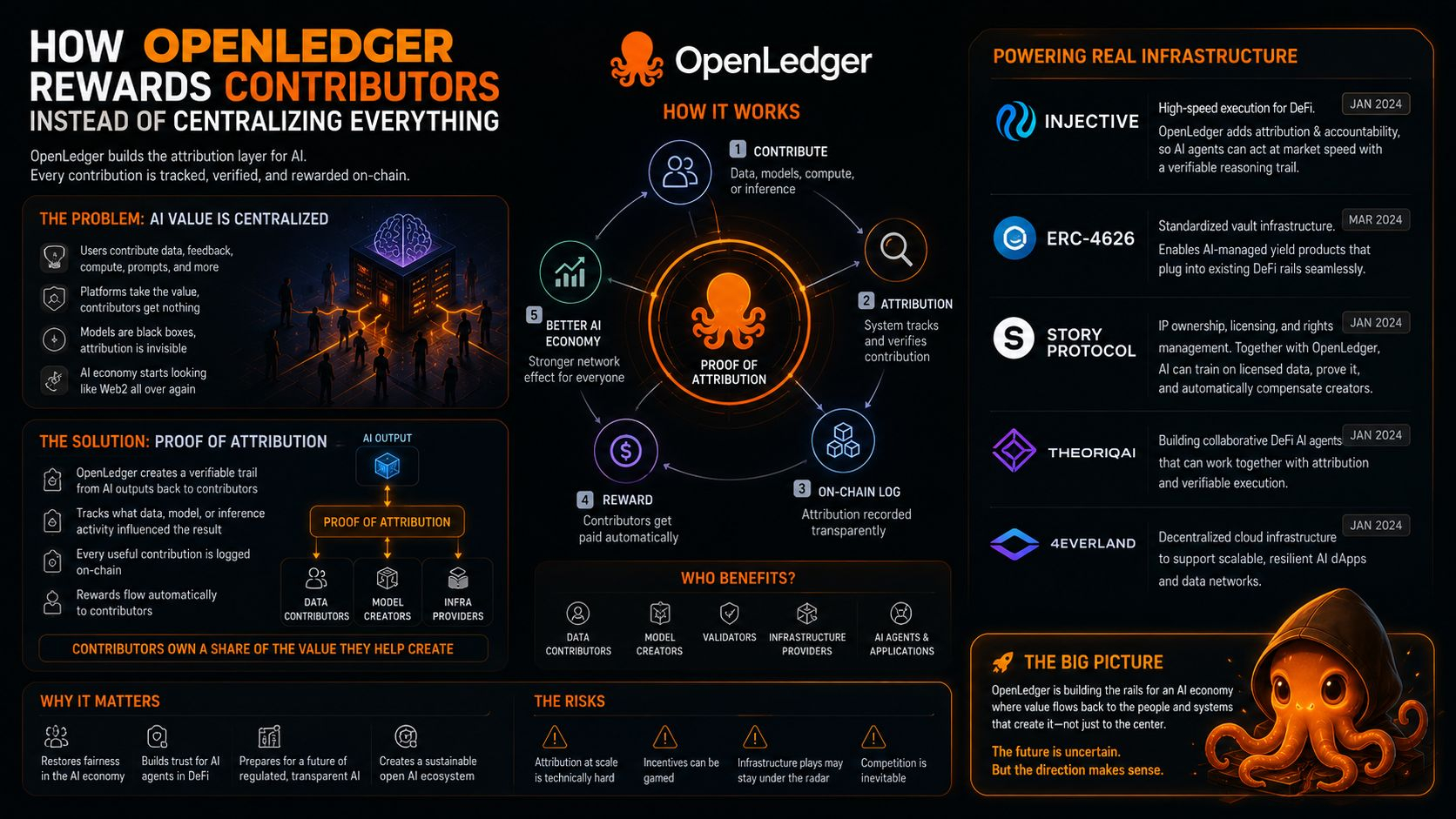
#SuiGaslessStablecoinTransfers
