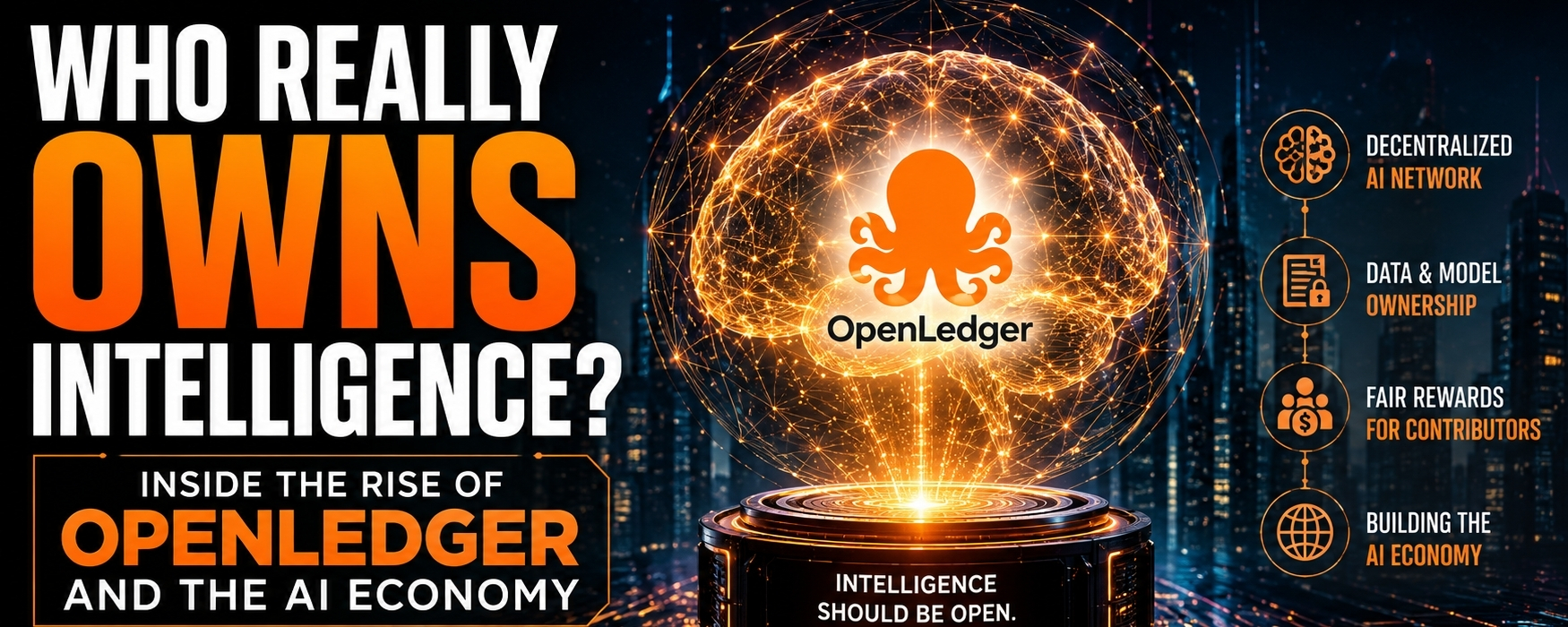
I have been watching the AI industry evolve at an almost unbelievable pace over the last few years. Every month brings another breakthrough model, another billion-dollar funding round, another company claiming it will redefine the future of intelligence. At first, I was fascinated by the technology itself. Like most people, I was impressed by what AI could do generate essays, create art, automate coding, simulate conversations, even replace certain forms of human labor. But the deeper I looked into the ecosystem behind artificial intelligence, the more I realized the real story was not about AI models at all.
It was about ownership.
That realization completely changed the way I look at projects like OpenLedger (OPEN), an AI blockchain focused on monetizing data, models, and agents. I do not see it as just another crypto narrative trying to ride the AI wave. I see it as part of a much bigger conversation that most people still underestimate.
The modern AI economy is built on something strangely invisible. Every AI system learns from data generated by humans our conversations, emotions, habits, searches, creativity, market activity, photos, opinions, and behavior patterns. In many ways, humanity itself has become the training infrastructure for machine intelligence. Yet almost none of the people contributing that value actually own any meaningful share of the systems being built on top of it.
That imbalance feels deeply important to me.
When I think about companies dominating the AI race today, I notice that they are not only competing for better models. They are competing for control over data pipelines, compute infrastructure, and economic influence. The headlines usually focus on GPUs, valuations, and chatbot performance, but underneath all of it is a struggle over who controls the future flow of intelligence.
That is where OpenLedger caught my attention.
Its core idea is surprisingly simple but also incredibly ambitious: transform AI-related assets like datasets, models, and autonomous agents into liquid economic primitives on-chain. In other words, instead of allowing intelligence to remain trapped inside centralized corporate systems, OpenLedger wants intelligence itself to become part of an open marketplace.
The more I thought about that concept, the more I realized how disruptive it could become if it actually works.
Right now, most users unknowingly participate in a one-sided exchange. We provide data constantly while platforms capture nearly all the value. Social media platforms profit from attention. AI companies profit from training data. Consumers receive convenience, but ownership stays centralized. Over time, this creates an economy where a small number of companies accumulate extraordinary influence because they control the intelligence infrastructure of society itself.
I think this is one of the least discussed risks in AI.
People often debate whether AI will replace jobs, but I rarely see serious discussion about who owns the intelligence systems replacing those jobs. That distinction matters because ownership determines power. Throughout history, technological revolutions have always rewarded whoever controlled the infrastructure underneath them. Oil created energy empires. Railroads created industrial monopolies. The internet created data monopolies. AI may create cognition monopolies.
And cognition could become the most valuable asset humanity has ever produced.
That possibility is both exciting and unsettling.
When I look at OpenLedger, I do not only see a blockchain project. I see an attempt to challenge the default assumption that AI infrastructure must be centralized. The project is trying to build a framework where contributors can potentially monetize datasets, where models can become composable assets, and where AI agents may eventually operate inside decentralized economic systems instead of corporate silos.
What makes this especially interesting to me is that OpenLedger is entering a space filled with contradictions.
The AI industry constantly talks about democratization, but the economics of AI are becoming increasingly concentrated. Training frontier models requires enormous computational resources. Data collection at scale favors giant platforms. Infrastructure costs create barriers that smaller players struggle to overcome. In practice, the market naturally pushes toward centralization.
That is why decentralized alternatives matter, even if they face enormous obstacles.
I think many people underestimate how much control AI companies could eventually possess. An advanced AI system is not just software. It influences information flow, productivity, communication, decision-making, and increasingly financial systems. Whoever controls large-scale intelligence networks may indirectly shape culture, labor markets, and political narratives.
That level of concentration worries me more than the technology itself.
At the same time, I also think people romanticize decentralization too easily. Blockchain projects often promise empowerment while quietly creating new forms of inequality through token concentration and speculative behavior. OpenLedger is not automatically immune to those problems simply because it uses decentralized infrastructure. If ownership becomes concentrated among early insiders or whales, then the system risks recreating the same imbalances it claims to solve.
This is why I believe the hardest challenge for OpenLedger is not technological.
It is economic design.
How do you build an intelligence marketplace that rewards contribution fairly without collapsing into speculation? How do you measure the actual value of data? How do you prevent manipulation when AI-generated synthetic data floods the internet? These questions become even more complicated when machine-generated intelligence starts training future machine-generated intelligence.
I think society is moving toward a strange reality where authentic human experience itself becomes economically valuable.
That idea sounds futuristic, but signs of it are already visible. Companies desperately seek high-quality human-generated datasets because synthetic content eventually creates feedback loops. Human nuance, emotion, unpredictability, and creativity remain difficult to replicate fully. Ironically, the more AI expands, the more uniquely human input may become premium infrastructure.
OpenLedger exists directly inside this transition.
It is trying to create liquidity around intelligence itself.
That phrase may sound abstract today, but I believe it could define the next era of digital economies. Just as financial markets unlocked liquidity for capital, projects like OpenLedger are attempting to unlock liquidity for cognition. If that model succeeds, people may eventually treat datasets, AI models, and digital agents as productive assets in the same way investors treat stocks, commodities, or intellectual property today.
Of course, success is far from guaranteed.
The reality is brutal. Competing against massive AI corporations with billions in capital and infrastructure is extraordinarily difficult. Most decentralized AI projects will probably fail. Many will overpromise and underdeliver. Some will become pure speculation disconnected from real utility.
But even with all those risks, I still think projects like OpenLedger matter because they force people to confront a bigger question:
If humanity collectively trains artificial intelligence, should humanity collectively participate in the value it creates?
I keep coming back to that question because it touches something deeper than technology. It touches economics, ethics, labor, creativity, and ultimately power itself.
For decades, people believed data was the new oil. I think that analogy was incomplete. Oil powers machines, but data powers intelligence. And whoever owns intelligence infrastructure may shape the future more profoundly than any industrial empire before it.
That is why I do not see OpenLedger as just another AI blockchain.
I see it as part of a larger battle over who owns the future of intelligence itself.