
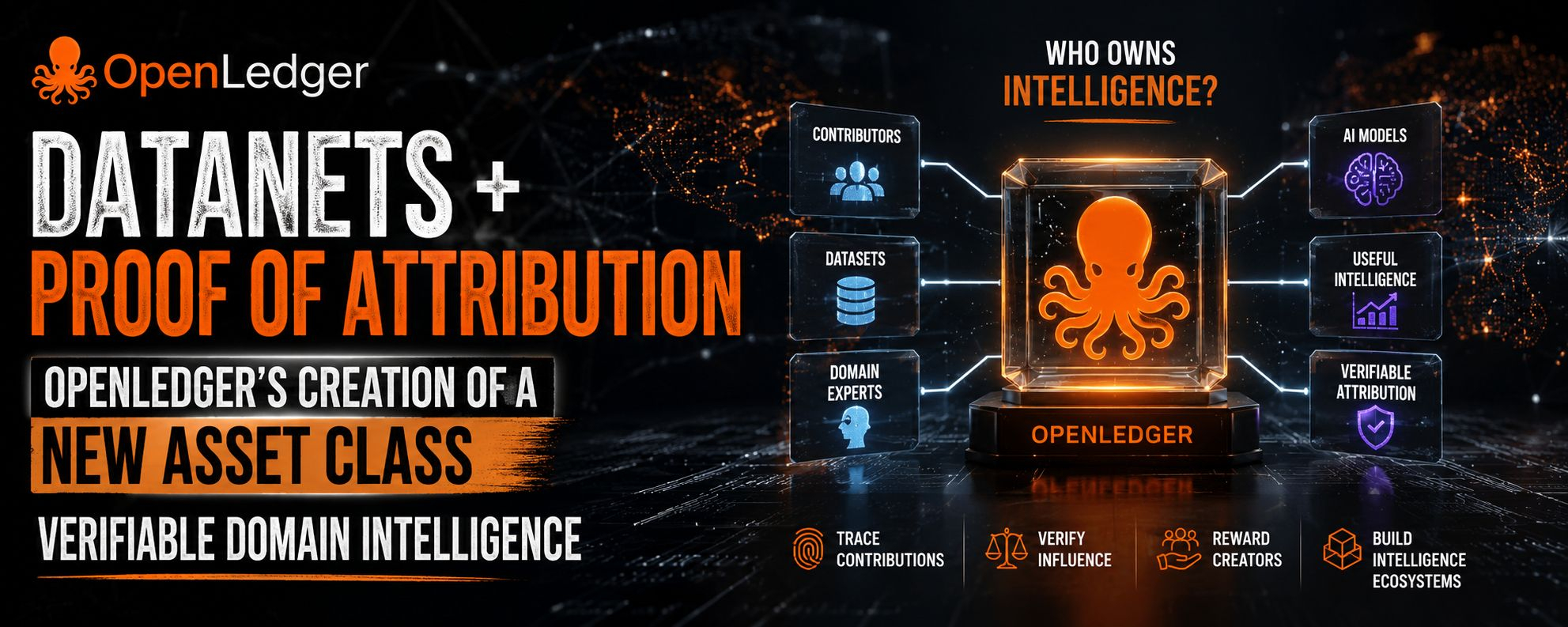
Every cycle eventually produces a new obsession around ownership. Not just ownership of tokens… ownership of output itself.
A few years ago it was blockspace. Then liquidity. Then attention. Then GPU power. Then data.
Now AI arrives and suddenly the question changes again.
Who actually owns intelligence?
Not in the philosophical sense. Operationally.
Who owns the data that shaped it. Who trained it. Who contributed to it. Who gets paid when that intelligence becomes useful.
And honestly… most of the internet still has no clean answer for that.
That’s where I ended up looking deeper into openledger.xyz� recently. Not because the branding convinced me. Crypto branding rarely means much anymore. But because the underlying idea keeps pulling me back into thought.
“Proof of Attribution.”
At first glance it sounds almost too neat. Too clean. Crypto has a habit of reducing giant human coordination problems into elegant three-word concepts.
Usually reality is messier.
But I stop and think here…
The actual problem they’re trying to solve is very real.
AI models today are becoming economically valuable in ways most people still underestimate. Domain-specific intelligence especially. Medical reasoning. Legal interpretation. Financial prediction. Scientific retrieval. Industrial workflow memory. Small vertical datasets with high signal.
That kind of intelligence is turning into infrastructure.
But the strange thing is that the people creating the raw intelligence layer — the contributors, curators, communities, experts — usually disappear economically once the model is trained.
The model becomes the asset. The contributors become invisible.
That asymmetry matters more than people think.
Because over time, high-quality data creation slows down when attribution disappears.
Humans respond to incentives whether we like admitting it or not.
And this is where @OpenLedger
becomes interesting to me. At least conceptually.
They’re not just talking about AI infrastructure in the generic “decentralized AI” way every project now claims. They’re specifically trying to create what looks like a verifiable attribution layer tied to domain intelligence itself.
In simple terms…
If a dataset, model contribution, or knowledge source helps produce useful AI output, there should theoretically be a way to trace that contribution and reward it.
Simple idea.
Operational nightmare.
And that’s the part I keep thinking about.
Because crypto people often underestimate how difficult attribution becomes once systems scale.
Tracking ownership of static assets is easy compared to tracking informational influence.
If ten thousand contributors shape a domain-specific AI model over time, how exactly do you measure contribution quality? Weight? Persistence? Relevance decay?
What happens when one tiny obscure contribution becomes disproportionately valuable later?
How do you prevent gaming?
How do you stop synthetic spam contributions from poisoning attribution systems?
That sounds simple until you think operationally.
Especially in crypto.
People optimize incentives aggressively. Sometimes destructively.
The moment attribution becomes monetizable, behavior changes immediately.
You no longer have “contributors.” You have economic actors trying to maximize extraction.
And honestly, I think this is where many decentralized AI narratives quietly break apart underneath the surface.
The theory sounds beautiful.
Collective intelligence. $OPEN contribution. Shared ownership. Permissionless innovation.
But real systems encounter friction almost immediately.
Bad data. Low-context contributors. Reward farming. Coordination collapse. Sybil behavior. Contribution inflation.
Humans are very predictable once incentives appear.
Still…
I don’t think that invalidates the direction entirely.
Because the current AI landscape already has a major imbalance forming underneath it.
A handful of centralized entities are accumulating extraordinary intelligence leverage through proprietary datasets and closed training systems. Everyone sees the consumer layer — chatbots, copilots, image generators — but the real moat increasingly looks like domain-specific data ownership.
Not raw models. Curated intelligence ecosystems.
That distinction matters.
And OpenLedger seems to understand this better than many projects in the sector.
The term “Datanets” initially sounded vague to me. Another crypto abstraction trying to create a new category through terminology.
But after sitting with it longer, I think the underlying thesis is basically this:
Small, specialized, continuously evolving networks of human knowledge may become independently valuable economic units.
Not giant generalized AI. Focused intelligence domains.
And if those domains can be verified, attributed, and economically coordinated properly… they potentially become a new asset class entirely.
Verifiable domain intelligence.
That phrase stayed in my head longer than I expected.
Because weirdly enough, crypto has always struggled with intangible asset pricing.
We know how to speculate on tokens. We barely know how to value sustained collective intelligence production.
Especially decentralized intelligence.
Most DAOs failed partly because governance itself is exhausting. Most contributors eventually disengage. Participation decays. Coordination becomes ceremonial instead of functional.
But AI changes the equation slightly.
Now knowledge contributions potentially have measurable downstream utility.
At least in theory.
That’s the key phrase though.
In theory.
The practical side is much harsher.
For example…
Will contributors actually maintain high-quality domain datasets consistently over years?
Or will engagement collapse once speculative excitement fades?
Crypto users historically love extraction phases more than maintenance phases.
Maintenance is boring. Curation is repetitive. Verification requires patience.
Speculation is easier.
I think about this a lot because decentralized systems often fail quietly through operational fatigue rather than dramatic collapse.
Nobody announces the system stopped working.
People just stop caring gradually.
And data ecosystems are especially vulnerable to this.
A domain-specific intelligence network only works if: the data stays fresh, contributors remain incentivized, quality control survives scale, and attribution remains trusted.
That last part matters more than people realize.
Trust in attribution systems is fragile.
If contributors believe rewards are inaccurate or manipulable, participation quality deteriorates quickly.
Especially among high-signal contributors who actually matter most.
Experts generally do not tolerate broken incentive systems for long.
This creates another interesting tension inside OpenLedger’s broader thesis.
The system probably needs enough openness to grow… while simultaneously requiring enough structure to preserve signal quality.
That balance is extremely difficult.
Too open, and noise overwhelms the network. Too restrictive, and participation dies.
Crypto repeatedly oscillates between these extremes.
And AI adds another layer of complexity because intelligence itself is probabilistic.
Attribution inside deterministic systems is easier.
But with AI outputs, causality becomes blurry very fast.
Which contributor influenced which output exactly? How much? Across which time horizon?
I stop and think here again because this is probably the hidden challenge most observers underestimate.
Not the blockchain layer. Not tokenomics. Not scaling infrastructure.
Epistemic accounting.
Trying to account for informational influence across evolving machine systems.
That’s a profoundly hard problem.
Maybe even harder than decentralized finance itself in some ways.
Because finance at least has clearer transactional boundaries.
Knowledge doesn’t.
And yet…
Even with all that skepticism, I still can’t dismiss the idea completely.
Because the internet is clearly moving toward machine-mediated knowledge economies whether people like it or not.
AI agents will increasingly interact with other AI agents. Models will consume outputs from other models. Synthetic information layers will compound rapidly.
In that environment, provenance may become economically critical.
Where did this intelligence originate? Can it be trusted? Who contributed to it? Who gets compensated?
These questions don’t disappear.
They intensify.
Especially once AI-generated content floods everything.
Ironically, the more synthetic the internet becomes, the more valuable verified human domain expertise might become.
That could be where OpenLedger’s thesis gains traction eventually.
Not because decentralization alone is compelling anymore. Crypto narratives matured past that.
But because attribution itself may become necessary infrastructure.
Necessary… but still extremely difficult to operationalize.
And honestly, that’s probably the healthiest way to look at projects like this right now.
Not as guaranteed winners. Not as revolutionary saviors. Not as obvious failures either.
Just serious attempts at solving emerging coordination problems before those problems fully surface publicly.
Sometimes crypto gets ahead of reality by years.
Sometimes it invents elegant theories nobody truly needs.
The uncomfortable truth is that both outcomes can look identical early on.
I think that’s why OpenLedger keeps sitting in this strange category for me.
The core idea feels increasingly relevant. The implementation risks feel enormous. The timing might be early. Or exactly right.
Hard to tell.
Because in practice, creating a functioning market around verifiable intelligence contribution requires something crypto historically struggles with:
long-term behavioral consistency.
And humans are inconsistent creatures.
We chase incentives. We abandon systems. We optimize shortcuts. We lose interest.
That never changes.
Still…
If attribution infrastructure actually matures — real attribution, not symbolic dashboards pretending to measure contribution — then this entire category could become surprisingly important later.
Not immediately. Not overnight.
Slowly.
Almost invisibly at first.
And maybe that’s the part that keeps me watching projects like OpenLedger despite my skepticism.
Not certainty.
Just cautious curiosity.
The feeling that underneath all the noise, AI and crypto may eventually converge around one surprisingly simple question:
Who owns intelligence once intelligence itself becomes economically productive?
I’m not fully convinced anyone has solved that yet.
But I also don’t think the market has fully understood how important that question may become.$ZEST #OpenLedger