
Artificial intelligence has become one of the most powerful technologies in today’s world, but the way it is currently developed raises some serious concerns. At the moment, most AI systems are controlled by a small number of large companies that own the data, infrastructure, and models. As a result, only these organizations fully understand how the systems are trained, how they operate, and who actually benefits from them financially. For everyday users and even the people who contribute data, the whole process often feels unclear and out of reach.
OpenLedger offers a different approach. Instead of keeping AI centralized in the hands of a few companies, it proposes a decentralized system built on blockchain technology. The idea is to make AI development more open, transparent, and fair, where everyone involved can see what is happening and is also rewarded for their contributions.
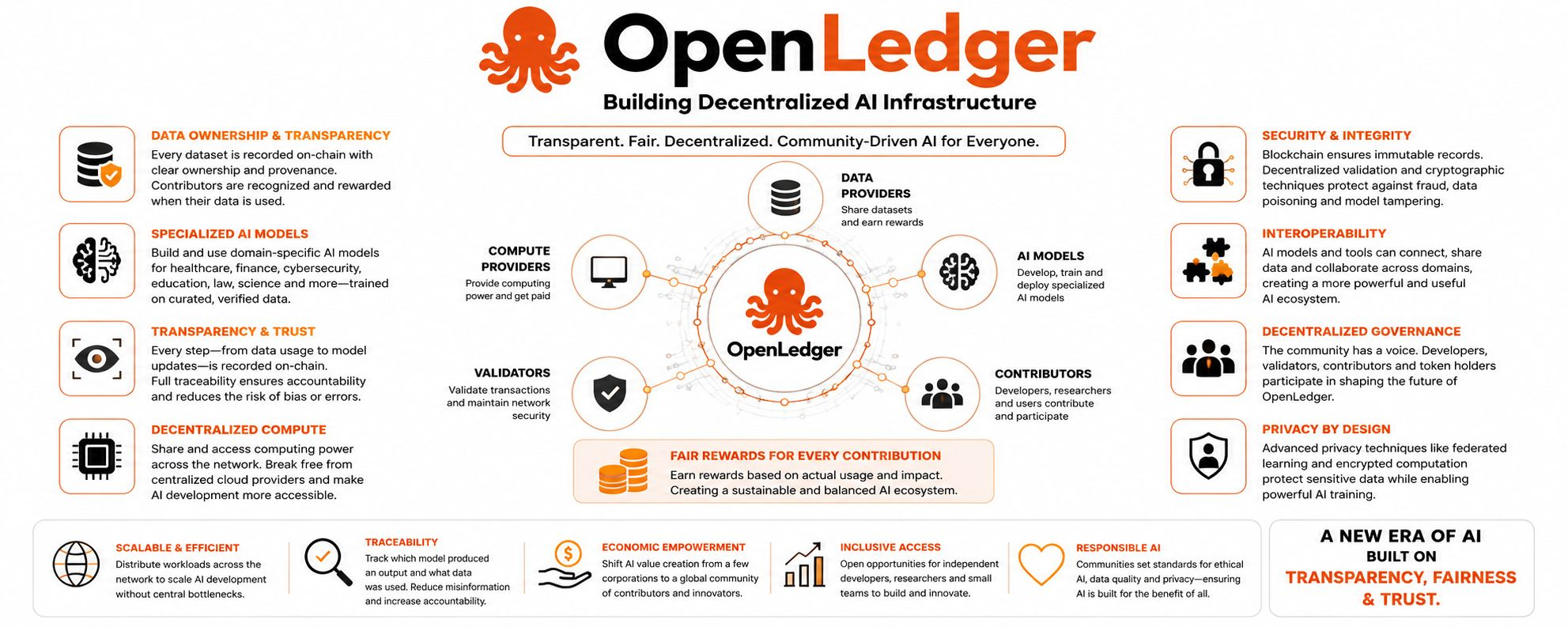
Unlike traditional blockchain projects that mainly focus on finance or digital transactions, OpenLedger is designed specifically for AI. It brings together datasets, AI models, computing power, validators, and contributors into a single network. Every meaningful action in the system can be recorded and verified on-chain, which adds transparency and trust to the entire process.
One of the biggest issues in today’s AI landscape is data transparency. AI models are trained on massive datasets, but people usually don’t know where that data comes from or whether it was collected ethically. In some cases, data is taken from the internet without permission or proper credit, which can create problems like bias, misinformation, and privacy concerns.
@OpenLedger addresses this by tracking data ownership and contributions on-chain. Every dataset added to the network is recorded, making it clear who provided it and where it originated. This also ensures that data creators can be properly recognized and rewarded when their data is used in training AI models.
This changes the economics of AI. In the current system, large companies capture most of the value generated from data, while the people who actually create it receive very little in return. OpenLedger shifts this balance by rewarding contributors whenever their data is used. Because everything is recorded on the blockchain, rewards can be distributed more fairly based on actual usage and impact.
Another important part of OpenLedger is its focus on specialized AI models. Instead of only building general-purpose systems, it supports models tailored for specific fields like healthcare, finance, cybersecurity, education, law, and science. These focused models can often be more accurate and reliable because they are trained on curated, verified data.
For example, a healthcare AI built on OpenLedger could rely on trusted medical datasets, reducing the risk of incorrect or misleading outputs. In finance, models could be trained on verified economic data, making their predictions more dependable.
Trust is one of the central goals of the platform. Many AI systems today operate like black boxes: you get results, but you don’t really know how they were produced. OpenLedger aims to change that by maintaining a full record of how models are built and updated. Every step—from data usage to training changes—can be stored on the blockchain, creating a clear and traceable history.
This level of transparency is especially important in high-stakes areas. In healthcare, inaccurate predictions can affect patient safety. In finance, biased models can influence lending or investment decisions. In legal systems, flawed analysis can impact justice. OpenLedger tries to reduce these risks by making AI systems more accountable.
Access to computing power is another major challenge in AI development. Training advanced models requires huge resources, which are usually controlled by big tech companies. This makes it difficult for smaller developers and researchers to compete.
OpenLedger tackles this by allowing people to share computing resources in a decentralized way. Instead of relying on a single centralized infrastructure, participants contribute their unused computing power to the network, making AI development more accessible and less dependent on major cloud providers.
In return, participants are rewarded. Data providers earn for sharing useful datasets, compute providers are paid for their processing power, and validators are rewarded for maintaining the network’s security and stability. This creates a balanced ecosystem where everyone has an incentive to contribute.
Blockchain technology plays a key role in securing the system. Because blockchain records are extremely difficult to alter, all actions—from data uploads to model updates—can be permanently stored and verified. This helps prevent fraud, hidden manipulation, or unauthorized changes.
Security is further strengthened through decentralized validation. Instead of relying on a single authority, multiple participants verify activity on the network, making it much harder for bad actors to compromise the system. Cryptographic techniques also help protect against issues like data poisoning and model tampering.
Another important feature of OpenLedger is interoperability. In many current AI systems, models and tools work in isolation. OpenLedger creates a shared environment where different AI systems can interact, exchange data, and build on each other.
For instance, a cybersecurity model could collaborate with fraud detection tools, while healthcare systems could connect with research databases. This kind of collaboration makes AI more powerful and useful over time.
Governance is also decentralized. Instead of decisions being controlled by a single company, the community participates in decision-making. Developers, contributors, validators, and token holders all have a voice in how the system evolves.
This structure also supports more responsible AI development. Communities can define rules around privacy, data quality, and ethical usage. Because everything is transparent, decisions are made in a more open and accountable way.
Privacy remains a key priority. In sensitive fields like healthcare and finance, data cannot always be shared openly. OpenLedger can use techniques like federated learning and encrypted computation, allowing AI models to be trained without directly exposing private data.
Overall, @OpenLedger aims to reshape how value is created and shared in AI. Instead of most profits going to large corporations, contributors and participants in the ecosystem are rewarded more fairly. This opens up opportunities for independent developers, smaller teams, and individuals to take part in building AI systems.
It also improves scalability. As demand for AI continues to grow, centralized systems often become expensive and limited. A decentralized network spreads the workload across many participants, making it easier to scale without relying on a single point of control.
Another benefit is traceability. OpenLedger can track which model produced a specific output and what data was used in the process. This makes it easier to verify AI-generated content and helps reduce misinformation.$OPEN
In the end, OpenLedger represents a shift toward a more open and community-driven future for AI. Instead of being controlled by a few organizations, AI becomes something built collectively—where transparency, fairness, and trust are built into the system itself.
The core idea is simple: AI should not only be powerful, but also transparent, fair, and accessible to everyone.