
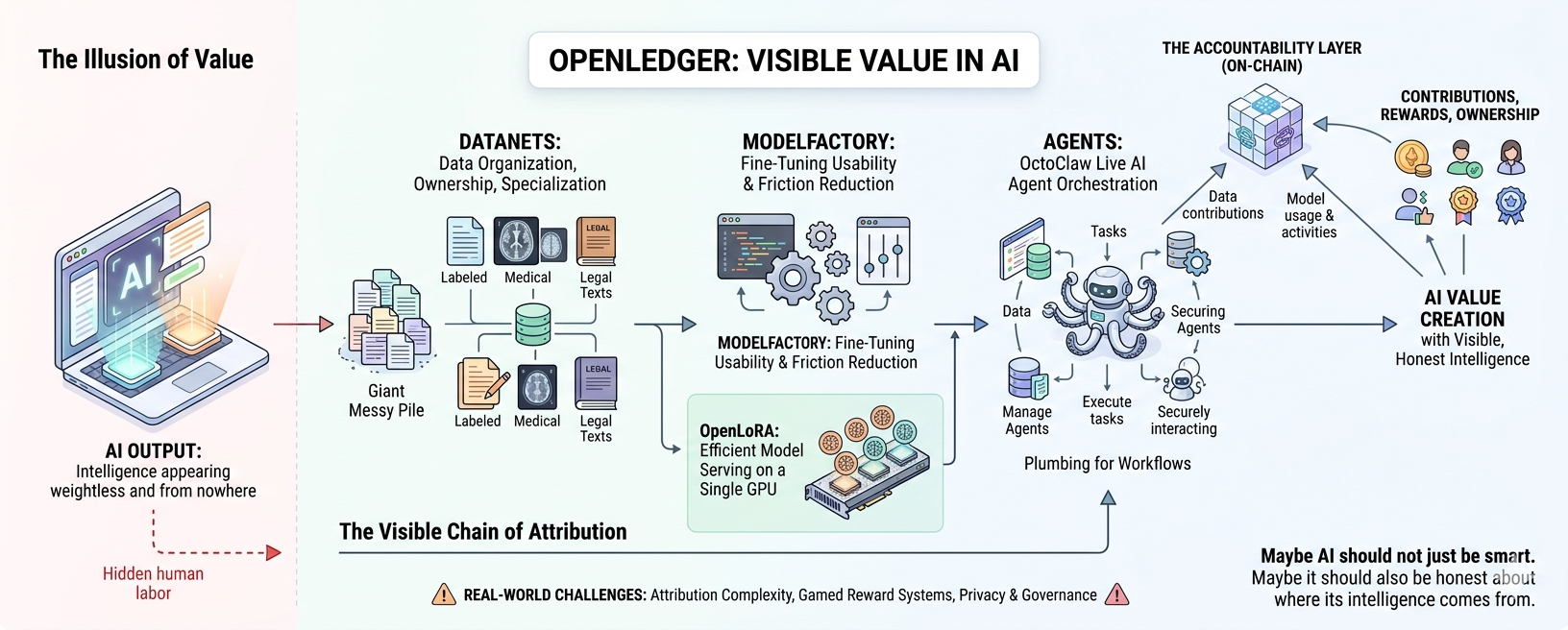
OpenLedger feels interesting for a reason that is easy to miss at first. A lot of AI projects talk as if the whole world is waiting for another platform, another token, another giant promise. OpenLedger is a little different. Beneath the buzzwords, it is really asking a simpler question: if data helps train a model, and a model creates value, and an agent does work, then why does the value usually end up looking like it came from nowhere?
That question matters more than it sounds like it does. Most AI systems are built on layers of human effort that stay hidden once the final product is released. Someone gathered the data. Someone cleaned it. Someone labeled it. Someone shaped it. Someone trained the model. Then the output appears polished and almost weightless, as if intelligence just fell out of the sky. OpenLedger is pushing back against that illusion. It is trying to make the chain visible again.
What makes that idea appealing is that it does not feel theatrical. It feels practical. The project is built around attribution, rewards, and traceability. In other words, it is trying to answer a very real problem: how do you track who contributed what, and how do you make sure they are not erased once the system starts generating value? That is a much more grounded ambition than the usual “AI revolution” talk people throw around so casually.
The Datanets concept sits right at the center of that thinking. Instead of treating data like a giant messy pile, OpenLedger treats it as something that can be organized, owned, and used more carefully. That matters because not all data is equal, and not all AI needs everything. A strong medical model does not need random internet noise. A legal assistant does not need endless irrelevant chatter. Specialization is not a weakness. Sometimes it is the whole point. OpenLedger seems to understand that.
ModelFactory follows the same logic. It is not trying to dazzle people with mystery. It is trying to make model fine-tuning usable. That might sound boring until you remember how much software fails simply because it is inconvenient to work with. A tool can have a clever idea behind it and still be unusable in practice. OpenLedger’s approach feels like it is trying to lower the friction so more people can actually build something with it, not just admire the concept from a distance.
OpenLoRA adds another layer to that practical side. The idea of serving many fine-tuned models efficiently on a single GPU is not the kind of thing that gets dramatic headlines, but it is the kind of detail that decides whether a system can survive outside of a pitch deck. That is often the hidden reality of AI infrastructure. The big vision is easy to say. The expensive part is making it run without collapsing under its own weight.
And then there are agents. Everyone talks about agents now, usually in a way that sounds bigger than the reality. OpenLedger’s OctoClaw seems more grounded than that. It is framed as a live AI agent for building, automating, and executing workflows, with a focus on orchestration and secure execution. That sounds less like a sci-fi fantasy and more like plumbing. Honestly, that is probably healthier. Useful systems rarely arrive looking glamorous. They usually arrive looking organized.
What keeps OpenLedger from feeling like just another crypto-AI mashup is that it appears to care about accountability more than spectacle. It is not simply saying “AI, but on-chain.” It is trying to build a structure where contributions can be tracked and rewarded without pretending that AI value appears by magic. That is a stronger idea than it first seems. Maybe even a necessary one.
Of course, the hard part is that all of this sounds cleaner in theory than it will in practice. Attribution is messy. Reward systems can be gamed. Transparency can run into privacy problems. Governance can slow everything down. Those are not minor issues. They are the actual battlefield. But at least OpenLedger seems to be aiming at the real problem instead of wrapping it in polished noise.
That is why the project stands out a little. Not because it promises to reinvent everything, but because it feels like it is trying to put names back onto the work behind AI. Data. Models. Agents. Contributions. Rewards. Ownership. Those words are ordinary, but together they point to something important: maybe AI should not just be smart. Maybe it should also be honest about where its intelligence comes from.
And that, more than the marketing language, is where OpenLedger starts to feel worth paying attention to.
